

When considering an outdoor lighting overhaul, your design will likely include several different types of fixtures. This ‘layered lighting’ look is usually achieved using a combination of flood or area lights, path lights, up lights, downlights, and possibly even spotlights – all of which can enhance the curb appeal of your home or business, highlight architectural features, and increase safety and security.

LED flood lights are among the most popular outdoor lighting options in residential and commercial applications; however, with so many options for light distribution, it can be a bit confusing to know the difference and determine which is best for your lighting needs. Our aim is to help you understand how beam spread works so you can be confident you’re choosing the right outdoor light for your project.
Beam spread, or beam angle, measures the spread of light (the width of the beam) from a reflected light source. As light moves away from a reflected light source, it spreads out and becomes less intense. Manufacturers often define spot and flood lights in slightly different ways, so it’s important to evaluate each light individually.

Floodlights
Flood lights have a wide beam spread and are generally used when a broad illumination is desired. Flood lights are designed to produce bright light on an ample area, and are common solutions for lighting parking areas, driveways, and large patios, backyards and decks. We also sometimes see floods installed high up on trees as downlighting to create the appearance of moonlight bathing a garden, lawn, or patio.

Light comes from a smaller angle, creating a light that becomes more diffused at long distances. So although the beam spread from a flood is wider than a spot, the light doesn’t reach as far. Flood lights most often have a beam spread of more than 45 degrees and up to about 120 degrees; however, some lights that are marketed as floods may have a beam as narrow as 25 degrees. If you’re looking for a light with that narrow of a beam angle, you might be better off looking a spotlights instead.
Spotlights
Spotlights and small landscape floods (sometimes called spot floods) are generally used for accenting specific features and smaller areas because they make it easier to direct the light precisely where you want it. Spotlights are typically limited to narrow beams of 25 degrees or less. The narrow angle of the light keeps the beam in a concentrated area, so they’re ideal to use when there is a large distance between the light and the area being illuminated. This is the type of light you’ll often see as an uplight to illuminate tall trees, flag poles, statues, and other landscape elements.

Narrow beam spotlights have a lower percentage of beam lumens falling outside the area to be lighted than wide beam flood lights. The dramatic light and shadow created by this can provide interesting visual effects in outdoor settings. Small landscape spots can also be used to contain light to small outdoor seating areas, without worrying about causing light pollution or blasting into a neighbor’s window.
NEMA
NEMA is a light distribution classification system developed by the National Electrical Manufacturers Association (NEMA). This system is used primarily for floods and sports lighting. NEMA describes the distribution of light within the beam produced by the fixture. The ‘NEMA beam spread’ of a light refers to the two edges where light intensity spreads horizontal and vertical to 10% of the maximum beam intensity, and correlates to whether the light output is very narrow, very wide, or somewhere in between.
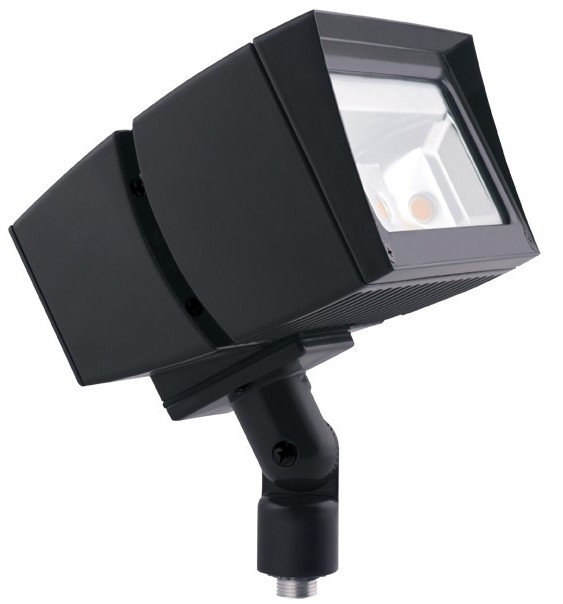
Often, when shopping for LED flood lights, you’ll see beam spread listed as ‘NEMA type’. RAB Lighting is a major brand in outdoor lighting that utilizes NEMA type to classify their large catalog of flood families. NEMA is presented as the horizontal beam spread (first number), followed by the vertical beam spread (second number). So, for example, if the horizontal beam spread is 140 degrees and the vertical beam spread is 120 degrees, the NEMA type would be 7 x 6, classifying it as a wide flood.
The following classifications will help you calculate the horizontal and vertical NEMA rating for your fixture’s particular beam spread.

Standard Beam Spreads

Mounting Height
Mounting height plays an important role in the effectiveness a lamp has on its intended target. Because LEDs cast a cone of light and are naturally directional, the beam will always dictate the area that will be illuminated.
Determining the ideal beam angle for your fixture requires knowing the distance between where the light will be mounted, and the area you plan on illuminating. Keep in mind a closer distance will not need a long-range narrow beam, so it’s best to go with a wider flood. To light a specific target at a further distance, a more narrow, farther-reaching beam will be ideal.
For multiple fixture placement, you may need to consider the distance between light sources and the beam’s radius to avoid overlapping. If your plan is to ‘layer’ wider beam fixtures for ambiance, your beam spread diameter (radius x 2) should be equal to or greater than the distance between fixtures.

Many manufacturers provide photometric reports on their product data sheets, giving you enough information to determine whether or not the fixture will meet the requirements of the intended application.
Contact Us
At PROLIGHTING, we specialize in lighting solutions for indoor and outdoor applications. If you are looking for a fixture, need a lighting layout, or want a quote for a project, our certified lighting experts can help. Fill out a contact form here, or access the live chat feature during our normal business hours (8AM to 5PM EST).


Comments are closed.