

The LED lighting world is mourning a legend this week. The renowned innovator of LED illumination, scientist Nick Holonyak Jr., passed away in Urbana, Ill. He was 93. Holonyak is credited with developing the first practical visible-spectrum light-emitting diode (LED) in 1962. The breakthrough paved the way for today’s modern LED applications including light bulbs, TVs, smart phones and other device displays, lasers, and so much more. The University of Illinois at Urbana-Champaign, where Holonyak taught as a professor of electrical and computer engineering and physics for 50 years, announced his death.
One of the earliest researchers in semiconductor materials and a pioneer in the field of optoelectronics – devices that convert electricity into light or vice versa – Holonyak also contributed to technologies in household dimmers, lasers for CD and DVD players, fiber-optic communication lines, and other electronics and communications devices.
Holonyak demonstrated the first visible-light-emitting diode while working at General Electric on Oct. 9, 1962. Prior to his discovery, infrared LEDs had been made with the material gallium arsenide. Holonyak’s LED emitted a visible red light using crystals of gallium arsenide phosphide he created.”It’s a good thing I was an engineer and not a chemist. When I went to show them my LED, all the chemists at GE said ‘You can’t do that. If you were a chemist, you’d know that wouldn’t work.’ I said, ‘Well, I just did it, and see, it works!'” Holonyak said in a 2012 interview.
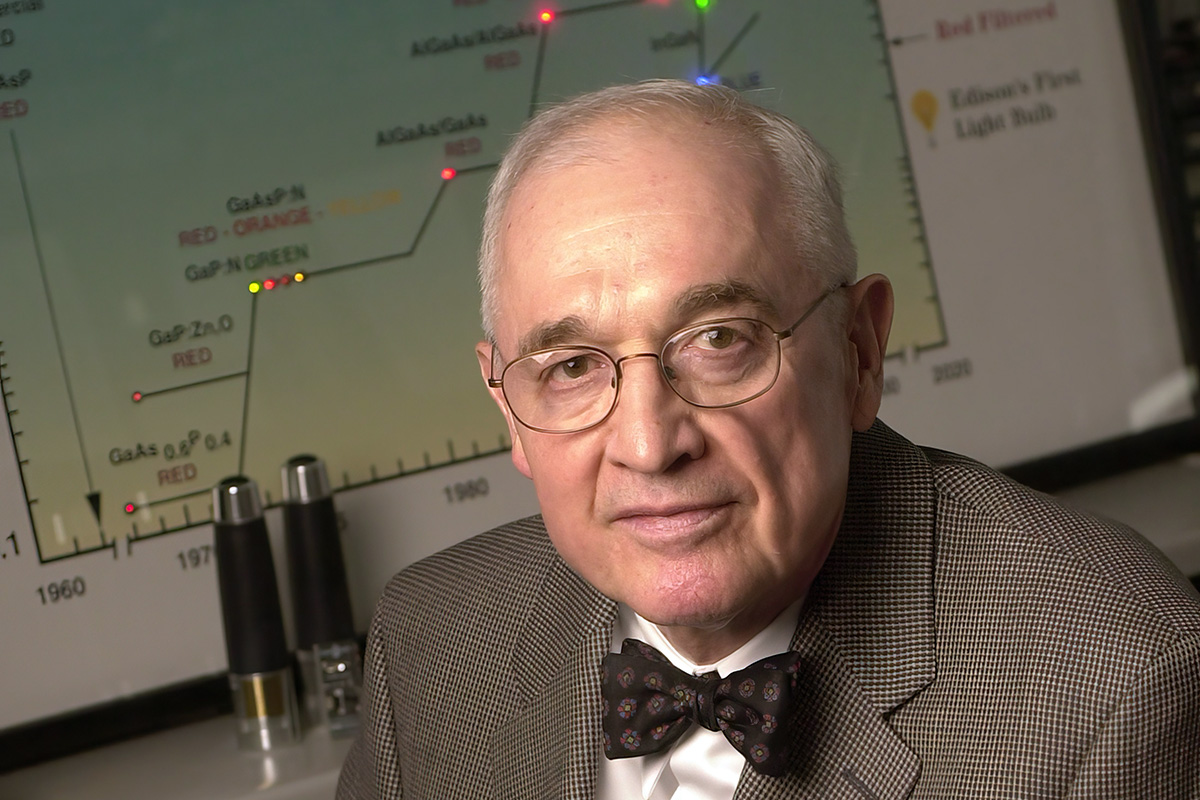
Photo by Bill Wiegand
More recently, Holonyak was one of five scientists awarded with The Queen Elizabeth Prize for Engineering in 2021 for the creation and development of LED lighting, which forms the basis of all solid state lighting technology.
Photos: University of Illinois




Comments are closed.