

Lighting a warehouse or manufacturing facility is a tall order. These cavernous spaces need a layout that accounts for fixture count, light distribution, color temperature and a list of other specifications. Whether you’re working on new construction or a retrofit, the details decide whether you end up with proper lighting and a return on the investment. This guide covers how to choose LED high bay lighting and how to size it before you buy.
Good lighting decisions in a large workspace raise productivity and cut energy costs at the same time. Employees see their work clearly, concentrate better and make fewer errors. Meanwhile LED high bay lighting saves substantially against metal halide and fluorescent alternatives, which is why almost nobody specs HID anymore.

At PROLIGHTING we watch the industry closely to bring you commercial lighting that’s innovative and efficient. Below are the LED high bays we sell most of, plus the sizing math that tells you which one you need.
How to Size LED High Bay Lighting
Most people start by asking which fixture to buy. Start with how much light the space needs instead, and the fixture choice narrows itself.
Step 1: Set a Foot Candle Target
Different work needs different light levels. General guidance by application:
| Space | Target Foot Candles |
|---|---|
| Bulk storage, low activity warehouse | 10 to 20 fc |
| Active picking aisles, shipping and receiving | 20 to 30 fc |
| General manufacturing | 30 to 50 fc |
| Detailed assembly, inspection | 50 to 100 fc |
| Gymnasiums and athletic facilities | 30 to 50 fc |
| Big box retail | 50 to 75 fc |
Step 2: Work Out Total Lumens
Multiply your square footage by the target foot candles. A 10,000 square foot warehouse at 20 fc needs roughly 200,000 lumens delivered to the floor.
Add a margin on top of that. Fixtures lose output over time, dust and dirt accumulate on lenses, and a space designed to exactly hit its target on day one will fall short by year three. Twenty percent is a reasonable cushion.
Step 3: Match Beam Angle to Mounting Height
This is where layouts go wrong. The higher the fixture, the narrower the beam needs to be, or the light spreads out and arrives dim.
- Under 20 feet: a wide 120° distribution covers ground efficiently.
- 20 to 30 feet: around 90°, the most common warehouse case.
- Over 30 feet: 60° or narrower, so the light reaches the floor with useful intensity.
- Narrow racking aisles: an aisle distribution throws light down the length of the aisle rather than into the racking.
A 90° fixture at 40 feet produces a wide, weak pool. The same lumens through a 60° optic actually land where people work.
Step 4: Don’t Match the Old Wattage
On a retrofit, the instinct is to replace a 400W metal halide with something close to 400W of LED. Don’t.
HID depreciates hard. A metal halide lamp near end of life may be delivering half of what it did new, and you’ve been living with that gradually dimming space without noticing. Size by the lumens you actually need. The LED usually lands far below the HID wattage it replaces, which is where the energy savings come from.
Linear vs UFO vs T8: Which Type?
| Type | Best For | Trade Off |
|---|---|---|
| Linear | Racking aisles, long runs, spaces where light needs to follow a shape | Bulkier to ship and store than a UFO |
| Round (UFO) | Open floors, gyms, arenas, general area coverage | Less efficient over narrow aisles |
| T8 tube ready | Budget projects, and anywhere you want to service a lamp instead of a fixture | Lower output ceiling than a modern integrated fixture |
Linear LED High Bays
Linear LED high bay fixtures deliver even, uniform light. They suit large indoor spaces with high ceilings, typically above 25 feet, including warehouses, retail, manufacturing plants and athletic facilities. The distance between floor and ceiling calls for enough lumen output to push quality light down and out from the fixture. Linear high bays are a direct replacement for HID and fluorescent fixtures, cutting energy use by up to 85%.

Linear models mount directly to the ceiling or hang from chains, aircraft cable or v-hooks. They come in a range of lumen packages, lengths and wattages. Color temperature is usually 4000K or 5000K to get the bright daylight look these environments need. Eye strain, fatigue and loss of focus are real problems for people working under light that’s too dim or too harsh.
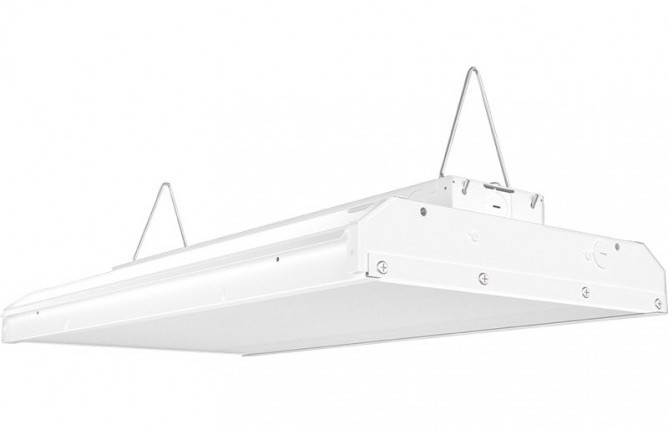
RAB Lighting is the linear high bay we ship most, and the RBAY17 series is the current workhorse. It runs up to 39,200 lumens with selectable wattage, so one part number covers several applications and the output gets set on site. Lower output versions around 20,350 lumens handle more modest ceilings.
Options across RAB’s high bay range include 0-10V dimming, surge protection and battery backup, plus passive infrared motion sensing or a Lightcloud controller that ties into RAB’s wireless commercial lighting control system. RF occupancy and daylight harvesting matter to anyone trying to hold energy costs down. RAB’s high bays carry long rated life and a DLC Premium listing, which increases rebate eligibility.
Rated life deserves a note of its own. High bays are expensive to service because everything at 30 feet needs a lift and a crew. A fixture rated at 100,000 hours or more isn’t just a spec line, it’s the difference between one service visit and four.
Another solid linear option is our PROLIGHTING® LED Linear High Bay, which delivers strong savings against fluorescent and HID and also carries DLC Premium. Sylvania’s linear high bay at 22,100 max lumens with selectable wattage is another strong seller for us.
Round UFO LED High Bays
The days of giant metal halide and high pressure sodium fixtures are gone. Many people now choose UFO LED high bays for the lighter, sleeker shape. As the name suggests, UFO refers to the round form factor. These compact fixtures pack current LED technology and high quality output into a small housing. They’re a strong option for ceilings above 20 feet and spread light evenly across a space, which is why they’ve become the popular choice for retail, warehouses, horse arenas and athletic facilities.

Sylvania has been a trusted name for decades, and their UFO LED High Bay remains our best selling round high bay. The 30,000 lumen model with selectable wattage does the most volume, with a 48,000 lumen version for taller ceilings. The Sylvania UFO is durable and impact resistant, with an IP65 rated airtight housing that keeps moisture and contaminants out of the crevices where they cause problems.
Sylvania offers three color temperatures on the UFO, 3500K, 4000K and 5000K, which is broader than most high bays on this list. It mounts by hook, pendant or surface and works with a coordinating polycarbonate refractor or aluminum reflector, sold separately. Expect a long rated life and a DLC Premium listing.
RAB’s H17 UFO is the other round high bay we move in volume, at up to 37,253 lumens with selectable wattage. A polycarbonate refractor is available for it as well, which is worth adding when you need to spread light in a space with light colored surfaces.
Keystone has also become a significant part of this category for us, with UFO models around 30,000 to 32,330 lumens including a Contractor Prime line aimed at budget sensitive projects.
For a comparable alternative, our PROLIGHTING® UFO LED High Bay replaces outdated metal halide while cutting maintenance and energy costs. It ships standard with a polycarbonate lens, carries DLC Premium and works in retail, warehouse, gymnasium or industrial settings. Both it and the Sylvania come with a five year warranty, which matters when the operating conditions are harsh.
LED T8 High Bays
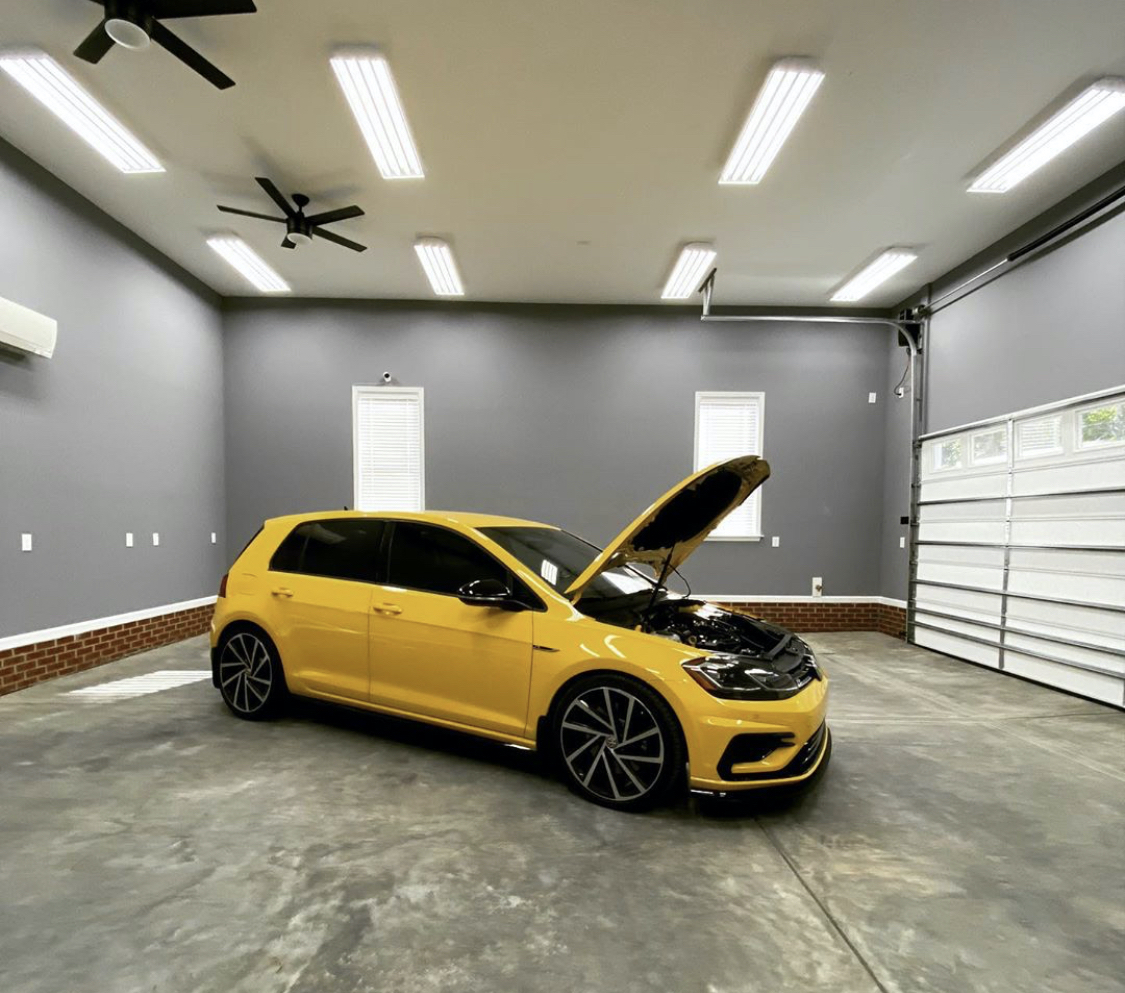
LED T8 high bay fixtures are the affordable option for indoor work. They come with or without lamps, in 4, 6 or 8 lamp configurations. Low power draw, instant start, and light without glare.
The real argument for them is serviceability. When a lamp fails you swap the tube, not the fixture. On a facility with a hundred fixtures at 25 feet, that difference adds up over a decade. And as with all LED, there’s no UV and no mercury.

An LED ready T8 high bay ships without lamps, built without a ballast and wired with non-shunted sockets so it accepts most line voltage LED T8 tubes. Sockets on one end are usually prewired to a disconnect for a fast hookup.
Keystone’s tube ready high bays have become the strongest seller in this category for us, particularly the 48″ six lamp single end version. We also carry TechBrite LED T8 High Bays preloaded with Keystone LED T8 Tubes in 4000K neutral white or 5000K daylight. When a lamp eventually fails, install a new LED T8 lamp and you’re done.
Add an Occupancy Sensor
This deserves its own section, because the single item we ship most in the high bay category isn’t a fixture. It’s a fixture mount occupancy sensor.
That tells you something about where the savings actually are. A warehouse aisle nobody walks down for six hours doesn’t need to be lit for six hours. Sensors typically cut runtime substantially in low traffic zones like bulk storage, back aisles and loading areas, and they pay for themselves faster than almost any other line item on a lighting job.
Two approaches. A fixture mount occupancy sensor added to each unit is simple and works with almost anything. Or specify fixtures with integrated sensing, which is cleaner but locks you into that fixture’s control scheme.
Also worth asking about: many utility rebate programs pay more for fixtures with integrated controls than for the fixture alone.
Rebates and DLC Listings
Energy companies still offer significant rebates on commercial LED upgrades, and they can cut the upfront cost of a project enough to change the payback math entirely.
The mechanism is the DLC listing. Most utility programs require a fixture to appear on the DesignLights Consortium Qualified Products List, and many pay a higher rate for DLC Premium than for standard DLC.
Two things to know before you order. Listings are assigned per catalog number, not per product family, so confirm the exact SKU. And most programs require pre approval before the work starts, meaning a rebate can be lost by installing first and applying later.
We’re Here to Help
There are other factors in choosing the right LED high bay lighting. You’ll need to work out fixture count and spacing based on your ceiling height and the layout. The nature of the work and the surrounding environment matter too: whether you need dimming, motion sensing, or fixtures that resist weather, wash downs or harsh cleaning solvents. In facilities doing color sensitive work, a high CRI fixture is worth specifying deliberately.
An LED upgrade gets you lower maintenance and energy costs and removes the safety concerns that come with poor lighting.
We don’t expect you to have all the answers. Our certified lighting specialists can help with technical questions, fixture selection, layouts and quotes. If you have questions about anything on this list, reach out to our team and we’ll put together a solution that fits your budget and your schedule. Give us a call or use the live chat on our site.
Updated September 2026

Comments are closed.