
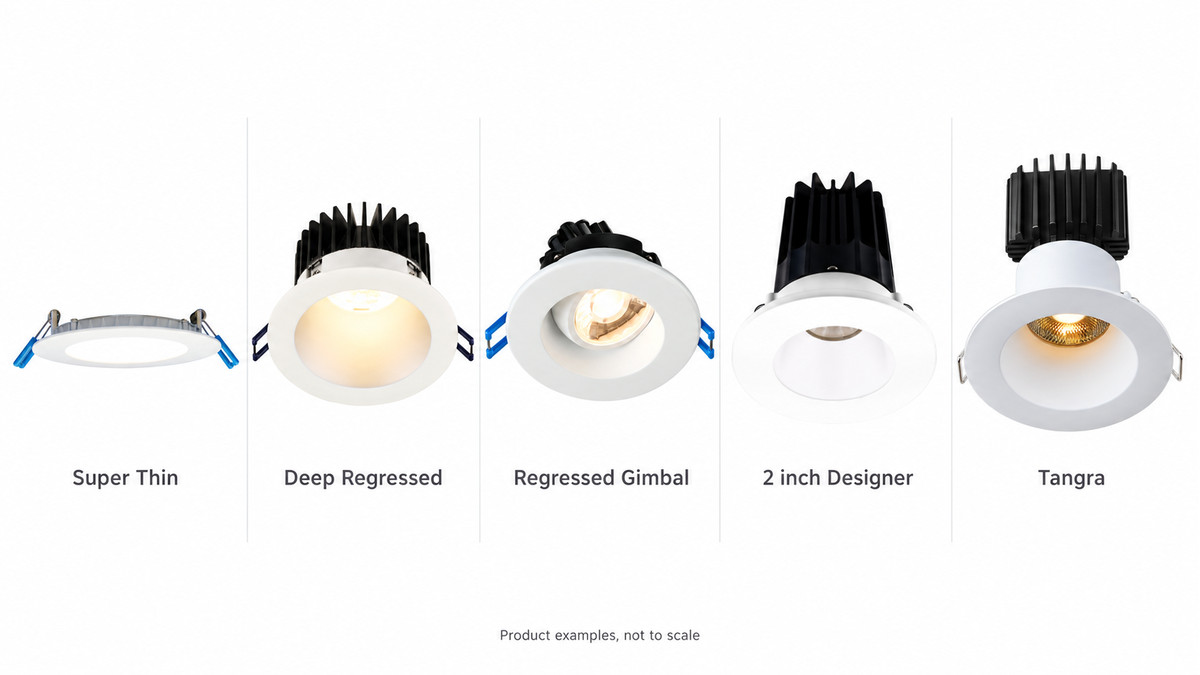
Choosing Lotus recessed lighting gets a lot easier once you answer two questions: how much room is there above the ceiling, and where do you want the light to land? A basement with shallow joists, a living room with a stone fireplace and a kitchen with carefully chosen finishes can each call for a different Lotus fixture, even on the same job.
Lotus LED Lights built its name on the original super slim downlight, and the lineup has grown well past it. At PROLIGHTING you’ll find Lotus Super Thin downlights, regressed and deep regressed fixtures, three kinds of adjustable gimbals, dedicated sloped ceiling models, the 2″ Designer Series and the modular Tangra family. This guide explains what each one changes, so you can narrow the catalog down before you start comparing part numbers.
One thing makes the whole lineup easier to read: the labels overlap. Super Thin describes how slim the fixture body is. Regressed describes where the light source sits. Gimbal means you can aim it. Designer and Tangra are product families. So a regressed gimbal is two of those things at once, and Tangra includes fixed, adjustable and sloped styles under one name.
Lotus Recessed Lighting: Quick Comparison
| Family | Start here when | What it does differently | Models to know | Check before ordering |
|---|---|---|---|---|
| Super Thin | Ceiling space is tight | A body about 1/2″ thick sits right above the drywall, with the driver in a separate box | LB4R, LL4R | Room for the driver box, exact cutout |
| Regressed and Deep Regressed | Glare matters | The LED sits back inside the trim, so it’s harder to see from across the room | LL4RR, LD4R, LE4RR | Fixture depth, beam angle, trim style |
| Gimbal | You need to aim the light | The light tilts and rotates toward art, a wall or a fireplace | LRG series, floating gimbals, LL3G and LL4G | Tilt range, beam angle, ceiling slope |
| 2″ Designer Series | You want a small opening and a choice of trims | Interchangeable reflectors and trims on a 2″ fixture | LED-2-S8W2, LED-2-S15W | Installed depth, trim, location rating |
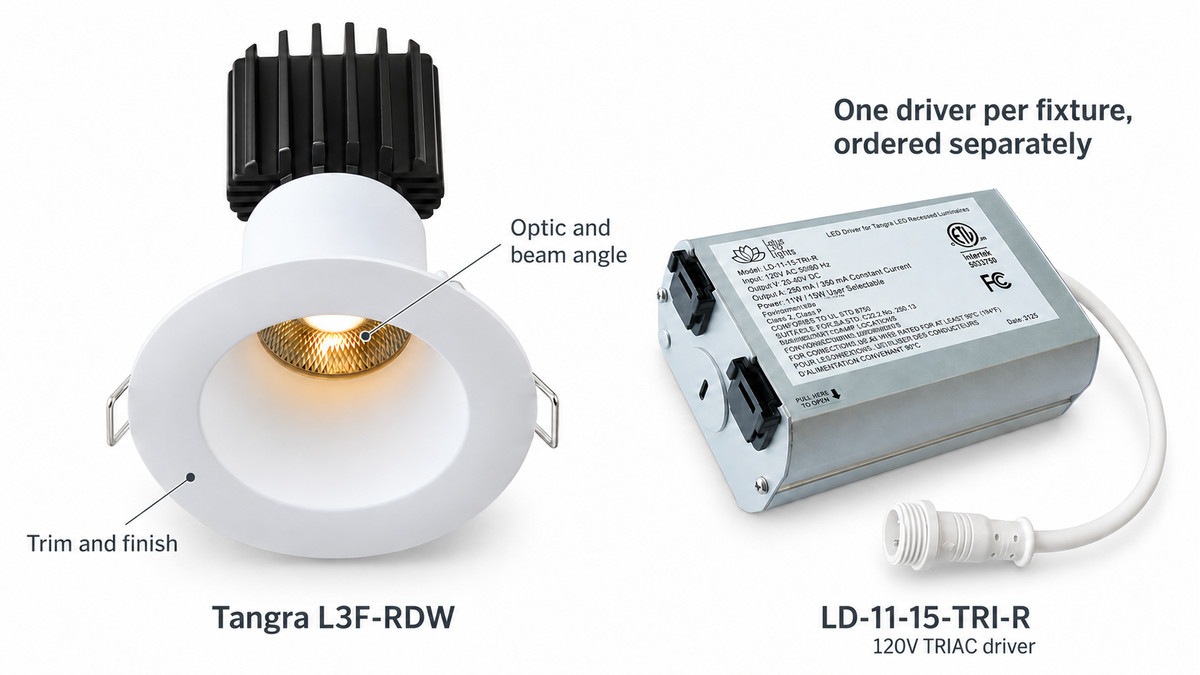
| Tangra | You want one architectural family across a whole project | Modular 3″ fixed and gimbal styles with separate optics, LED packages and drivers | L3F, L3G | Full configuration and the separately ordered driver |
The short version: Super Thin solves fit, regressed solves glare, gimbals solve aiming, Designer gives you a small opening you can customize, and Tangra lets you specify a coordinated architectural system. Most real projects end up mixing two or three of these.
How Lotus Canless Downlights Work
People call them pot lights, can lights or downlights, but almost every Lotus fixture in this guide shares the same basic design. There’s no traditional recessed can. The fixture plugs into a separate connection box that holds the LED driver, and the fixture itself snaps into the ceiling opening with spring clips. Lotus holds the design patent on that driver connection box, and it’s the reason Lotus fixtures fit where a can never could.
Many Lotus models are also Type IC rated, meaning they can sit in direct contact with insulation, and air tight, so no housing is needed in an insulated ceiling. Ratings still vary by model, so check IC, air tight, damp or wet location and any fire rating on the spec sheet for the exact fixture you’re buying.
For new construction, pair each fixture with a Lotus rough in plate. The FRP4 flanged plate with hanger bars spans the joists and gives the drywall crew a correctly sized opening to cut around. It’s one of the most ordered Lotus accessories we ship, and it takes a lot of guesswork out of trim out. Plates are sized to the fixture and trim, so match them carefully. Trimless versions, for example, use their own plate. You’ll find them with the other Lotus accessories and power supplies.
How Much Ceiling Space Each Lotus Downlight Needs
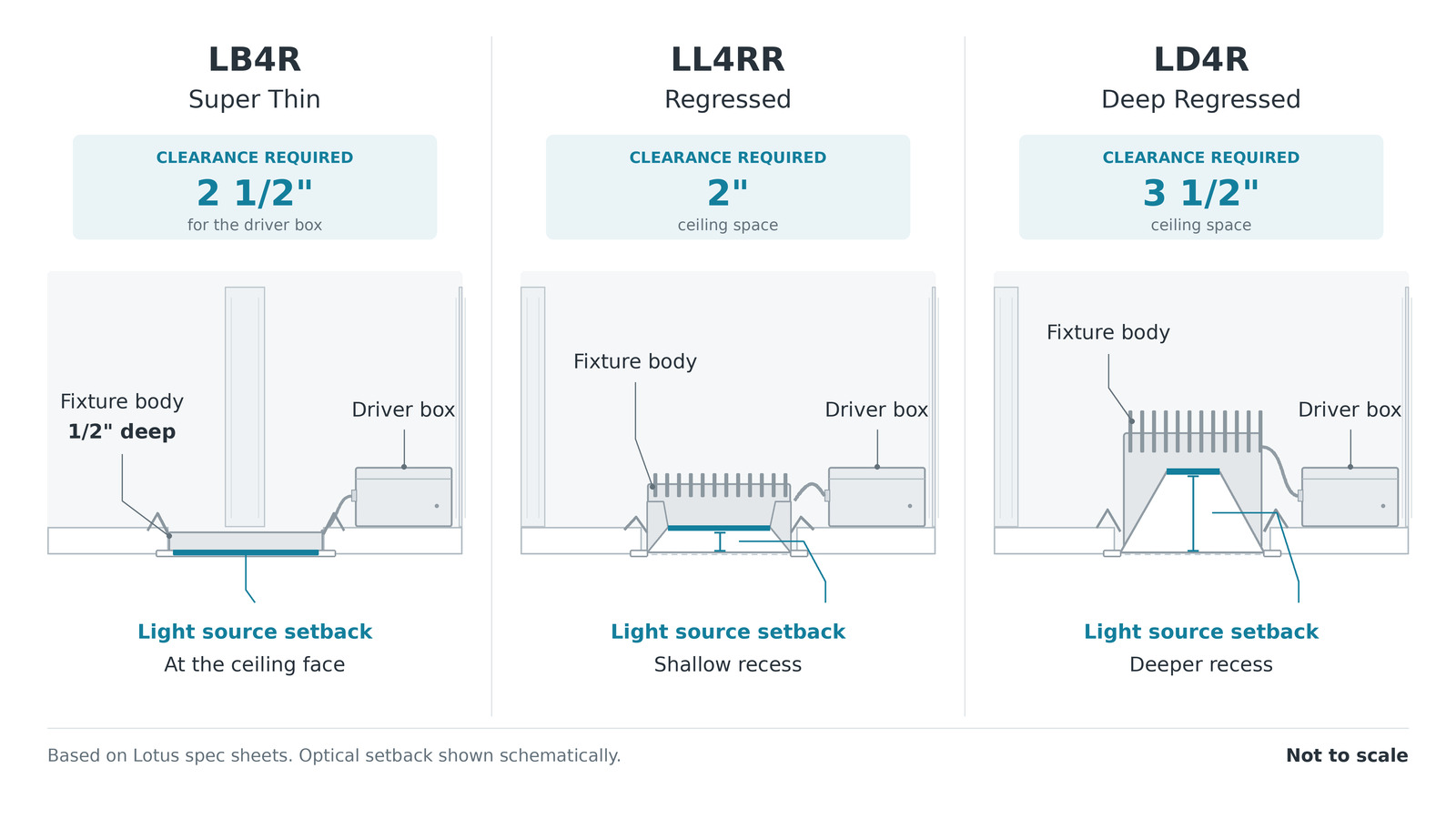
Fixture thickness and the clearance you need above the ceiling are two different numbers, and mixing them up is the most common reason a light doesn’t fit. Here’s how some of the most popular Lotus recessed lighting models compare, based on what Lotus lists for each one.
| Model | Type | What Lotus lists |
|---|---|---|
| LB4R | 4″ Super Thin | 1/2″ thick; 2 1/2″ of clearance for the driver box |
| LED-4-S9W-5CCT-FG | 4″ floating gimbal | 1 3/8″ deep; fits in 1″ of ceiling space |
| LL4RR | 4″ regressed | 2″ deep; 2″ of clearance |
| LRG3 | 3″ regressed gimbal | 2 1/2″ of clearance with Romex, 3 1/2″ with MC or BX cable |
| LD4R | 4″ deep regressed | 3 1/2″ thick; 3 1/2″ of clearance |
| LED-2-S15W | 2″ Designer Series | About 4 3/8″ tall |
Two things jump out. The Super Thin LB4R has the thinnest body on the list, but its driver box still needs 2 1/2″, which is more than Lotus lists for the regressed LL4RR. And the 2″ Designer Series, with the smallest opening, is the deepest fixture here. A small aperture is a look, not a shallow install. Measure for the whole assembly, including the driver box and the type of cable your electrician is running.
Lotus Super Thin Downlights for Shallow Ceilings
Super Thin is where Lotus started, and it’s still the first place to look when joists, ductwork or a shallow ceiling cavity limit your options. The fixture body is about 1/2″ thick, so it can go directly under a joist. The driver lives in a separate connection box that you tuck wherever there’s room, and Lotus offers extension cables when the driver needs to sit farther away.
The LB4R is the economy 4″ model and one of our steadiest sellers. It comes in 3000K and 4000K, plus a dim to warm version (LB4R/32K) that goes from 3000K down to 2000K. The LL4R Ultimate Super Thin steps up to 13.5W with more output and more finish options. Both lines also come in 24V versions for low voltage systems.
The tradeoff is the look. A Super Thin fixture is a flat, glowing disc right at the ceiling, so you’ll notice the bright face from across the room more than you would with a regressed light. In a hallway, closet, laundry room or basement utility space, nobody minds. In a living room where people sit and look across the space, compare a regressed option if the ceiling has the depth for it.
Choose Super Thin when: fitting the fixture is the main challenge and you want clean, affordable general lighting.
Shop Lotus Super Thin LED Downlights
Lotus Regressed and Deep Regressed Downlights for Less Glare
A regressed downlight sets the LED back from the ceiling opening. A deep regressed fixture sets it back farther. The result is that you see light on the walls, floor and furniture instead of a bright dot in the ceiling, which is exactly what you want in rooms where people spend time.
Picture it from the sofa. You want the room to look bright, without a row of glowing points in your line of sight. Source depth helps a lot, but the reflector, the beam angle, where the fixtures go and where people sit all play a part. Deep regressed cuts glare. It doesn’t guarantee a glare free room on its own.
The 4″ LL4RR regressed downlight is the workhorse of the family. It’s only 2″ deep, rated for insulated ceilings, open plenum, wet locations and air tight installs, and it comes in 2700K, 3000K, 4000K, 5CCT selectable and 3000K to 1800K dim to warm. That dim to warm version is one of the most popular Lotus downlights we sell. The beam is wide at 90°, so LL4RR works well as general room lighting.
The LD4R is the deep regressed step up. It’s 3 1/2″ thick, with a 30° beam as standard and 15° or 60° options, so you can choose a tighter beam that keeps light off the walls or a wider one for broad coverage. Trims are interchangeable, with white, black, silver and oil rubbed bronze reflectors, plus thin trim, trimless, square (LD4S) and a 30° sloped version. There’s also a polycarbonate trim (LD4R-CPL) for corrosive or wet spots like ocean front soffits and steam showers. LD4R is open plenum rated, Type IC, air tight and wet location rated, and it can run on an optional 0-10V driver for commercial jobs.
On a tighter budget, the LE4RR Eco deep regressed downlight gives you the set back look with CCT selectable color for a fraction of the LD4R’s price.
Choose regressed when: visual comfort matters. Go with LL4RR for general light in tighter ceilings, and LD4R when you want the deepest set source and the most trim and beam choices.
Shop Lotus Regressed LED Downlights
Lotus Gimbal Lights for Art, Walls and Fireplaces
A gimbal lets you aim the light. Use one when the thing you want to light isn’t directly below the fixture: a painting, a fireplace, a stone wall, open shelving, or an island that doesn’t line up with the rest of the layout. Lotus makes three main kinds.
Regressed Gimbals (LRG Series)
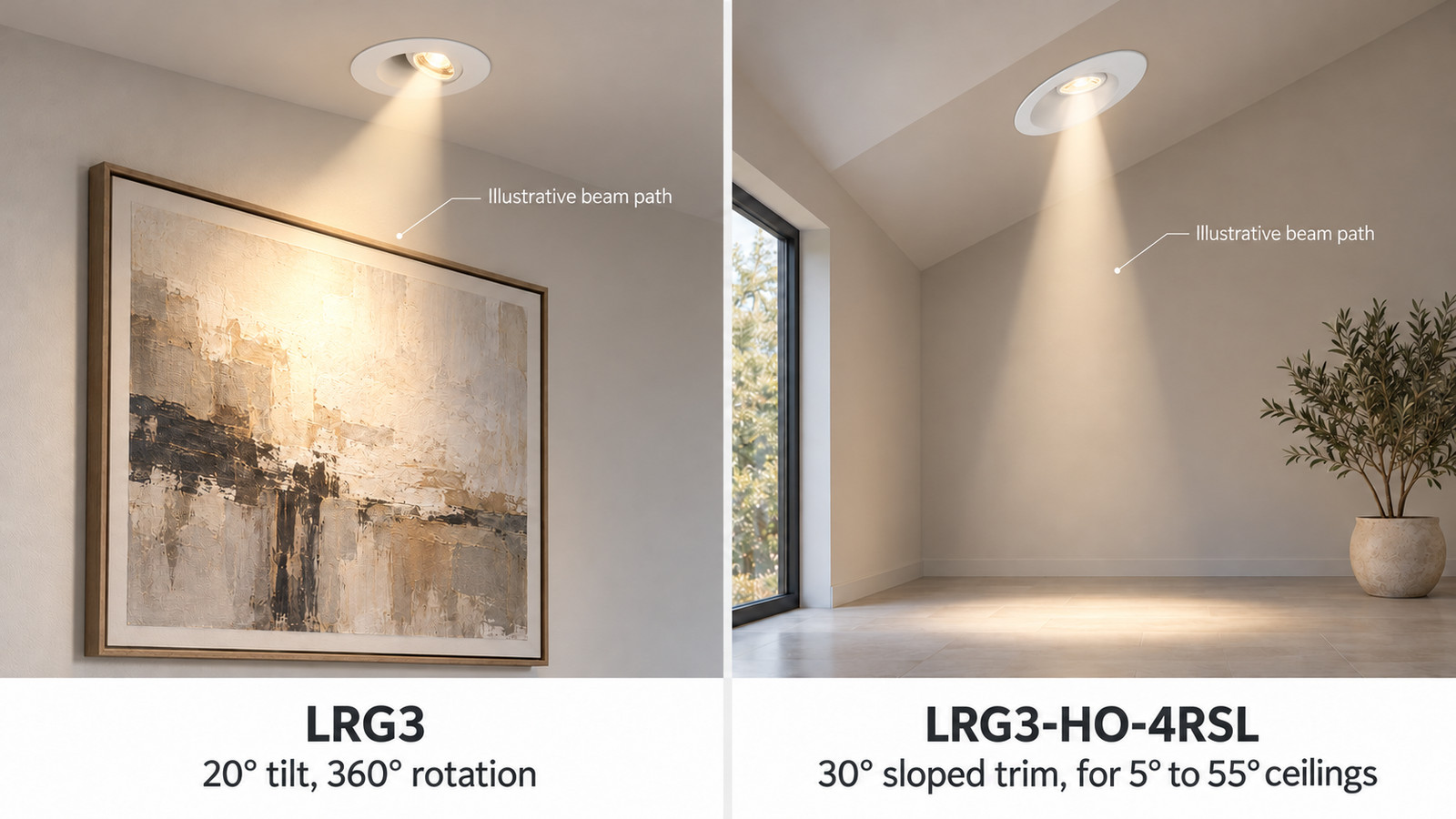
The LRG series combines aiming with a set back light source, so you get a directional beam without looking straight into the LED. It runs from 2″ up to 6″, and the 3″ LRG3 is the Lotus downlight we sell more of than any other. LRG3 has a 38° beam (15° optional), 20° of tilt and 360° rotation, and it comes in fixed CCT, 5CCT, dim to warm and high output versions.
Floating Gimbals
Floating gimbals give you an adjustable head in a very shallow package. The 4″ LED-4-S9W-5CCT-FG is 1 3/8″ deep, and Lotus says it fits in 1″ of ceiling space, which makes it the first gimbal to look at when a regressed gimbal won’t fit. It’s rated for damp locations, not wet, and the light source sits closer to the ceiling than it does on an LRG.
Eyeball Gimbals (LL3G and LL4G)
The eyeball style is the classic adjustable look, with a round head that pivots inside the trim. The 3″ LL3G has a 38° beam with 20° of tilt and 360° rotation. Both the LL3G and the 4″ LL4G come in finishes like brushed nickel, and LL4G adds a 60° beam option.
How to Compare Gimbals
Tilt is how far the beam can move away from straight down. Rotation is which direction it tilts. Beam angle is how wide the light spreads once it gets there. Twenty degrees of tilt is modest, so with a painting you’ll usually place the fixture closer to the wall than you might expect, then let the beam spread cover the piece. A 15° beam concentrates light on a single painting, while a 38° beam spreads across a wider wall or a fireplace surround.
Shop Lotus Regressed LED Gimbal Downlights
Lotus Recessed Lighting for Sloped Ceilings
A pitched ceiling is where a standard gimbal runs out of room. A 6/12 roof pitch puts the ceiling about 27° off level, which is more than the 20° a standard LRG3 can tilt, so the light can’t even point straight down. That’s why Lotus makes dedicated sloped models with a trim angled to match the ceiling.
The sloped LRG3-4RSL pairs a 30° sloped trim with the same 20° tilt, and Lotus rates it for ceilings pitched from 5° to 55°. It uses a 4″ trim and a larger cutout than the flat LRG3, which is a good reminder to go by the cutout on the spec sheet, not the size in the name. The 6″ LRG6-6RSL is the larger version, and it’s one of our most popular sloped ceiling lights.
If you don’t need to aim, Lotus also makes fixed sloped downlights: the LD3R-4RSL 4″ round 30° sloped regressed downlight and a 5″ 30° sloped version of the LD4R. Tangra has sloped gimbals too, in round and square with wide or thin trims.
Measure the pitch first. Hold a level against the ceiling and measure how much it rises over 12″ of run. A 6/12 pitch is about 27°, 8/12 is about 34° and 12/12 is 45°. Compare that number with the approved range for the model before you order.
Shop Lotus Sloped Ceiling LED Downlights or go straight to the sloped gimbal models.
Lotus 2″ Designer Series for a Small, Custom Opening
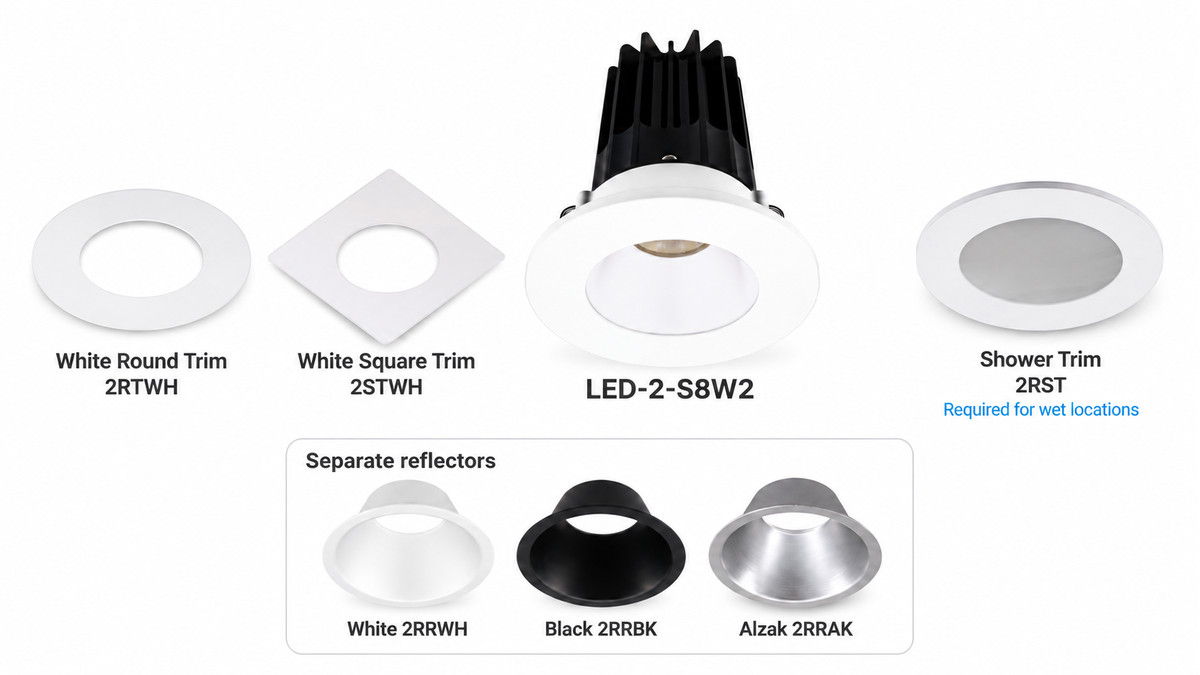
The 2″ Designer Series is for projects where the ceiling detail matters as much as the light. You choose the LED engine, the reflector and the trim, so a white reflector and white round trim can disappear into a painted ceiling, while a black reflector, pinhole trim or slot aperture gives you a more architectural look.
There are two engines. The LED-2-S8W2 runs 8W at roughly 580 to 600 lumens. The LED-2-S15W is the high output version at 15W and up to about 1,000 lumens. Reflectors come in white, black, alzak, bronze and chrome. Trims include round, square, pinhole, slot aperture, wall wash and a shower trim, in finishes like white, black, brushed nickel and bronze, with 24°, 38° and 60° beam options.
Here’s how a part number reads. LED-2-S8W2-30K-2RRWH-2RTWH-60D is the 8W engine at 3000K with a white round reflector (2RRWH), a white round trim (2RTWH) and a 60° beam. It’s one of the most popular Designer configurations we sell.
Two details catch people. The first is depth: the LED-2-S15W is about 4 3/8″ tall, so a small opening doesn’t mean a shallow install. The second is the location rating. Lotus rates the Designer Series for insulated ceilings and damp locations with standard trims, and for wet locations only with the 2RST shower trim. If the light is going over a shower, order the shower trim configuration. The trimless LED-2-S15W-T is also wet location rated.
Choose Designer when: you want a small aperture and control over the reflector, trim and beam, without moving up to a fully modular system.
Shop the Lotus 2″ Designer Series
Designer Series reflectors and trims change the look of the opening, and the 2RST shower trim is the one rated for wet locations.
Lotus Tangra for Architectural Projects
Lotus Tangra is the premium modular family in the lineup. The fixtures use a compact 3″ aperture (the sloped versions are 4″), with 26 styles split between fixed L3F downlights and adjustable L3G gimbals in round and square. You configure the trim, finish, optic, beam angle and LED package separately, including 95 and 98 CRI and dim to warm packages. Tangra is built in Canada with cast aluminum bodies.
The driver is its own line item. Each fixture needs one compatible Lotus Tangra driver, either the 120V TRIAC version for residential dimmers or the 120V to 347V 0-10V version for commercial controls. Both are power selectable between 11W and 15W.
We cover all 26 styles, the part numbers and the drivers in our Lotus Tangra downlights guide, and you can put together a full fixture code with the Tangra code builder.
Designer or Tangra?
Start with Designer when the 2″ format and its reflector and trim choices fit the project. Start with Tangra when one job needs fixed, aimable, sloped and trimless fixtures that all look related, or when you want 95 CRI or higher to show off finishes and artwork. Tangra asks you to make more decisions, and that’s the point. It’s built for designers and contractors who want control over every part of the fixture.
Match the Installation Method to Your Ceiling
Lotus recessed lighting fixtures that look alike from below can install very differently, so figure out what’s in the ceiling before you pick a trim.
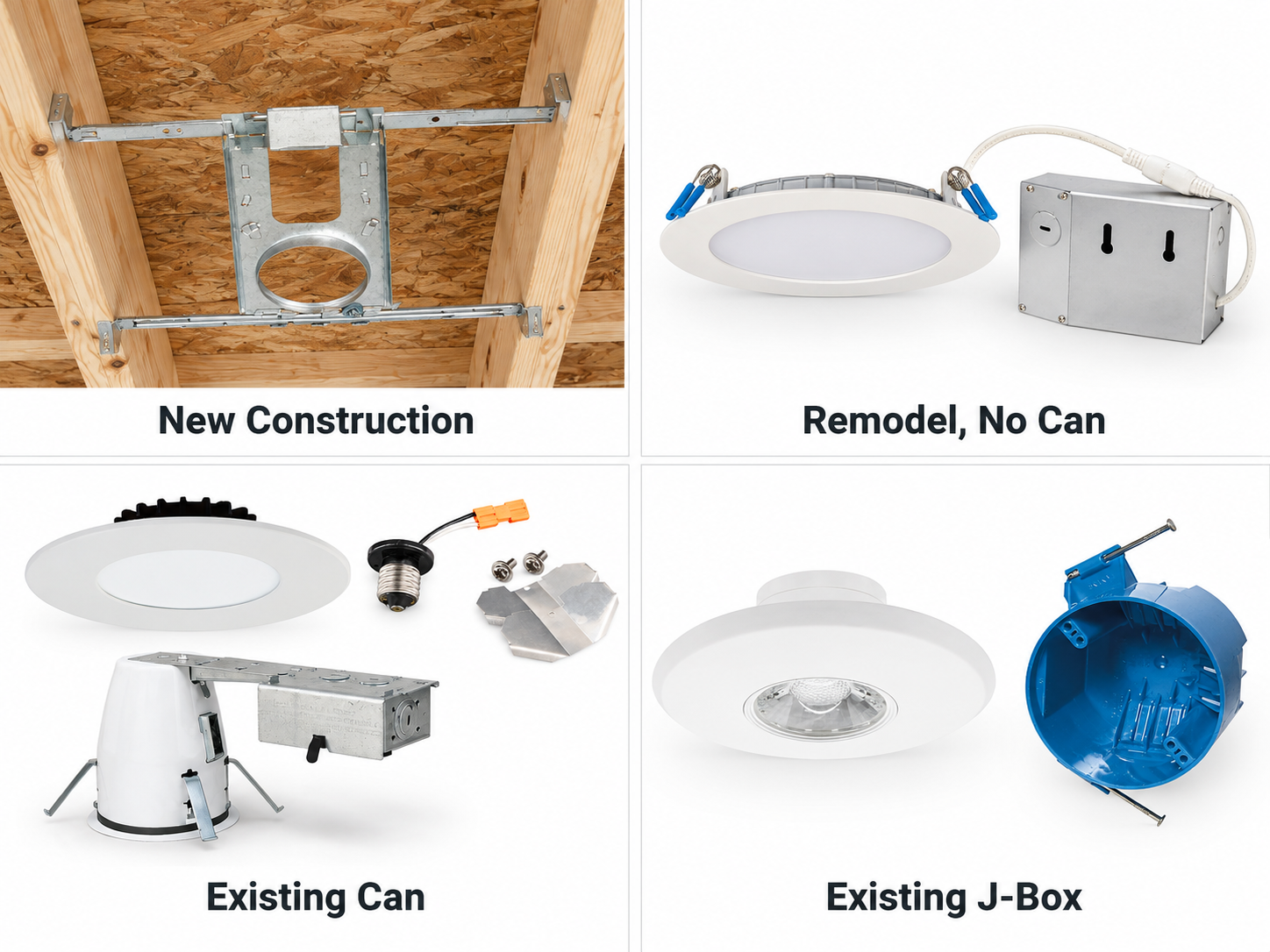
New construction: Set each opening with a Lotus rough in plate before the drywall goes up, either the FRP4 flanged plate with hanger bars or the flat RIP4. Match the plate to the fixture and trim style.
Remodel with no existing can: This is what most Lotus fixtures were designed for. Cut the opening to the size on the spec sheet, wire the driver box, and snap the fixture in with its spring clips. If a 4″ hole comes out a little large, a GR4 goof ring covers it. Our Lotus installation videos walk through the process.
Existing recessed cans: Some Lotus fixtures can go into an existing can instead. The LED-S8W-5CCT-MT works with the RK-4M retrofit kit, which includes an E26 adapter and butterfly clips, and the LBL-JB10W has its own retrofit kit for 4″ recessed housings. Confirm the can size and the kit before you order.
Existing junction box: J-box mount fixtures attach straight to a ceiling box and give you a recessed look without cutting a new hole. The 5″ LBL-JB10W-5CCT-AC fits most 3″ and 4″ junction boxes that are 1 1/2″ deep, is wet location rated and has 5CCT selectable color. Box shape and depth still matter, so check yours against the spec sheet. Browse the Lotus J-box mount lights, or read our Lotus J-box mount post for more detail.
One distinction trips people up: the connection box on a canless Lotus downlight is not the same thing as a ceiling junction box. A canless light brings its own driver box. A J-box mount light is designed to bolt onto a box that’s already in the ceiling.
Trimless: Trimless versions like the LD4R-IT, LRG3-HO-IT, LED-2-S15W-T and the Tangra invisible trims get finished into the drywall for a seamless ceiling. That means the drywall finisher needs to be part of the plan, and the right rough in plate needs to be in before the board goes up.
Fire rated ceilings: If the ceiling is part of a fire rated assembly, look at the Lotus fire rated models (the FR part numbers) instead of assuming a standard fixture will do.
Choose Color Temperature and Dimming Together
Once you’ve settled on a Lotus recessed lighting style, decide how the light should look at full brightness and when it’s dimmed. Lotus offers four approaches, and they don’t behave the same way.
- Fixed color temperature: One CCT, such as 2700K or 3000K. It’s the simplest option and usually a little brighter than the dim to warm version of the same fixture.
- 5CCT selectable: A switch on the driver box sets 2700K, 3000K, 3500K, 4000K or 5000K during install. It’s handy when you’re not sure what a room needs, but the color stays the same as you dim.
- Dim to warm: The light gets warmer as you dim it, the way an incandescent bulb does. Most Lotus dim to warm models go from 3000K down to 1800K (look for 3018K in the part number), while a few, like the LB4R/32K, stop at 2000K. It’s one of the most requested features on Lotus fixtures, especially for living rooms, dining rooms and bedrooms.
- Selectable CCT plus dim to warm: A few models, like the LRG3-4CCT+DTW-HO and the Tangra 4C90 package, combine selectable color with a dim to warm mode that runs from 3500K to 2700K.
For a kitchen, or anywhere finishes, food and artwork need to look right, compare CRI along with color temperature. Most of the Lotus downlights in this guide are rated 90+ CRI, and Tangra offers 95 and 98 CRI packages. Our color temperature guide walks through which Kelvin works best in each room.
Dimming
Most Lotus downlights ship with a 120V TRIAC driver for standard phase dimmers, and many offer an optional 120V to 347V 0-10V driver for commercial controls. Lotus recommends LED dimmers with a low range adjustment dial and publishes a Lotus dimmer compatibility list. Stick with the Lotus driver that came with the fixture, since Lotus says not to substitute other drivers.
If you’re running 0-10V, our guide to understanding 0-10V dimming covers the extra control wiring. You’ll find compatible wall controls in our dimmer selection.
Where to Start for Common Projects
A Basement With Low Joists
Start with Super Thin, like the LB4R, and use a floating gimbal anywhere you need to aim. If part of the ceiling has a few inches to spare, the 2″ deep LL4RR gives a TV or seating area a regressed look with less glare. The same basement can easily use two families.
A Living Room With Art or a Fireplace
Use LL4RR or LD4R for general light and LRG3 regressed gimbals for the fireplace and artwork. Dim to warm works well in every one of them. Walk the layout from the seats, not just the doorway, since that’s where glare shows up.
A Kitchen
LD4R and the 2″ Designer Series both work for general and task lighting. Choose beams that cover the counters, and plan the downlights around pendants and under cabinet lighting so the layouts don’t fight each other.
A Vaulted or Sloped Ceiling
Measure the pitch first, then choose a model rated for it, like the LRG3-4RSL, LRG6-6RSL or a Tangra sloped gimbal.
A Bathroom or Shower
Over the shower, choose a wet location configuration, such as the Designer Series with the 2RST shower trim, the trimless LED-2-S15W-T, LL4RR, LD4R or the LBL-JB10W J-box mount. For steam showers, look at the LD4R-CPL polycarbonate trim. If the shower ceiling is also sloped, the fixture has to meet both requirements, and local code always has the final word.
A Commercial Space
Plan the controls first. LD4R and LL4RR are open plenum rated and take an optional 0-10V driver, and Tangra has a dedicated commercial driver. If the job needs a full lighting layout, ask us for one.
What to Confirm Before You Order
Have these details ready when you compare Lotus recessed lighting options or ask PROLIGHTING for help.
- Ceiling: Material, thickness, slope and the clear depth above it, including room for the driver box and the type of cable being used.
- Opening: The exact cutout from the spec sheet, rough in plates for new construction, or the size of the existing can or junction box.
- Purpose: General, task or accent light, what you’re lighting, and where people will sit or stand.
- Performance: Lumens, beam angle, tilt, color temperature and CRI for the exact configuration.
- Controls: TRIAC or 0-10V, the dimmer model and the number of fixtures on each dimmer.
- Ratings: IC, air tight, damp or wet location, plenum and fire rating, each confirmed on the spec sheet.
- Complete order: Fixture, trim, reflector, driver (for Tangra), rough in plates and any extension cables.
For fixture count and placement, use our recessed lighting spacing guide along with the photometric files on the Lotus spec sheet. If you’re still choosing between brands, start with our complete guide to choosing LED recessed lighting.
Lotus Recessed Lighting FAQs
Does Lotus make can lights?
Mostly no, and that’s the point. Most Lotus downlights are canless. The fixture clips into the drywall and the driver sits in its own connection box, so no recessed housing is needed. If you already have cans, Lotus retrofit options like the RK-4M kit for the LED-S8W-5CCT-MT and the LBL-JB10W retrofit kit let you upgrade into an existing 4″ housing. For new construction, rough in plates take the place of a can.
What is the difference between recessed and regressed lighting?
Recessed describes any light installed into a ceiling opening. Regressed describes where the light source sits inside that fixture, set back from the opening instead of flush with it. So a recessed downlight can have a flat face like a Super Thin, a regressed source like the LL4RR, or a deep regressed source like the LD4R.
What is the difference between a regressed gimbal and a floating gimbal?
A regressed gimbal, like the LRG3, sets the aimable LED back inside the trim for less glare and needs a few inches of space above the ceiling. A floating gimbal, like the LED-4-S9W-5CCT-FG, is built for shallow ceilings at about 1 3/8″ deep, but its light source sits closer to the ceiling, so you’ll see more of it. Floating gimbals are rated for damp locations, while the LRG3 regressed gimbals are wet location rated.
Which Lotus recessed light is best for a low ceiling?
Separate the height of the room from the space above the ceiling. If the cavity is shallow, start with Super Thin or a floating gimbal. If the room is short but the cavity has a few inches to spare, a regressed fixture like the LL4RR is worth considering, since people’s eyes are closer to the ceiling and glare is easier to notice.
Can I use a standard gimbal on a sloped ceiling?
Only on a gentle pitch. A 6/12 pitch is about 27°, and a standard LRG3 tilts 20°, so it can’t point straight down. Use a sloped model like the LRG3-4RSL, which Lotus rates for 5° to 55° ceilings.
Can Lotus recessed lights go in a shower?
Yes, as long as you choose a wet location configuration. Good options include the Designer Series with the 2RST shower trim, the trimless LED-2-S15W-T, LL4RR, LD4R and the LBL-JB10W J-box mount. Standard Designer trims and floating gimbals are damp rated only, so they don’t belong directly over the shower. Always follow local code.
Is Tangra the same as the 2″ Designer Series?
No. They’re separate Lotus families. Designer is a 2″ fixture with interchangeable reflectors and trims. Tangra is a modular architectural system built around a 3″ aperture (4″ for the sloped models), with 26 fixed, adjustable and sloped styles, high CRI packages and a separately ordered driver.
Is Lotus LED Lights the same as WAC Lotos?
No. Lotus LED Lights is the North American manufacturer behind every fixture in this guide. Lotos is a separate downlight line from WAC Lighting. The names are close, but the fixtures, drivers and accessories aren’t interchangeable, so double check the brand and part number before you order replacement parts.
Shop Lotus Recessed Lighting at PROLIGHTING
No single Lotus recessed lighting family is right for every room, and that range is what makes the lineup so useful. Start with the ceiling and the surfaces you need to light, then compare the look, the optics and the controls. That process turns a very large catalog into a short list.
PROLIGHTING is an authorized Lotus LED Lights distributor. Browse the full Lotus LED Lights collection, request a quote for a larger project, or ask for a free lighting layout. Have your room dimensions, ceiling height and pitch, the depth above the ceiling and your preferred controls ready, and we’ll help you pick the fixture and every part it needs. Contractors and designers ordering in volume should check out our trade pricing program.
Published October 2026

Comments are closed.