
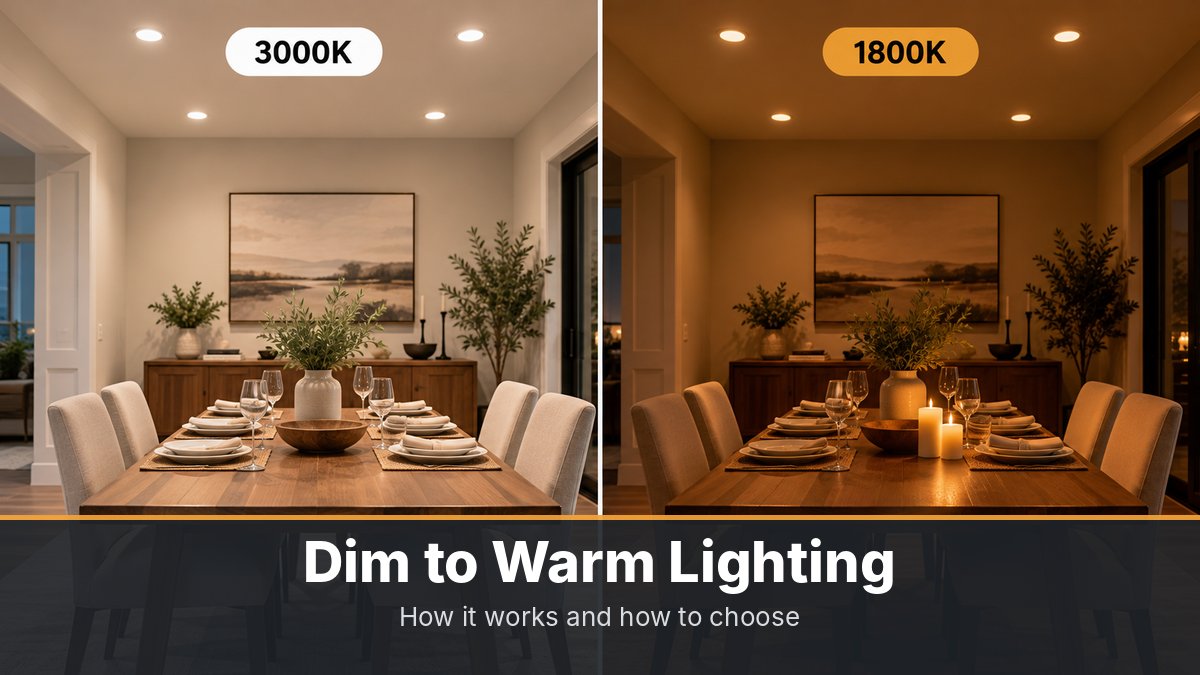
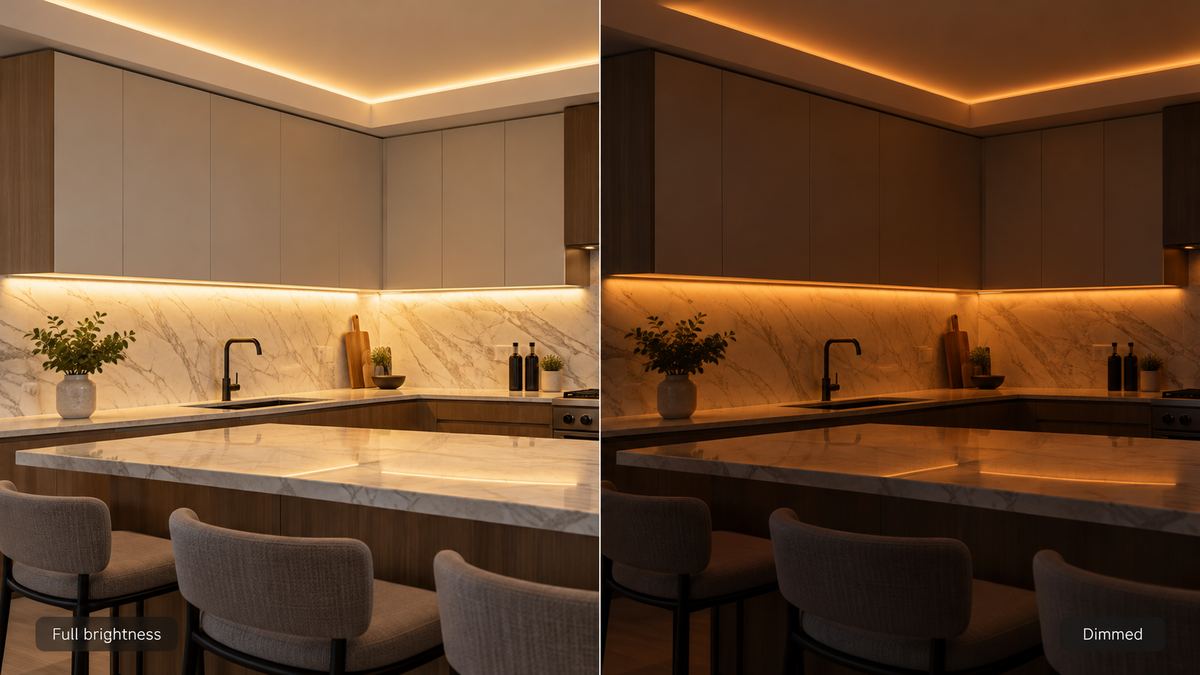
Turn down a standard dimmable LED and one thing changes: the amount of light. With dim to warm lighting, two things change at once. The light gets dimmer, and its color shifts warmer, the same way an incandescent or halogen bulb always did.
At full output, a dim to warm fixture might give you a clean 3000K white. As you lower the dimmer, that same fixture slides through warmer tones until it reaches 2200K, 2000K or even 1800K, depending on the product. One wall control handles both bright, useful light and a relaxed evening glow.
That makes dim to warm a great fit for rooms that do more than one job. A kitchen needs real task light during dinner prep and something softer once the dishes are done. A living room needs full output for cleaning or reading, then a warmer, lower light for a movie. Dining rooms, bedrooms, restaurants and hotels all benefit for the same reason.
Just know that not every dim to warm product behaves the same way. The starting color, the warmest color, the lumen output, the driver, the dimming method and the installation style all vary. Picking the right one means looking past the words “dim to warm” on the box.
What Is Dim to Warm Lighting?
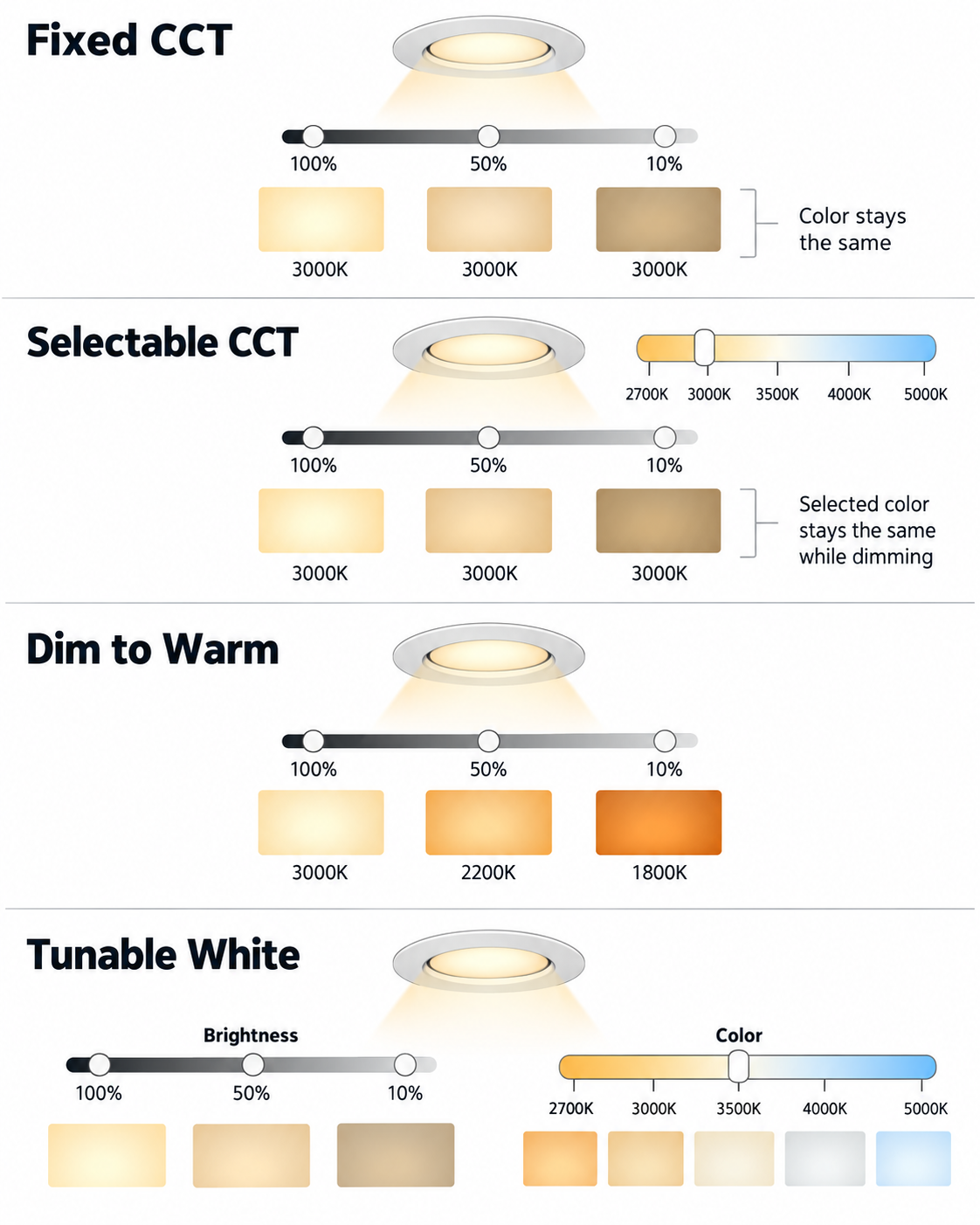
Dim to warm, also called warm dim or warm dimming, is an LED technology that ties brightness and color temperature together. As the light output goes down, the Kelvin temperature goes down with it.
Take a fixture rated 3000K to 1800K. At full brightness it looks like any other 3000K warm white LED. As you dim it, the light gets steadily warmer until, at the bottom of the range, it has the amber look of a candle or a deeply dimmed incandescent bulb.
You don’t pick 3000K, 2500K, 2200K and 1800K individually. The fixture follows a built in dimming curve, so the only control you touch is the dimmer. That’s the big difference between dim to warm and the other color options you’ll see on LED downlights and tape.
Dim to Warm vs Fixed CCT vs Selectable CCT vs Tunable White
These terms get mixed up constantly, but they solve different problems.
| Type | What happens to brightness | What happens to color temperature | Best when |
|---|---|---|---|
| Fixed CCT | Dims if the fixture is dimmable | Stays about the same | You already know the Kelvin you want |
| Selectable CCT | Dims normally | You pick one CCT with a switch at install, and it stays there | You want flexibility before the final color is decided |
| Dim to warm | Gets dimmer | Gets warmer automatically as it dims | You want one control for both bright and relaxed scenes |
| Tunable white | Adjustable | Adjustable separately from brightness | You want deliberate control over Kelvin through the day |
Some fixtures combine two of these. Lotus offers a 4CCT plus dim to warm package on fixtures like the LRG3-4CCT+DTW-HO and Tangra, where you pick a normal color with a switch and also get a dim to warm mode that runs from 3500K to 2700K. DALS does something similar on its Pivot flat gimbal. These hybrids are handy when the final design is still up in the air.
Our color temperature guide covers which Kelvin works best in each room if you’re still deciding on the starting point.
Compare the Warm Dimming Range First
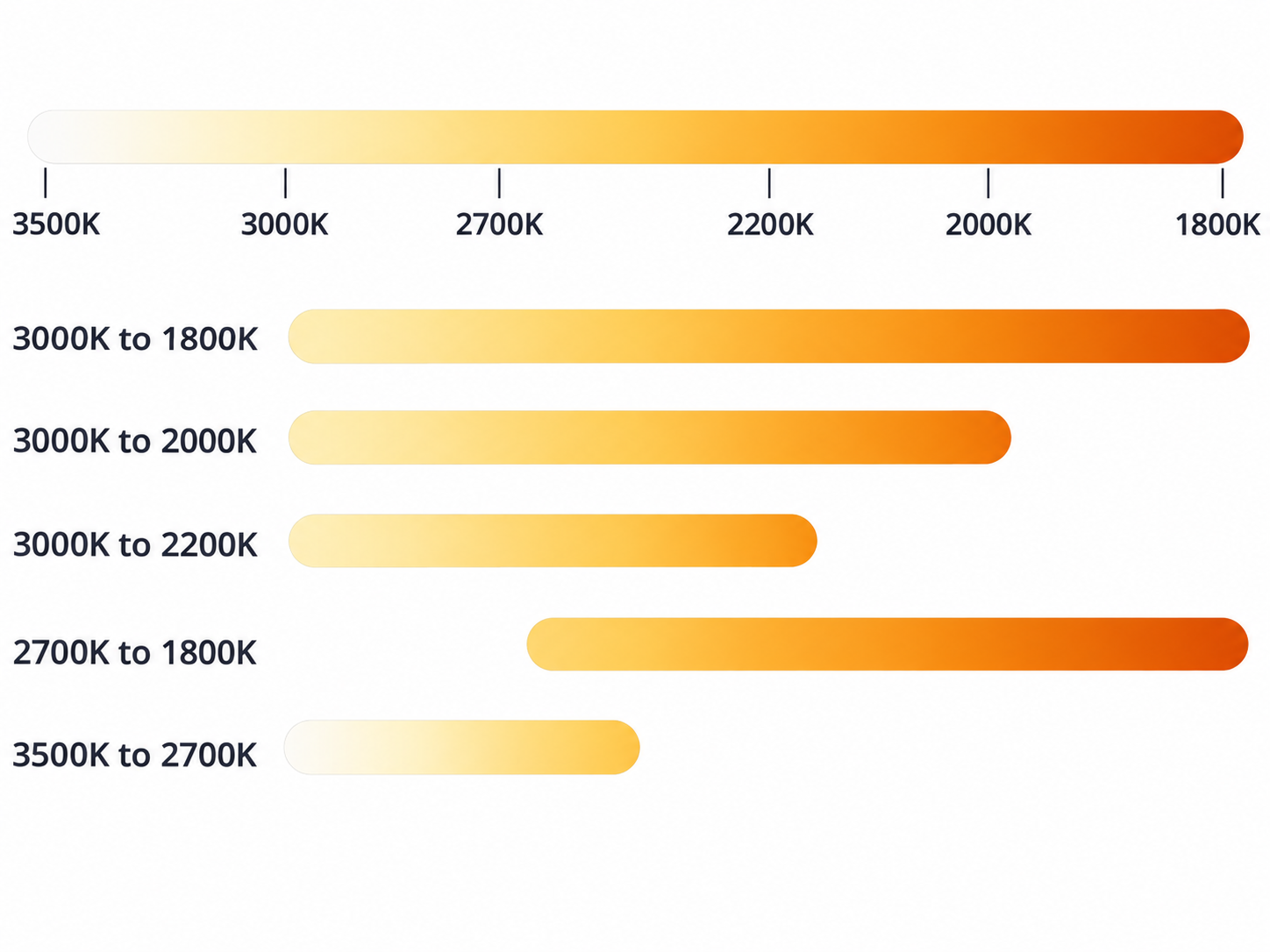
The easiest mistake to make is assuming every dim to warm fixture follows the same color curve. They don’t. Always look at the two Kelvin numbers: where the light starts and where it ends.
| Range | What it looks like when dimmed | Examples |
|---|---|---|
| 3000K to 1800K | The most dramatic shift, ending in a deep, candlelike amber | Lotus LL4RR-3018K, ELCO EKCL21SDD, Lotus COB tape, American Lighting Trulux STLWD |
| 3000K to 2000K | Very warm at the bottom, a bit less orange than 1800K | Lotus LB4R/32K, Diode LED VALENT 3000K to 2000K tape |
| 3000K to 2200K | Noticeably warmer in the evening, stopping short of deep amber | DMF HM3C H Series module, DALS Pivot FGM4-CDW |
| 2700K to 1800K | Starts warmer at full brightness and ends deep amber | Diode LED VALENT 2700K to 1800K tape |
| 3500K to 2700K | A gentler shift that starts crisper and never gets amber | Lotus 4CCT plus dim to warm packages |
A room full of 3000K to 1800K fixtures will look very different at low levels than a room full of 3000K to 2200K fixtures, even though both product pages say “warm dim.” 2200K gives a room a relaxed warmth, while 1800K pushes all the way to candlelight. Pick the one that fits how the room will actually be used at night.
How to Choose Dim to Warm Recessed Lighting
You’ll find dim to warm in many recessed lighting formats, from shallow canless fixtures to regressed downlights, gimbals and modular architectural systems. Looking for products first? Browse our dim to warm recessed downlights, then use these steps to narrow them down by installation type, color range and controls.
1. Decide How the Downlight Installs
Start with the ceiling, not the color. A canless super thin light, a regressed downlight, a gimbal and a modular housing system can all offer dim to warm, but they don’t install the same way.
For shallow ceilings, a super thin fixture like the Lotus LB4R/32K makes sense. If glare matters, look at a regressed source. If the light has to aim at artwork, shelving or a fireplace, look at gimbals. Modular systems like DMF H Series and ELCO Koto are useful when you want to coordinate housings, trims and light engines across a bigger project. Our guide to choosing LED recessed lighting walks through those fixture types in more detail.
2. Pick the Full Brightness Color
Ask what the room should look like with the lights all the way up. For most homes, 3000K is a good starting point. It’s warm enough for living spaces but still clean enough for kitchens, bathrooms and general task lighting. If you want crisper light for daytime tasks, a hybrid that starts at 3500K is worth a look.
3. Compare the Warm End of the Curve
Then decide how warm the room should get at the bottom of the dimmer. 2200K reads as relaxed and warm. 1800K reads as candlelight. Which one you want depends on the room.
4. Check Beam Angle, Glare and Aiming
Warm dimming doesn’t replace normal lighting design. A wide regressed downlight still behaves like a wide regressed downlight, a narrow optic still creates a tight beam, and a gimbal still matters if the target isn’t directly below the fixture. Pick the light distribution first, then treat dim to warm as one more layer of control.
5. Verify the Driver and Dimming Method
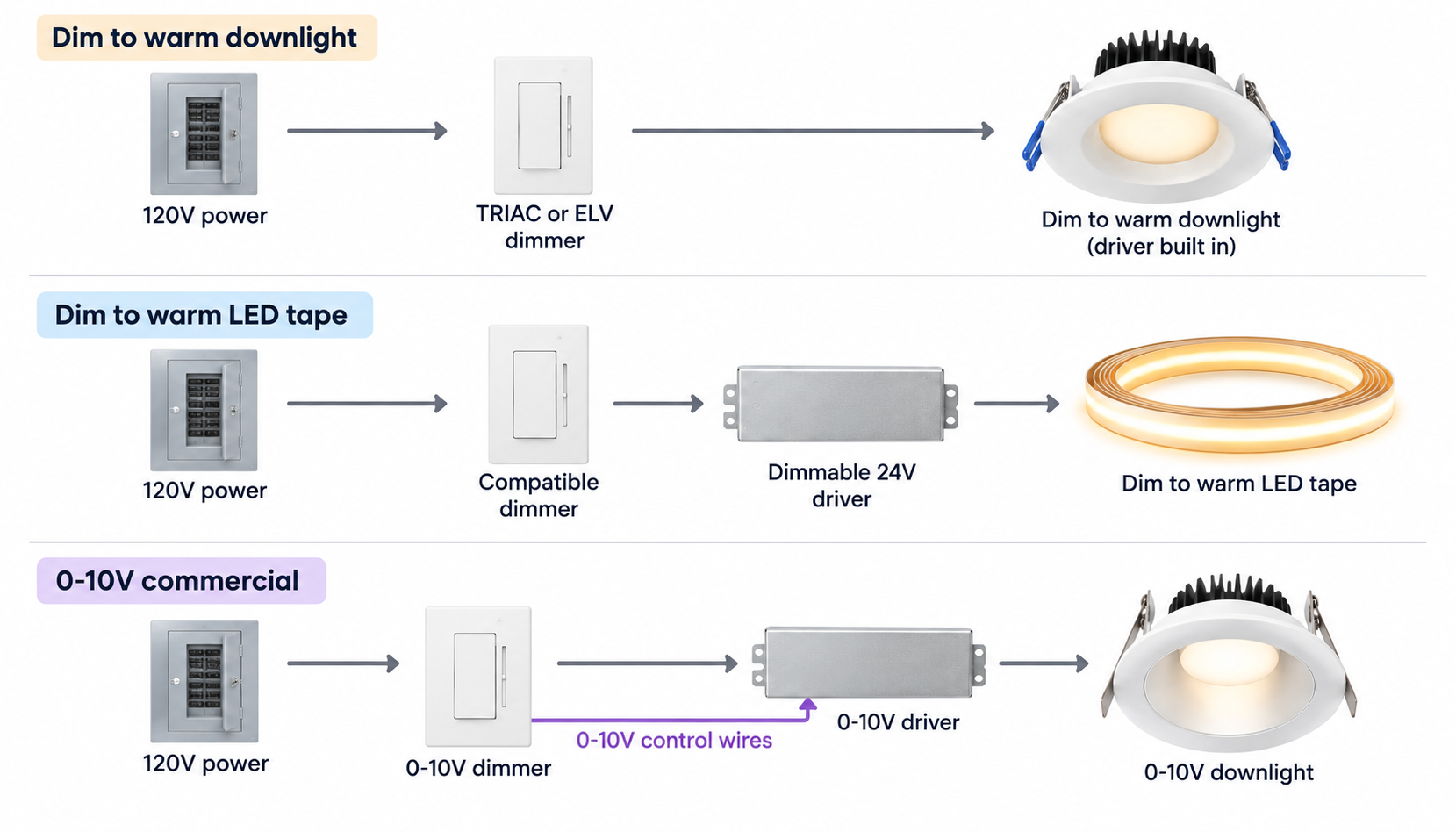
This is where compatibility matters most. Many residential dim to warm downlights run on standard TRIAC or ELV phase dimmers, while commercial versions may use 0-10V or another protocol. Don’t assume a fixture works with a wall dimmer just because both say “LED dimmable.” Check the manufacturer’s dimmer compatibility list for the exact model.
Dim to Warm Downlights to Compare
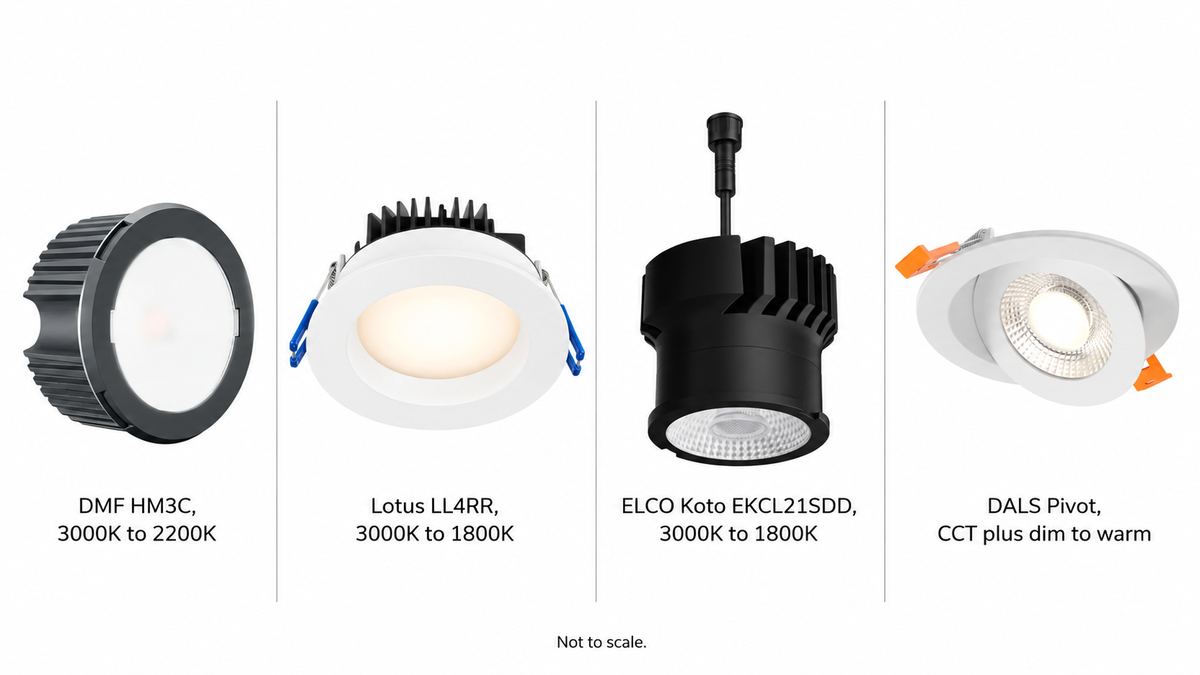
These four downlights take very different approaches to dim to warm, which makes them a good way to see the range of options.
DMF H Series HM3C
The DMF HM3C is DMF’s Natural Warm Dim module for the H Series. It shifts from 3000K to 2200K and has a brightness switch that sets 350, 750 or 950 lumens from one module. It runs on 120V with TRIAC or ELV dimming and pairs with H Series 3″ or 4″ housings and trims. For a full breakdown of the H, M, X and C families, see our DMF recessed lighting guide.
Best fit: whole home residential projects that want a classic warm dimming feel and a modular housing and trim system.
Lotus LL4RR-3018K-WH
The Lotus LL4RR-3018K-WH is a 4″ regressed canless downlight that goes from 3000K to 1800K. It puts out 850 lumens at 90+ CRI, is only 2″ deep, and is rated wet location, air tight and Type IC. It’s also one of the most popular dim to warm downlights we sell. Lotus offers 3000K to 1800K versions in several other families too, including select regressed gimbals, the deep regressed LD4R and 2″ Designer Series configurations.
Best fit: living rooms, kitchens and bedrooms where you want less glare and a strong warm shift at low light levels.
ELCO Canless Koto EKCL21SDD
The ELCO EKCL21SDD is a Canless Koto module with a 3000K to 1800K range. It delivers 950 lumens at 10.5W and includes interchangeable 25°, 38° and 60° lenses. Because Koto is a modular system, the light engine pairs with a compatible Koto power pack, like the Koto Remodel IC Power Pack, and the power pack you choose sets the input voltage and dimming method.
Best fit: projects where you want warm dimming plus more control over beam angle, aperture and trim style.
DALS Pivot FGM4-CDW-WH
The DALS Pivot FGM4-CDW-WH combines selectable CCT and dim to warm in a 4″ flat gimbal. It’s a 9W fixture rated at 940 lumens and 90+ CRI, with six settings on one switch: 2700K, 3000K, 3500K, 4000K, 5000K or a dim to warm mode that goes from 3000K to 2200K. It tilts 90° and rotates 360° with a 40° beam, takes a 4 1/4″ cutout, is wet location rated and works with the TRIAC and ELV dimmers on DALS’ compatibility list.
Best fit: remodels where you want an aimable, shallow fixture but don’t want to lock in one color before installation.
Dim to Warm LED Tape Light
The idea is the same with dim to warm LED strip lighting: turn the brightness down and the tape gets warmer. The electrical system is what changes.
Every product in our dim to warm LED tape light category runs on 24V, so the tape never connects straight to 120V house power. It needs a compatible dimmable 24V driver between the line voltage circuit and the tape. The category includes tape from Lotus, American Lighting, Diode LED and RAB.
Lotus COB Dim to Warm Tape
The Lotus ES-FSCOBWW-W-24-2-DTW is a 16 foot, 24V COB reel that goes from 3000K to 1800K, using 4.6 watts per foot for 350 lumens per foot. COB construction gives you a continuous line of light instead of visible dots. Lotus says no separate controller is needed to change the color, since the warm shift happens as the tape dims, but you still need the right 24V driver and dimming method. Lotus also makes a sauna rated IP67 version of its dim to warm COB tape.
American Lighting Trulux
The Trulux STLWD-3018-16 is a 16.4 foot, 24V reel that goes from 3000K to 1800K at 262 lumens per foot and 3 watts per foot. There’s also a high output HTLWD version at 335 lumens per foot. Trulux pairs with matching dimmable 24V drivers and accessories, which makes it an easy system to build out. Our guide to the Trulux tape system covers the parts.
RAB ARCTAPE
RAB’s TIC-DW ARCTAPE comes on a 32 foot reel and goes from 3000K to 1800K, at 188 lumens per foot and 2.5 watts per foot on 24V.
Diode LED VALENT
Diode LED’s VALENT line gives you three warm dimming curves to choose from: 2700K to 1800K, 3000K to 1800K and 3000K to 2000K, in lower and higher output versions and in wet location versions. It’s a good reminder that warm dim strips aren’t interchangeable.
How to Choose a Dim to Warm Tape System
- Voltage: Every tape in our dim to warm category is 24V, so plan for a driver.
- Watts per foot: Multiply the total footage by the watts per foot, then choose a compatible driver that can handle that load with some headroom. Follow the tape and driver manufacturer’s guidance on loading and maximum run.
- Lumens per foot: A cove, an accent shelf and under cabinet task lighting don’t need the same output.
- Warm dimming range: 3000K to 1800K, 3000K to 2000K or 2700K to 1800K.
- Maximum run and cut points: Maximum runs in our category range from about 16 feet to 62 feet, so check before you plan one long run.
- Location rating: Standard dry location tape, wet location tape and sauna rated tape are not interchangeable.
If the light source will be visible or reflected in a polished countertop, COB tape is worth a close look because the line looks continuous.
Does Dim to Warm Need a Special Dimmer?
Not a special one, but it does need to be a compatible one.
Many residential dim to warm downlights are designed for compatible TRIAC or ELV LED dimmers. As you turn the dimmer down, the fixture’s LED and driver change both brightness and color on their own. Commercial versions may use 0-10V instead, which needs a 0-10V driver and a separate pair of low voltage control wires. Keep in mind that a fixture being 0-10V dimmable doesn’t make it dim to warm. The fixture or module has to be built for warm dimming. Our guide to understanding 0-10V dimming explains that setup.
With 24V tape, the wall control doesn’t power the tape directly. The driver sits between line voltage and the tape, and the driver, dimmer and tape all need to agree on the dimming method.
A good order to work in:
- Choose the fixture or tape.
- Confirm its voltage and dimming protocol.
- Choose a compatible driver if one isn’t included.
- Choose a dimmer approved for that fixture or driver.
- Check minimum load, maximum load and low end dimming before you buy for the whole job.
Working in that order prevents most warm dimming problems. You’ll find compatible wall controls in our dimmer selection and drivers in our LED driver category.
Where Dim to Warm Lighting Works Best
Living Rooms and Family Rooms
Living rooms are a natural fit for warm dimming. Run the lights bright for cleaning, reading or company, then bring them down later. Because the color warms as it dims, the room feels intentionally different instead of just darker.
Dining Rooms
Dining rooms show off the benefit especially well. You get good visibility while setting the table, then a warmer, candlelit feel for dinner without adding a second lighting system.
Kitchens
Dim to warm works well in kitchens, especially open ones that flow into a living or dining area. Pay attention to the full brightness color. If you prefer 3500K for task lighting, a product that starts at 3000K may not be your first pick, and a hybrid with selectable CCT plus dim to warm is worth considering.
Bedrooms
Bedrooms rarely need cool light at night. A 3000K to 1800K or 3000K to 2200K range lets one fixture cover normal lighting and low evening light.
Restaurants, Hotels and Hospitality
Warm dimming fits any space whose mood changes through the day. Bright output supports setup and cleaning, while lower levels create the warm look guests expect in the evening.
Coves and Under Cabinets
This is where dim to warm tape makes the most sense. The light source disappears into a cove, cabinet or shelf, and the color shift changes the character of the whole lit surface.
Common Dim to Warm Mistakes
Assuming every LED changes color when it dims. Most standard dimmable LEDs don’t. A fixed CCT LED stays close to the same color while only its brightness changes.
Comparing only the warm end. A 3500K to 2700K product and a 3000K to 1800K product look different at both ends of the dimmer. Check where each one starts as well as where it stops.
Expecting full output to match the fixed CCT version. Dim to warm versions are often a little less bright at full output. The Lotus LL4RR, for example, is listed at 1,000 lumens in 3000K and 850 lumens in its 3000K to 1800K dim to warm version.
Mixing warm dimming curves in the same view. Two brands can both say “dim to warm” but change color at different rates as the dimmer moves. If several fixtures need to look identical, keep them on the same product family and curve.
Ignoring the driver. The fixture, driver and wall control all have to agree on the dimming method.
Treating tape like a complete fixture. Tape is one part of a system. The driver, wire, connectors, channel, location rating and maximum run all matter.
Dim to Warm Lighting FAQs
Can I make my existing recessed lights dim to warm?
Not with a new dimmer alone. A fixed CCT LED stays the same color when it dims, so you’d need to replace the light source with a dim to warm version. That might mean a new canless downlight, a dim to warm retrofit module for an existing can, or a new light engine in a modular system like DMF H Series or ELCO Koto if the existing housing and trim are compatible.
Does dim to warm work on a regular on/off switch?
It turns on and off normally, but without a dimmer it simply stays at its full brightness color, usually 2700K or 3000K. You need a compatible dimmer to get the warm shift.
Is dim to warm the same as tunable white?
No. Dim to warm links color to brightness, so bright means whiter and dim means warmer, all from one ordinary dimmer. Tunable white lets you set color separately from brightness, for example 4000K during the day and 2700K at night at the same light level, but it usually needs a more involved control system.
Is 1800K or 2200K better?
Neither is better. 2200K is warm without going fully amber, while 1800K pushes into a candlelike glow. Choose based on how dramatic you want the color change to look at low levels. For kitchens and spaces where you still want to see clearly with the lights down, 2200K is often the easier fit.
Can I mix dim to warm and regular LEDs on the same dimmer?
It may work electrically if the dimmer is approved for the combined LED load, but it usually isn’t a good visual match. The regular fixtures stay about the same color as they dim, while the dim to warm fixtures keep getting warmer, so the difference is obvious in the same view.
Does dim to warm LED tape need a special controller?
Not usually. Single channel dim to warm tape, like the Lotus COB tape, shifts color as it dims on a compatible 24V dimmable driver and wall control. Tunable white tape is different and needs a controller for its separate color channels.
Shop Dim to Warm Lighting at PROLIGHTING
Dim to warm lighting brings back the best thing about incandescent: the light gets warmer as the room gets darker. The difference now is that you get to choose how it happens. A simple residential downlight might go from 3000K to 2200K. A regressed canless light can reach 1800K. A hybrid gimbal can give you several normal white settings plus warm dimming. And a 24V COB tape system can wash a whole cove or cabinet in an amber glow at night.
Start by deciding what the room needs at full brightness and how you want it to feel with the lights low. Then compare the fixture or tape, its warm dimming range and the controls together, which is far more reliable than shopping by the words “dim to warm” alone.
Browse our dim to warm LED tape, the Lotus LED Lights collection, DMF H Series downlights and ELCO Canless Koto modules, or request a quote and ask for a free lighting layout. Our lighting specialists can help match the fixture, driver and dimmer before you order.
Published October 2026

Comments are closed.