
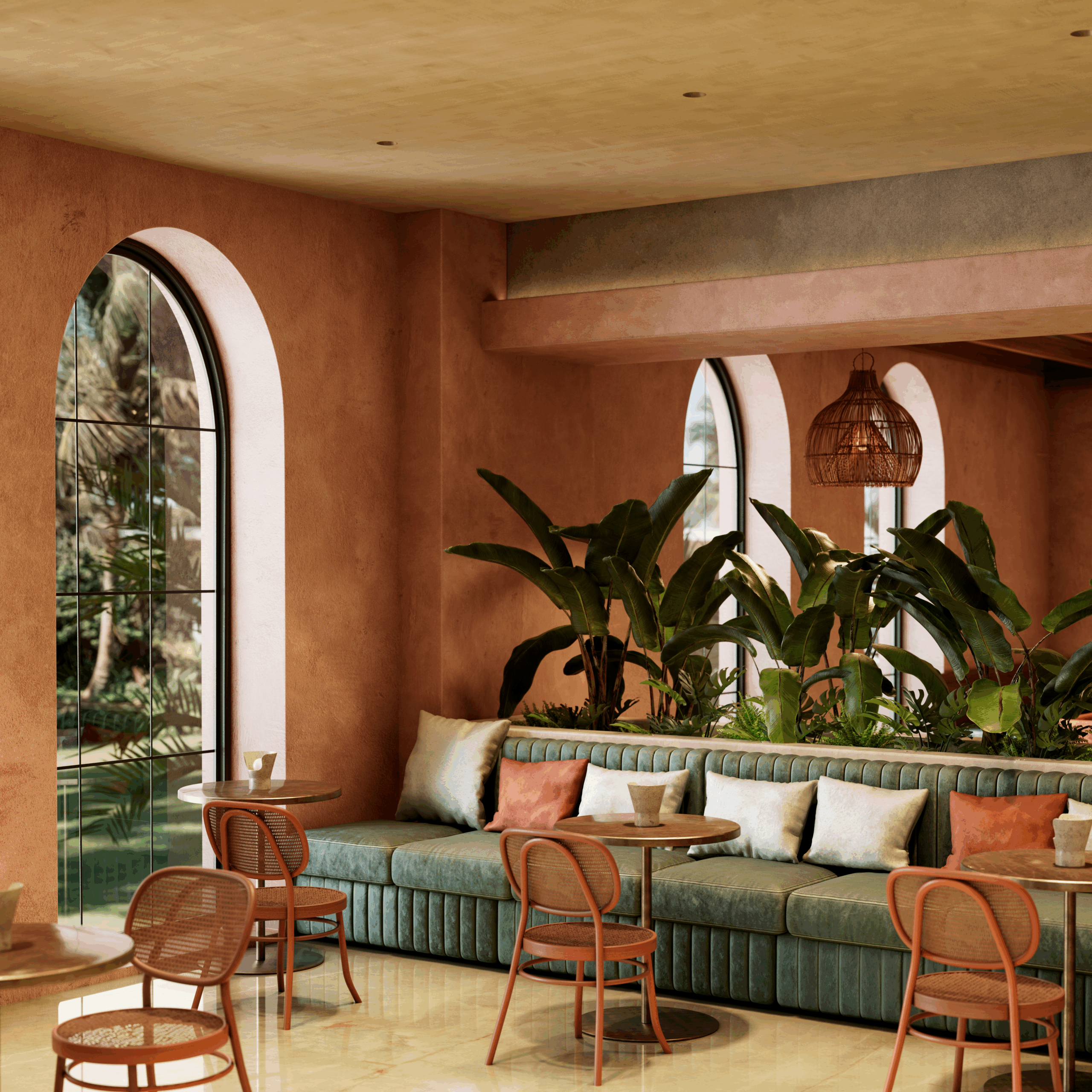
Choosing DMF recessed lighting gets confusing fast. DMF offers several modular downlight families that look similar on the surface, but each one is built around a different balance of aperture size, output, optical control, installation flexibility and project type.
At PROLIGHTING you’ll find DMF’s core downlight systems, including the H Series, M Series, X Series and C Series, along with the new True 1, DMF cylinders and surface mount lighting. The right choice comes down to whether you’re lighting a home, designing an upscale architectural space, specifying a commercial project or just looking for dependable general lighting.
This guide breaks down the differences between the DMF downlight families so you can figure out which system fits your project.
DMF H vs M vs X vs C Series: Quick Comparison
| Series | Best For | Aperture | Light Output | Color Quality | Dimming & Voltage |
|---|---|---|---|---|---|
| H Series | Whole home residential | 3″ & 4″ | 350, 750 or 950 lm | 90+ CRI | TRIAC/ELV to 5%; 120V |
| M Series | Residential and commercial | 4″ (6″ available) | 750 to 3,500 lm* | 93 CRI | 0–10V or TRIAC/ELV to 1%, DALI-2 to 0.1%; 120/277V |
| X Series | Architectural, small aperture | 2″ | 500 to 1,500 lm | 93 CRI | 0–10V or TRIAC/ELV to 1%, DALI-2 to 0.1%; 120/277V |
| C Series | General commercial ambient | 4″ & 6″ | 1,000, 1,500 or 2,000 lm | 80+ CRI | 0–10V to 5%; 120/277V |
*M Series output depends on the configuration. The IC rated M Series family reaches 1,500 lumens, while M Series Commercial extends to 3,500 lumens.
The short version: H keeps things simple, M covers the widest range of applications, X delivers the tightest optical control in the smallest aperture, and C strips commercial downlighting down to the essentials.
Pay attention to that color quality column. H, M and X all deliver 90 CRI or better, but C Series comes in at 80+ CRI. That’s a deliberate choice on DMF’s part and it fits the corridors and service areas C Series was built for, though it makes the family a poor fit anywhere finishes, merchandise or skin tones need to look accurate.
How DMF’s Modular Downlight Systems Work
Before comparing the individual families, it helps to understand DMF’s modular approach.
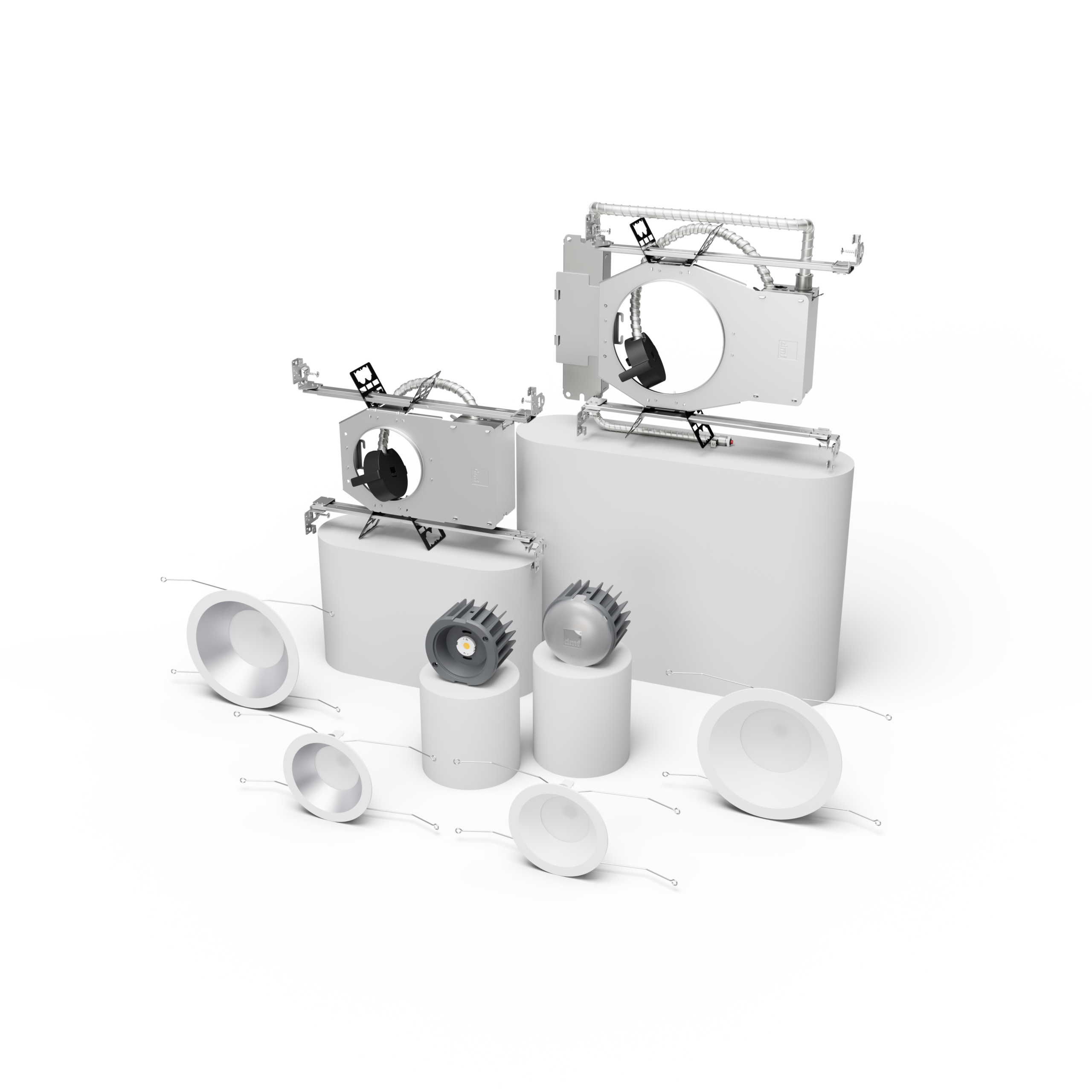
Rather than building every downlight as one permanently integrated fixture, DMF splits it into three separate components: the housing, the LED light engine module and the trim. Depending on the series, that lets you select different outputs, optics, trim styles, installation types and finishes while staying inside one product platform.
Two design decisions make this more than a marketing point.
First, DMF puts the driver inside the light engine module rather than in the housing. That means a failed or outdated module can be swapped from below the ceiling without pulling the housing or opening the drywall. On a large job, that changes the maintenance math considerably.
Second, several DMF modules include a brightness switch, so one part number covers multiple output levels. An installer sets the lumens on site instead of ordering a different module for every room. Fewer part numbers to stock, fewer mistakes at rough-in.
The approach earns its keep on projects with several room types or ceiling conditions. A designer can hold one visual appearance across the whole job while adapting output, beam pattern or trim style room by room.
Compatibility is the thing to watch. Housings, modules and trims need to be selected for the correct DMF family and configuration. For full manufacturer specifications, visit the DMF Lighting website.
DMF H Series: Best for Whole Home Residential Lighting
The DMF H Series is where most residential projects should start, and it’s the most popular DMF family we sell by a wide margin.
H Series comes in 3″ and 4″ versions and delivers 350, 750 or 950 lumens from a single module with a brightness switch. It offers 90+ CRI at 3-step SDCM, fixed 2700K and 3000K, and DMF’s Natural Warm Dim, which travels from 3000K down to 2200K as the fixture dims. Installation covers new construction, remodel and retrofit, and the family carries ENERGY STAR, Title 24 JA8, Declare Listed, wet location, IC and NSF/ANSI 2 ratings, with fire rated and plenum rated housing options.
The part numbers worth knowing: the HM3C module is the Natural Warm Dim light engine that does most of the work, and it pairs with H3 or H4 housings and trims depending on aperture. The HM30 is the fixed 3000K version with the same brightness switch.
DMF publishes useful guidance on picking output: 950 lumens suits ceilings from 9 to 12 feet, 750 lumens suits 7 to 9 feet, and 350 lumens works for ambient fill. That takes most of the guesswork out of a whole home layout.
The tradeoffs are real, and they’re the reason H Series stays affordable. You get one beam distribution, general ambient, rather than a menu of spots and floods. Dimming is TRIAC/ELV down to 5%, not the 1% you’d get from M or X Series, and the module runs on 120V only. In a house, none of that matters. On a commercial job at 277V, it rules the family out.
Trim options include round, square, flush, adjustable and flangeless styles in white and black, which is plenty of range for kitchens, bedrooms, hallways and living rooms.
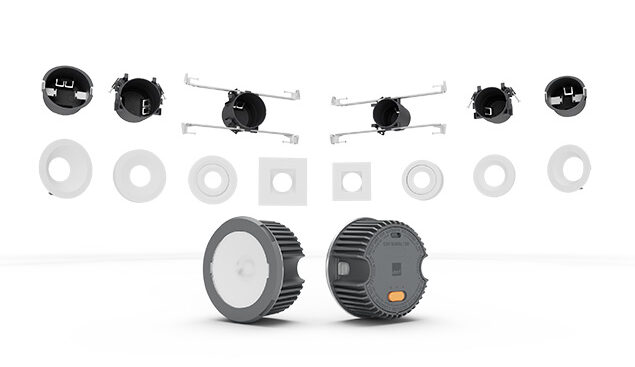
Choose H Series when: you want attractive, high quality residential downlighting and don’t need a long menu of output, beam angle or control combinations.
For a deeper look at this system, read our DMF H Series guide.
Shop DMF H Series LED Downlights
DMF M Series: Best for Maximum Versatility
If H Series is the straightforward residential option, the DMF M Series is what to reach for when a project needs range.
M Series is built on a 4″ downlight platform, with some 6″ configurations available, and stretches across an unusual span of applications. DMF offers residential and IC rated systems, commercial configurations that go much brighter, adjustable heads, wall washing, Warm Dim, Tunable White, multiples and emergency options, plus a long list of specialty trims. Color quality sits at 93 CRI across the family.
Control options are where M Series pulls ahead. The platform supports 0–10V and TRIAC/ELV dimming to 1%, DALI-2 to 0.1%, and 120/277V input. DMF has also added a Lutron Athena wireless node to the commercial line, which matters on jobs with many small control zones.
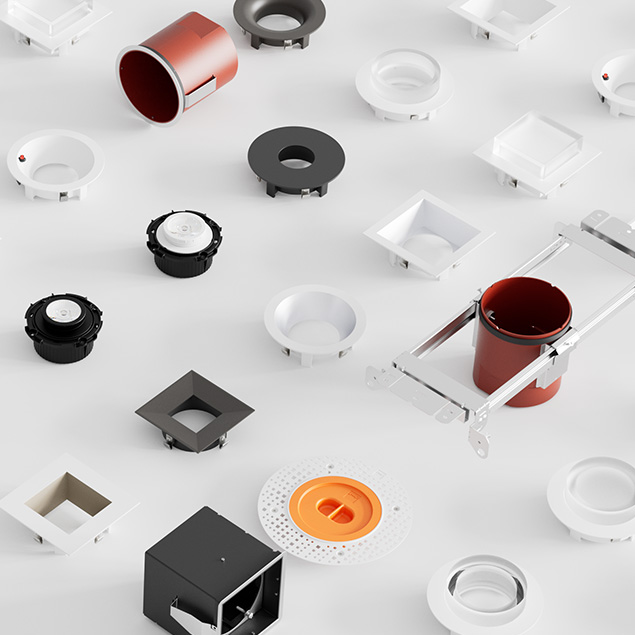
M Series Residential (DRD2)
The IC rated M Series family is built around the DRD2 light engine module, offering 750 to 1,500 lumens with a broad set of beam distributions and color temperature choices, including 2400K through 4000K plus Warm Dim and Tunable White.
Beam spreads cover 15° narrow spot, 25° spot, 40° flood, 60° wide flood, 90°+ general ambient, linear spread and soft focus, and the optics are field changeable. Installation covers new construction, remodel, retrofit, shallow plenum, concrete, millwork and flangeless mud in applications.
Compared with H Series, M Series hands the designer far more control over how light lands in the room. Trims include round and square styles along with hyperbolic, pinhole, wall wash, flangeless, decorative, emergency, coastal marine grade and non-conductive dead front options. Ratings include ENERGY STAR, Title 24 JA8, Declare Listed, wet location, fire rated, STC/IIC sound rated, Chicago plenum, IC, NSF/ANSI 2 splash zone and IP66.
Shop DMF M Series Residential Downlights
M Series Commercial
For higher ceilings and brighter spaces, M Series Commercial extends the platform to output packages from 750 to 3,500 lumens, topping out at 40.5W.
The commercial family handles recessed downlighting, adjustable lighting, wall washing and emergency lighting, with the same 15° through 90° beam range and either integrated or detachable driver options.
The payoff is continuity. One visual style carries through a building where ceiling heights and illumination requirements change dramatically from space to space, because the trims stay the same while the module behind them changes. Swapping a fixed downlight for an adjustable is a quick connect operation, not a re-spec.
Shop DMF M Series Commercial Downlights
M Series Multiples
DMF also extends M Series into recessed fixtures with multiple heads. Each head aims independently, so one ceiling opening produces several directional beams.
These earn their place in retail, hospitality and architectural work, particularly for lighting art, millwork or a run of wall displays without cutting a row of separate holes in the ceiling. Trim options include round, hyperbolic, pinhole, low profile, wall wash, flangeless, decorative and emergency.
Choose M Series when: you need DMF’s most flexible platform, want more trim and optical choices, have both residential and commercial requirements on one job, or need more light output than H Series can deliver.
DMF X Series: Best for Precision Architectural Lighting
The DMF X Series is the answer when you want the smallest possible ceiling aperture without giving up lighting performance.
X Series is a 2″ downlight system. The fixed downlight module runs 500 to 1,500 lumens; the adjustable module runs 500 to 1,000 lumens with 360° rotation and 35° tilt. DMF rates the system as comparable to a 3″ or 4″ downlight in ceilings up to 10 feet, which is the whole point of specifying it. Color quality is 93 CRI at 2-step SDCM, the tightest binning in the DMF lineup.
Beam spreads start at a 10° ultra narrow spot and run through 20° narrow spot, 30° spot, 40° flood, 50° wide flood and a 50° by 30° linear spread. DMF’s Cross Beam TIR optics focus light at the trim opening before spreading it into the room, which cuts the beam clipping and glare that usually come with a small aperture.
Two installation details matter more than the specs on a 2″ fixture:
The Precision Lock Collar. Overcutting the ceiling is the classic small aperture problem, and it means drywall repair. The collar eliminates it and pulls the trim flush. Housings work with ceiling thicknesses from 1/2″ to 1 1/4″, with extension collars available for thicker assemblies.
Below ceiling serviceability. The housing has a trap door that gives access to the splice box from underneath, and the driver lives in the module rather than the housing. Pull the service cord, swap the module, snap it back. DMF calls it the first genuinely serviceable 2″ downlight, and on a job with a hundred of them that claim is worth checking.
X Series also supports fixed color temperatures from 2400K through 4000K plus Warm Dim (3000K to 1800K) and two Tunable White ranges, with 0–10V and TRIAC/ELV dimming to 1% and DALI-2 to 0.1%. Trims come in round and square profiles with wall wash, flangeless, pinhole, hyperbolic and decorative options. The family carries ENERGY STAR, Title 24 JA8, Declare Listed, wet location, Chicago plenum, IC, Dark Sky and NSF/ANSI 2 ratings.
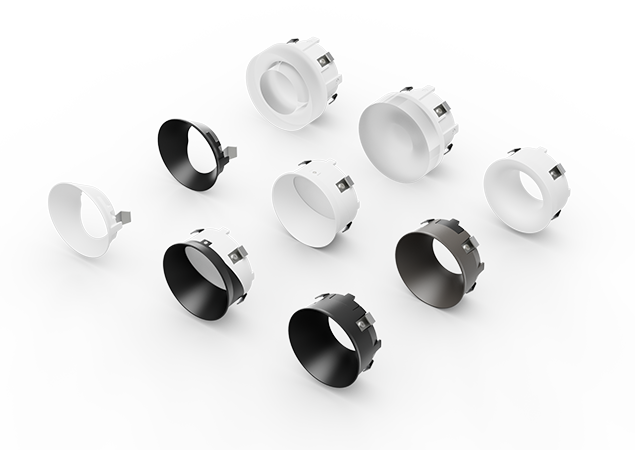
X Series extends into cylinders as well, in pendant, surface mount and ADA compliant wall mount configurations. Because the cylinders use the same light engine modules as the recessed fixtures, color and output stay consistent between a recessed downlight indoors and a cylinder over an entry.
That combination lands well in upscale residential, hospitality, retail, galleries and architectural interiors, where the fixture should stay visually discreet while the light stays tightly controlled.
Choose X Series when: a small aperture and precise beam control matter more than picking the simplest system.
Shop DMF X Series LED Downlights
DMF True 1: The 1 Inch Downlight
DMF’s newest platform pushes the aperture down to 1 inch.
True 1 produces roughly 500 to 750 lumens at 93 CRI on 120–277V, in fixed and adjustable versions. The adjustable module offers 360° rotation and 35° lockable tilt, with 30°, 40° and 50° beam spreads, color temperatures from 2400K through 4000K, and a dim to warm option that runs 3000K to 1800K.
Getting usable output and controlled glare out of a 1″ opening is genuinely difficult, because at that size any stray light on the trim reads as glare. DMF’s answer is a patent pending optical stack that combines several non-scattering elements with a final microstructure layer, producing a true cross beam focus with minimal spill.
True 1 is the fixture to look at when the design brief calls for the ceiling to read as clean as possible and the downlight to essentially disappear. As the newest family it has the shortest catalog, so check availability with us before you spec a full job around it.
DMF C Series: Straightforward Commercial Lighting
The DMF C Series goes the other direction from everything above.
Instead of the configuration range of M Series or the optical precision of X Series, C Series covers simple 4″ and 6″ commercial downlighting and stops there. It provides 1,000, 1,500 and 2,000 lumen packages with a brightness switch or fixed output, 3000K, 3500K and 4000K, one general ambient distribution above 90°, and 0–10V dimming to 5% on 120/277V. Trims are round. Installation is new construction.
The narrow set of choices is the point. Not every commercial project needs a dozen beam angles or color tuning, and for corridors, stairwells, common areas and service spaces a short spec sheet speeds the job along. C Series also carries a non-conductive dead front, NSF/ANSI 2 splash zone listing and wet location listing, with components that are 90% recyclable at end of life.
The thing to know before you spec it: C Series delivers 80+ CRI, a step down from the rest of the DMF lineup. In a corridor nobody will notice. In a lobby, a retail floor or a medical exam room, they will, and M Series at 93 CRI is the better call.
Choose C Series when: you need dependable general commercial illumination, color accuracy isn’t a driving requirement, and you want to keep fixture selection simple.
Shop DMF C Series LED Downlights
What About DMF Cylinders and Surface Mounts?
Not every DMF fixture needs to be recessed into the ceiling.
DMF extends most of these platforms into cylinder lighting, in pendant, surface mount and wall mount configurations. Because the cylinders share light engine modules with the recessed families, you can run a consistent color temperature and output from a recessed downlight in a lobby to a pendant over a reception desk.
PROLIGHTING also carries DMF’s DRD5S surface mount family, sometimes listed as the S Series, in 4″, 8″ round and 18″ linear configurations. These are the answer when you want the clean look of a recessed fixture but a housing in the ceiling isn’t practical, which covers concrete decks, plenum conflicts and finished ceilings you’d rather not cut.
For a closer look at the DRD5S family, read our DMF DRD5S Surface Mount guide.
How Do You Choose the Right DMF Series?
Most projects sort themselves out once you know what matters most.
Lighting a house with a simple, flexible system? Start with H Series. Need one platform covering the widest range of applications, optics and output? That’s M Series. Designing around a small architectural aperture with precise beam control? X Series at 2″, or True 1 if you want the aperture to disappear entirely. Specifying straightforward commercial ambient lighting where color accuracy isn’t critical? C Series keeps it simple.
Three questions cut through most of the ambiguity:
Does anything run on 277V, or need dimming below 5%? That rules out H Series and points to M or X.
How much ceiling do you want the fixture to occupy? Aperture drives the aesthetic more than any other single choice, and DMF now spans 1″ through 6″.
Picking the series is only step one. From there, confirm lumen output, color temperature, beam angle, dimming method, installation type and trim style. DMF backs these families with a five year, 50,000 hour warranty.
DMF Recessed Lighting FAQs
What is the difference between DMF H Series and M Series?
H Series is a straightforward 3″ and 4″ residential platform with three output levels up to 950 lumens, one beam distribution and TRIAC/ELV dimming to 5% on 120V. M Series is a more configurable 4″ family built around the DRD2 module, with far more optics, trims and installation options, 93 CRI, 120/277V input, dimming to 1% or lower, and commercial configurations reaching 3,500 lumens.
What is the difference between DMF M Series and X Series?
M Series uses a 4″ aperture and covers a broad range of residential and commercial applications with output to 3,500 lumens. X Series uses a 2″ aperture and puts the emphasis on a compact appearance and precise beam control, including a 10° ultra narrow spot. DMF rates the 2″ X Series as comparable to a 3″ or 4″ downlight in ceilings up to 10 feet.
What size are DMF X Series downlights?
X Series is a 2″ aperture system, available in round and square profiles, with fixed downlight and adjustable modules and a universal housing offered in new construction, Chicago plenum and remodel versions.
Which DMF series has the highest lumen output?
M Series Commercial provides the highest output at 3,500 lumens. C Series reaches 2,000 lumens, X Series fixed downlights reach 1,500 lumens, H Series reaches 950 lumens and True 1 reaches roughly 750 lumens.
Which DMF series has the best color rendering?
M Series, X Series and True 1 all deliver 93 CRI. H Series delivers 90+ CRI. C Series delivers 80+ CRI, the lowest in the lineup and worth checking before specifying it where finishes or merchandise need to look accurate.
Which DMF series is best for residential lighting?
H Series is the strongest choice for straightforward whole home lighting and the family we sell most of. M Series Residential suits projects that need more optical, trim or installation flexibility. X Series appeals most in upscale architectural spaces where a small ceiling aperture is the goal.
What is the smallest DMF downlight?
True 1, with a 1″ aperture, producing roughly 500 to 750 lumens at 93 CRI in fixed and adjustable versions.
Does DMF offer dim to warm lighting?
Yes. H Series uses DMF’s Natural Warm Dim, which shifts from 3000K to 2200K as the fixture dims. M Series, X Series and True 1 offer Warm Dim from 3000K to 1800K, and M and X add Tunable White options.
Can DMF modules, trims and housings from different series be mixed?
Don’t assume components from different DMF families are interchangeable. Compatibility varies by series and configuration, so verify the housing, module, trim, voltage and controls together before ordering.
Can DMF downlights be serviced after installation?
Yes, and it’s one of the platform’s real advantages. DMF integrates the driver into the light engine module rather than the housing, so a module can be swapped from below the ceiling. X Series housings add a trap door for access to the splice box without opening the drywall.
What warranty comes with DMF Lighting?
DMF backs these downlight families with a five year, 50,000 hour warranty.
Shop DMF Lighting at PROLIGHTING
No single DMF recessed lighting family is best for every project. The strength of DMF’s lineup is that each series is designed around a different set of priorities, and the modular architecture means you’re not locked into your first decision.
For residential simplicity, start with H Series. For range and output, look at M Series. For a small aperture and precise optics, consider X Series or True 1. For general commercial ambient lighting on a short spec sheet, C Series is the easiest of the group to specify.
Explore our complete selection of DMF Lighting products at PROLIGHTING, or contact our lighting specialists if you need help matching the right module, housing, trim or series for your project.

Comments are closed.