
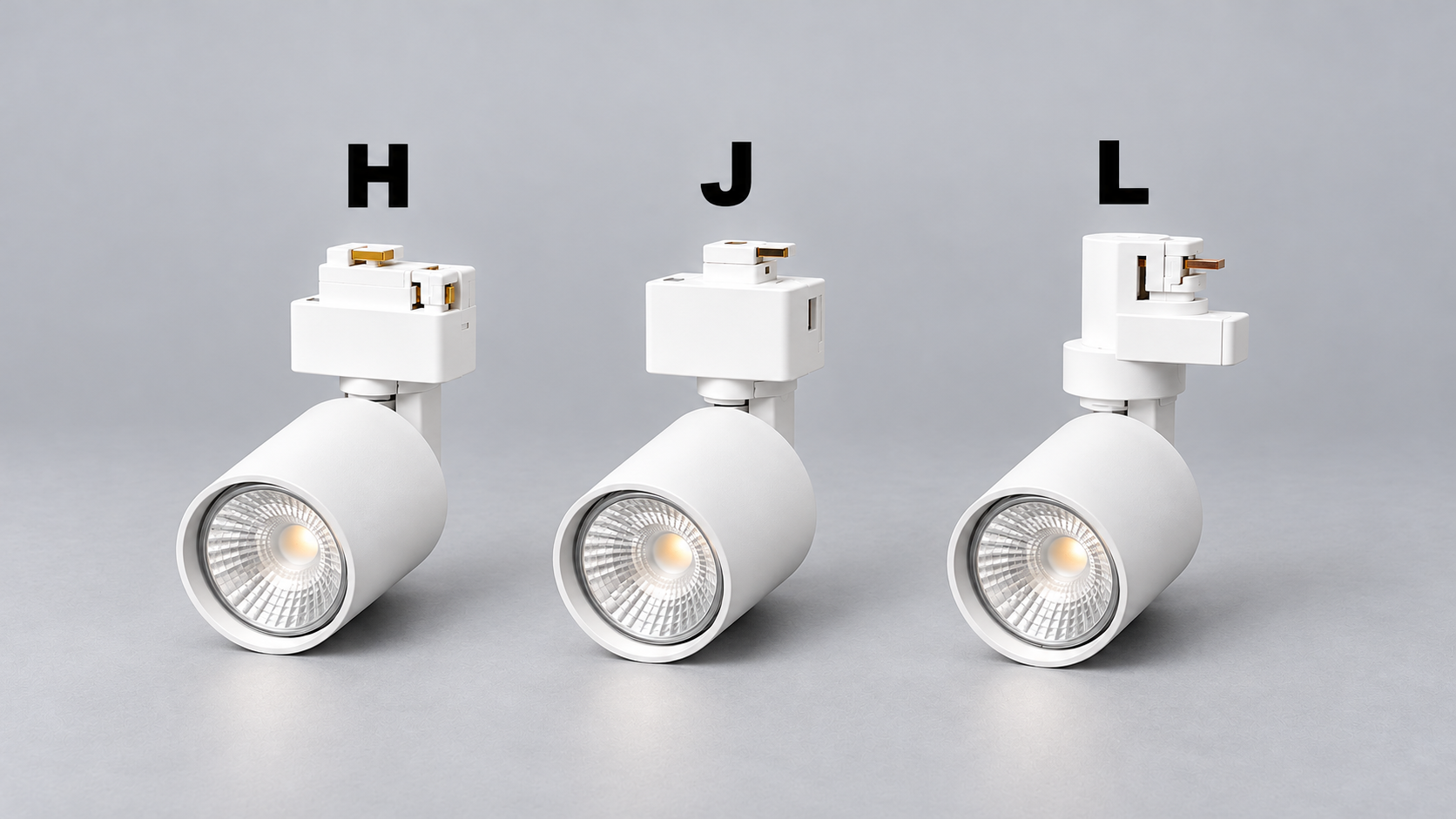
Replacing a track light should be simple: pull off the old head, pick a new one and lock it into the rail. Then the new head doesn’t fit. Usually the problem isn’t the wattage, the color or the brand. It’s the track system, and understanding H vs J vs L track lighting is how you avoid buying the wrong head twice.
Most traditional North American line voltage track falls into one of three families: H type, J type and L type. The letters come from Halo, Juno and Lightolier, the companies whose track designs became the standards. Today those letters describe the connection style, not the brand printed on the fixture. A Nora, WAC or Green Creative head can be built for H track, J track or L track.
PROLIGHTING doesn’t sell Halo, Juno or Lightolier branded track, but we carry hundreds of heads from Green Creative, Nora, WAC, Satco | Nuvo, RAB and Sylvania built to fit all three.
That matters because the three systems use different contacts and locking arrangements. A J track head won’t work in H track, and an L track connector isn’t interchangeable with a J track connector just because the rails look alike.
The good news is that once you know what to look for, identifying an existing track usually takes a few minutes. This H vs J vs L track lighting guide walks through how to do it, then covers the other details that trip people up: circuits, voltage, connectors, pendants and dimming.
H vs J vs L Track Lighting at a Glance
| Track type | Named for | How to spot it | What to buy |
|---|---|---|---|
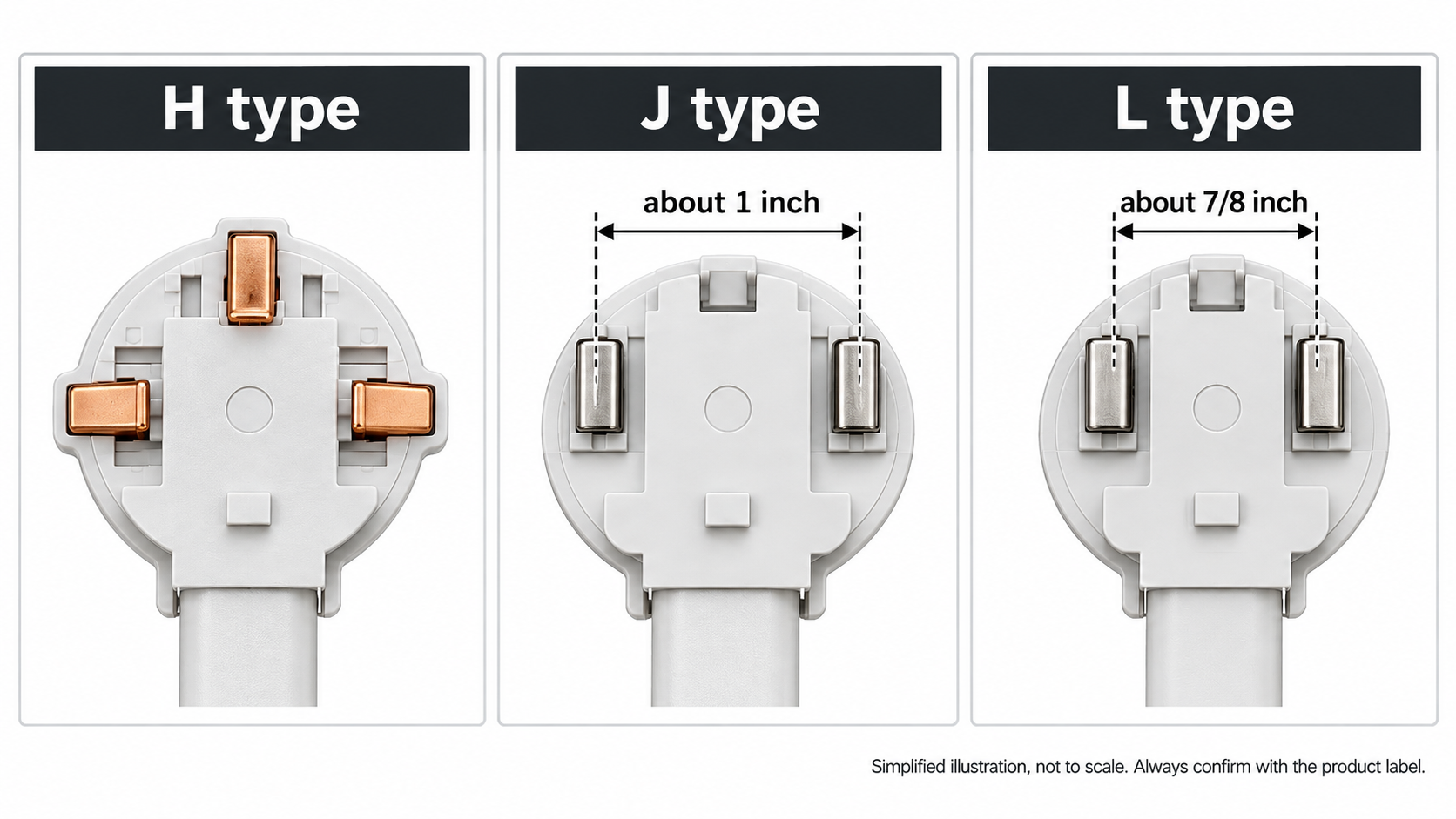
| H type | Halo | Three contacts on the adapter | Heads and parts listed for H track or Halo track |
| J type | Juno | Two main contacts about 1″ apart | Heads and parts listed for J track or Juno track |
| L type | Lightolier | Two main contacts a little closer together, about 7/8″ apart | Heads and parts listed for L track or Lightolier track |
Contact count and spacing are the classic way to tell H vs J vs L track lighting apart, and we cover them in our Nora LED track lighting article too. Just don’t rely on one clue alone. J and L contacts are only about 1/8″ different, which is easy to misjudge with a tape measure on a ladder. The most reliable answer comes from combining the adapter, any labels on the head or rail, the circuit type and the manufacturer’s compatibility information.
Why H, J and L Track Don’t Mix
All three are 120V track systems that look similar from below, but they’re built differently inside. According to Juno, the differences come down to the number of wires and the shape of the buss bars that carry power from the track to the fixture. The adapter on each head is shaped to match one of those layouts, so a head built for one system won’t seat or make contact properly in another.
That’s why the label on the head matters far more than the brand. A head doesn’t have to say Halo to work in H track. It has to be built and listed for H track.
How to Identify Your Track Type in 7 Steps
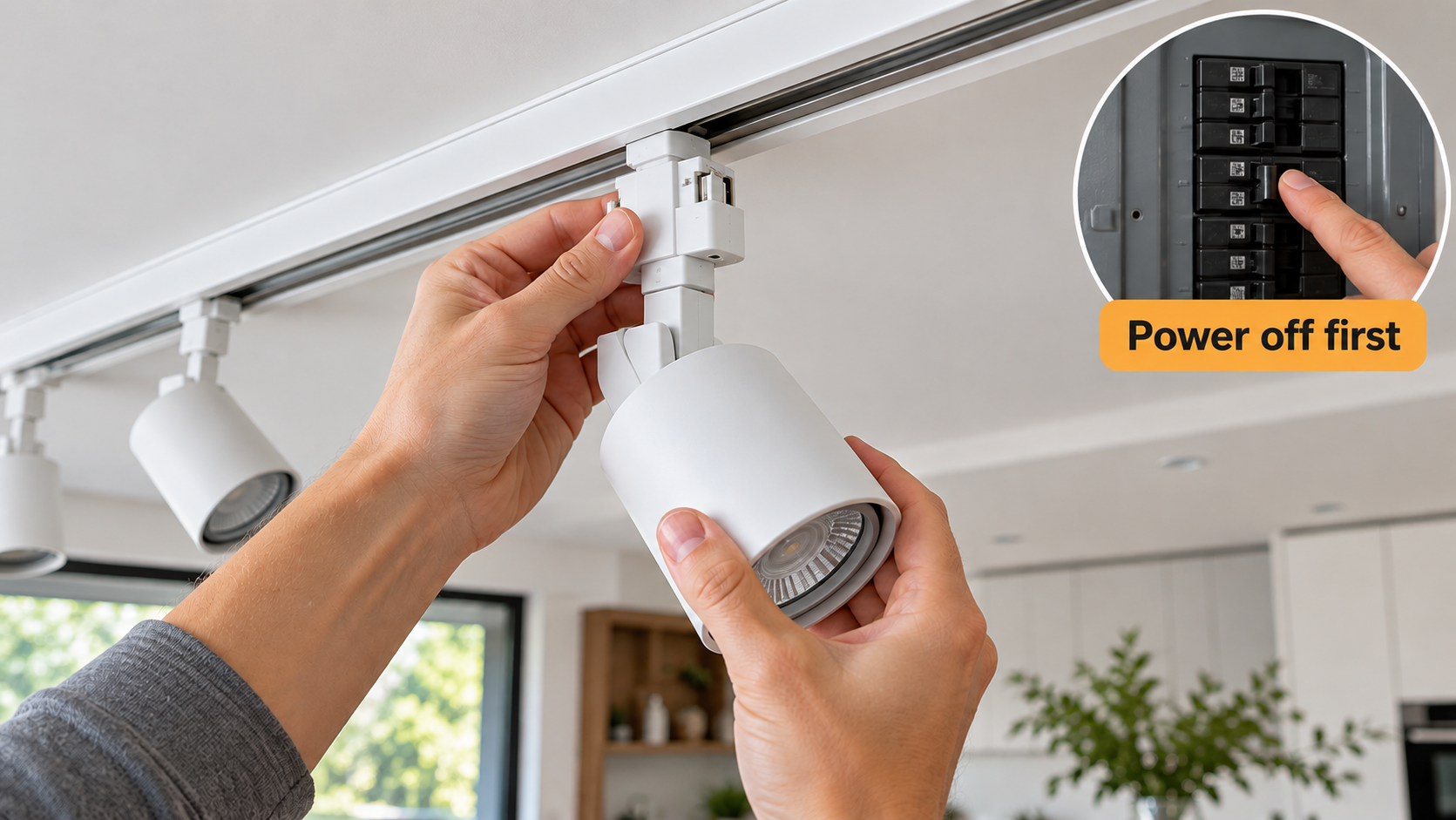
Turn off power to the track at the breaker first. Track manufacturers call for the power to be off before you install or remove a head.
- Look for a label. Check the existing head, the adapter, the feed and the inside or end of the rail for a brand or model number. A label that says H, J, L, Halo, Juno or Lightolier is better evidence than anything you can see from the floor.
- Remove a head and look at the adapter. Three contacts usually means H track. Two main contacts about 1″ apart usually means J track, and two contacts closer together, about 7/8″, usually means L track.
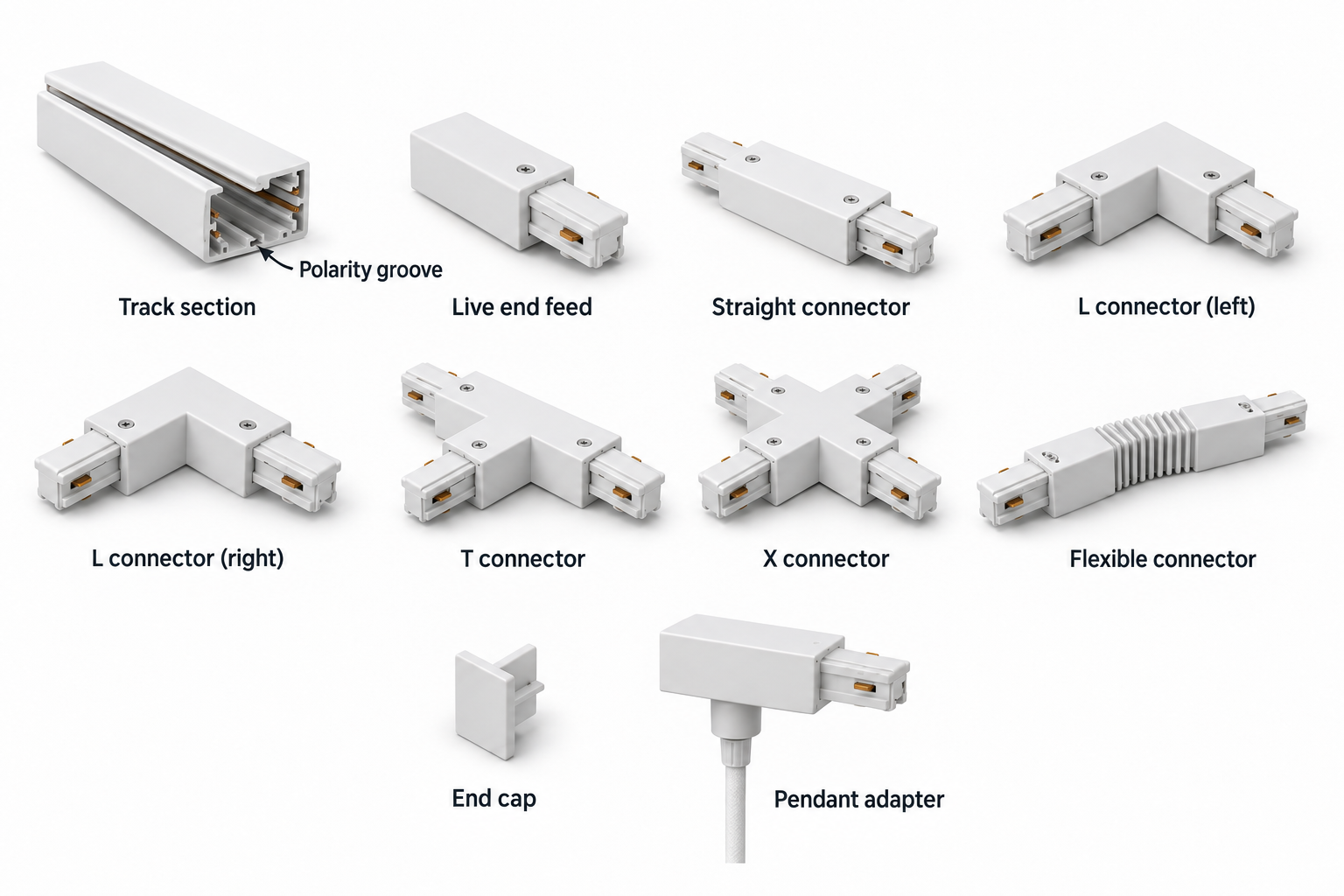
- Find the polarity groove or ridge. Most rails have a groove or ridge running along one side so heads and connectors go in one way only. Note which side it’s on before you order corner connectors or new heads.
- Check whether it’s one circuit or two circuit. H, J or L doesn’t tell you how many circuits the track carries. Two circuit track lets you control two groups of heads separately, and not every head works on both.
- Confirm the voltage. Most H, J and L track is 120V, but commercial and specialty systems can run at other voltages.
- Match the full product description. On the head you’re buying, look for wording like “H track,” “Halo adapter,” “J type,” “Juno adapter,” “L track” or “Lightolier adapter.” The fixture body alone doesn’t tell you.
- If it doesn’t seat and lock easily, stop. A head should twist in and lock the way the manufacturer describes. If it doesn’t, recheck the track type, circuit and adapter instead of forcing it.
If you still aren’t sure, take clear photos of the track profile, the adapter on an existing head, any labels and the power feed, and send them to our team. We can usually identify the system from good photos.
H Track Lighting (Halo Style)
H track, often called Halo style track, is the most common type you’ll run into, and it has by far the largest selection of replacement heads. In our track heads category, more than half of the heads are built for Halo style track.
H track uses a three contact adapter. Plenty of manufacturers build heads for it. The WAC TK-178 line voltage head, for example, is sold in a dedicated H track version, and Green Creative’s SOL gimbal track heads come in an H type version for PAR20, PAR30 and PAR38 lamps. Nora also builds much of its track head lineup for Halo style track.
Buy for H track when: your existing heads have three contacts or are labeled H, Halo or “Halo compatible.”
J Track Lighting (Juno Style)
J track follows the Juno connection. It looks enough like other track that guessing from the outside can easily lead to the wrong order. The two main contacts are about 1″ apart, but the full adapter shape and lock are what decide whether a head fits.
Green Creative is a good example of why you need to read the whole part number. Its Atom LED track head comes in separate H, J and L versions, and the ATM10-930-FL-DIM120-J-WH is the white 3000K J type version. The SOL gimbal heads and the WAC TK-178 also come in J track versions. From below, the H and J versions look nearly identical. The adapter on top is what separates them.
Buy for J track when: your existing heads have two contacts about 1″ apart or are labeled J, Juno or “Juno compatible.”
L Track Lighting (Lightolier Style)
L track comes from the Lightolier family. Like J track, it uses two main contacts, but they sit a little closer together, about 7/8″. J and L shouldn’t be treated as interchangeable just because they look alike from below.
L track has the smallest selection of the three, but you can still find modern LED heads for it. Green Creative’s Atom is available in an L type version, Nora offers heads with Lightolier adapters, and WAC still makes L track and components. That’s useful when you want to update an older Lightolier installation with LED heads without replacing the rail.
Buy for L track when: your existing heads have two contacts closer than 1″ or are labeled L, Lightolier or “Lightolier compatible.”
Are H, J and L Track Heads Interchangeable?
Not across the three track types. An H head isn’t a substitute for a J head, and a J head doesn’t become an L head because the fixture body looks the same.
Here’s the part that causes confusion: many manufacturers make the same fixture in separate H, J and L versions. You’ll see the same head listed three times with three different adapters. That’s why you’ll sometimes hear a head described as “universal.” It may be available for all three systems, but each version only fits one of them. No single adapter fits every track.
Mixing brands is a different question, and the answer is usually yes, as long as the system matches. A Nora head built for Halo style track will generally work on other H track. Even so, some manufacturers note that compatibility with other brands’ track should be confirmed before installation, especially with older, proprietary or two circuit systems. With H vs J vs L track lighting, match the system first, then check the exact product.
One Circuit vs Two Circuit Track
Circuit count is a separate choice from H, J or L.
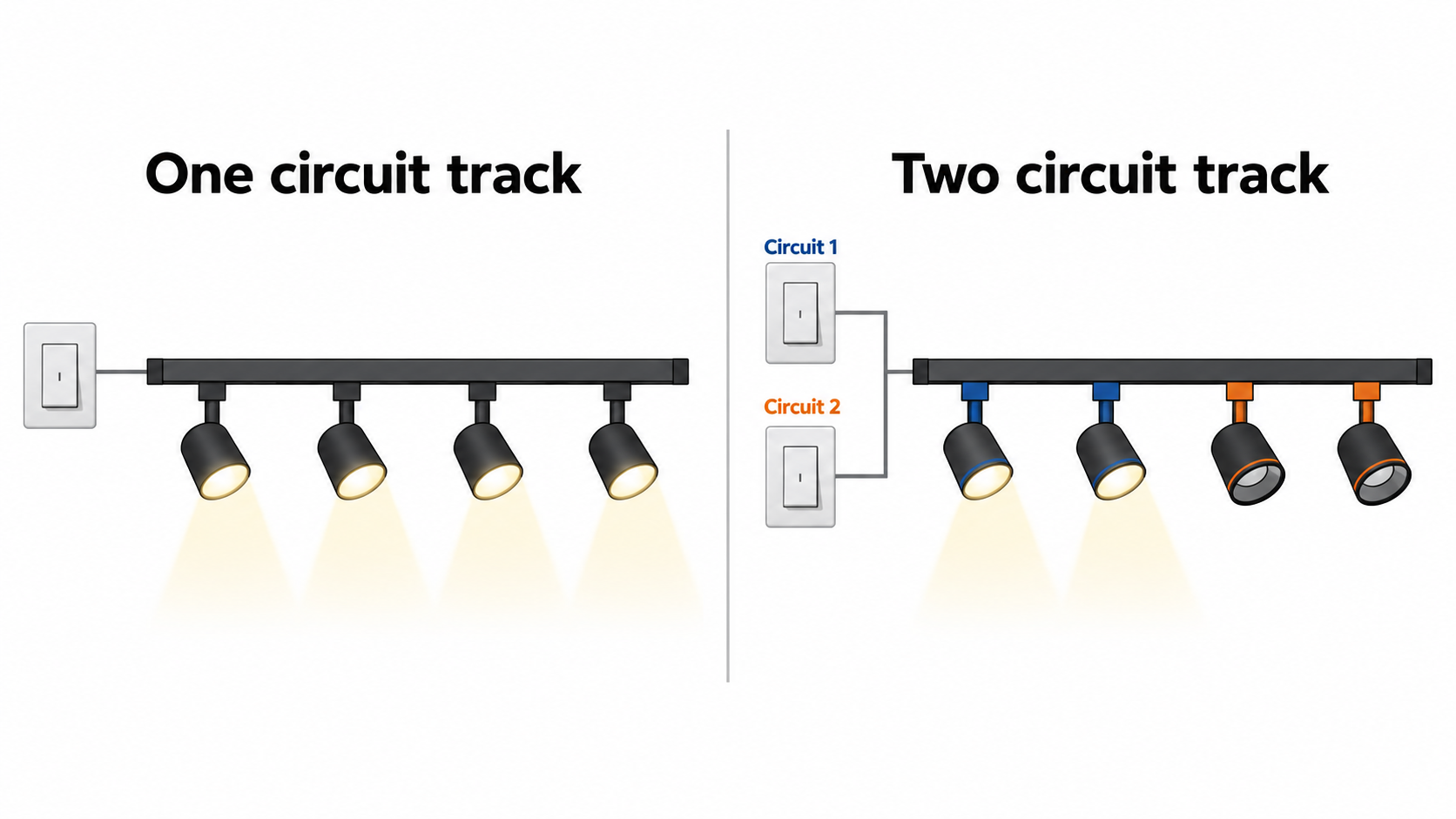
With one circuit track, every head on the run is controlled by the same switch or dimmer. Two circuit track carries two separate circuits on one rail, so you can split the heads into two groups and control them independently. That’s handy in retail, galleries, restaurants and larger homes where you want one group of accent lights on while another is off or dimmed.
Some heads work on both one and two circuit track and let the installer choose the circuit at the adapter. Green Creative’s Atom heads, for example, are rated for one or two circuit track. Others only work on one circuit track, so matching J to J, for example, doesn’t answer the whole question. Nora offers both one circuit and two circuit track if you’re building out a new system.
120V, 12V and 277V Track
Traditional H, J and L track used in homes and light commercial spaces is 120V line voltage. Almost every head in our track heads category is 120V, with a handful of 12V and 120V to 277V options for specialty and commercial systems.
A “low voltage track head” doesn’t necessarily mean the track itself is low voltage. Some low voltage heads have a transformer built into the adapter, so they plug into ordinary 120V track and step the power down for a 12V lamp. Commercial, architectural and magnetic track systems are a different story, so identify the exact family before ordering for one of those.
The simple rule: check the track’s input voltage and the head’s voltage separately. Don’t decide compatibility from the lamp voltage alone.
Feeds, Connectors and Pendant Adapters
The same compatibility rules apply when you extend or rebuild a run. Track sections, live end feeds, straight connectors, L connectors, T connectors, X connectors, flexible connectors and end caps are all part of one system. An H track connector won’t fit J track.
Orientation matters too. Because of the polarity groove, corner connectors are often sold in separate left hand and right hand versions. Sketch your layout and note which side the groove is on before you order parts for an L, T or X shaped run. Shop track sections and track components once you’ve identified the system you have.
Pendant adapters follow the same rule. An adapter that hangs a pendant from track has to be built for that track type, and the track, adapter and fixture all need to be rated for the weight. Don’t confuse an electrical pendant adapter, which powers the fixture, with a non electrical suspension or mounting accessory. Our mounting components cover the hardware side.
Does Track Type Affect Dimming?
Not directly. H, J and L describe the connection, not the dimming. Dimming depends on the head, the lamp or LED driver inside it, and the wall control.
An integrated LED head will list its dimming method, such as TRIAC or ELV. A lamp based head depends on the LED lamp you put in it. After you identify the track type, check the head’s voltage, whether it’s dimmable, its dimming method and the dimmer’s load rating. Two heads that both fit H track won’t necessarily behave the same on the same dimmer. Browse our dimmer selection once you know what the heads need.
Fixed Rail Lights Are Different
If your fixture is a complete bar with heads permanently attached, you probably have a fixed rail light instead of a modular H, J or L system. The heads are part of the fixture rather than separate pieces that lock into a standard track, so this guide’s replacement rules may not apply. We keep fixed track lights separate from track sections and heads for that reason.
Choosing a Track System for a New Install
Starting from scratch gives you more freedom, since there’s no existing rail to match. The real question isn’t just H vs J vs L track lighting. Look at the whole system:
- How many head styles, beam angles and lumen packages are available for it?
- Are matching feeds, connectors and pendant adapters easy to find?
- Do you need one circuit or two?
- What dimming method will the heads use?
- Will replacement heads still be easy to source in ten years?
On that last point, H track has the deepest selection by a wide margin, with J track second. For a new system, staying with one manufacturer’s track, feeds and connectors and choosing heads listed for that track is the simplest way to take the guesswork out.
Track Compatibility Checklist
Before you order a replacement head, pendant or connector for H vs J vs L track lighting, confirm:
- Track type: H, J or L, ideally confirmed by a label.
- Circuits: One circuit or two circuit, and whether the head works on yours.
- Voltage: The track’s input voltage and the head’s voltage.
- Orientation: Which side the polarity groove is on, especially for corner connectors.
- Adapter: The exact adapter listed in the part number or product title.
- Dimming: The head’s dimming method and a compatible dimmer.
- System: That the part is meant for your rail, not a fixed rail or proprietary system.
Track Lighting FAQs
What is the difference between H vs J vs L track lighting?
H vs J vs L track lighting refers to the three main North American track standards, named for Halo, Juno and Lightolier. H track uses a three contact adapter, J track uses two contacts about 1″ apart, and L track uses two contacts a little closer together. Heads and connectors have to match the system they’re built for.
Is H track the same as Halo track?
Yes, H type is the Halo style connection. Many other manufacturers make heads for it, so a head doesn’t need the Halo name to work. Look for “H track” or “Halo compatible” on the exact product.
Is J track the same as Juno track?
J type is the Juno style connection. Brands like Green Creative and WAC make heads with J type adapters, and many of them are available in our track heads category.
Is L track the same as Lightolier track?
L type is the Lightolier style connection. Manufacturers like Nora, WAC and Green Creative still make heads or components for L track.
Are track lighting heads universal?
No. Traditional track heads have to match the track they’re built for. Some heads are sold in separate H, J and L versions, but each version only fits one system.
Can I tell my track type just by looking at the rail?
Sometimes, but the adapter and labels are much better evidence. The three systems can look almost identical from below. Turn off the power, remove a head and check its contacts, its label and the rail’s polarity groove.
Can I put an H track head on J track with an adapter?
Don’t count on it. There’s no general converter between systems. A few manufacturers make specific adapters for specific heads, but those are product specific accessories, not proof that H and J are interchangeable. The reliable fix is to buy the head in the version that matches your track.
Can one track have two groups of lights?
Yes, if it’s a two circuit track and the heads are compatible with that arrangement. Each group can then be switched or dimmed on its own.
Shop Track Lighting at PROLIGHTING
Once you understand H vs J vs L track lighting, the easiest way to avoid a mistake is to identify the system before the fixture. Start with the rail and an existing adapter, figure out whether you have H, J or L track, then check the circuit, voltage and orientation. Once those match, you can focus on what actually changes the light in the room: lumens, beam angle, color temperature, CRI, dimming and style.
Browse all track lighting, track heads (filter by Halo, Juno or Lightolier compatibility), track sections, track components and Nora track lighting. Not sure what you have? Send us photos of your track and an existing head, and our lighting specialists will help you match the right parts.
Published October 2026



Comments are closed.