
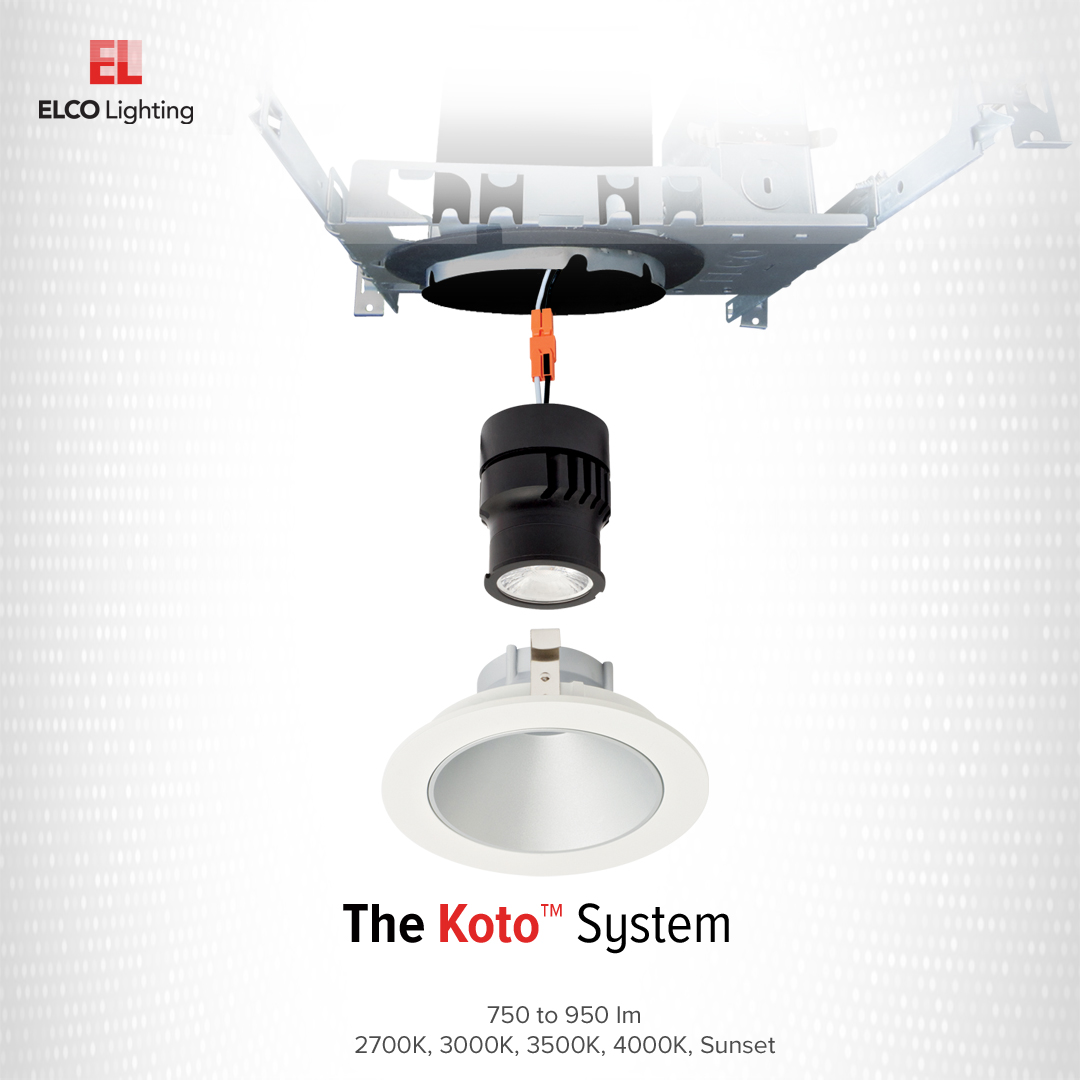
ELCO Koto recessed lighting works differently from the sealed canless downlights that fill most recessed lighting aisles. Instead of a separate fixture for every size, trim style and application, Koto is built as a system of LED modules, housings or canless frames, and twist on trims that all work together. One module can serve a 2″ trimless downlight in a hallway and a 4″ adjustable pinhole over a kitchen island.
That helps most on jobs where the design is still moving when the fixtures get ordered. PROLIGHTING now carries a broad selection of ELCO Lighting products, with a major focus on the Koto downlighting family. Once you understand how the pieces fit together, the catalog stops looking intimidating.
This guide covers what the Koto system is, how the individual series differ, how to select components in the right order, and how to verify compatibility before you order.
What Is the ELCO Koto System?
At the center of most ELCO Koto systems is the LED light engine, or module. That module goes into the appropriate housing, frame or power pack, and a compatible Koto trim finishes it off.
Think of the system as three decisions:
- Housing, frame or power pack: determines how the fixture is installed and supplies the electrical configuration. On some series this component also holds the driver and sets the fixture’s lumen output.
- Koto LED module: determines lumen output, color temperature, beam angle and, depending on the series, dimming behavior.
- Trim: determines the finished appearance in the ceiling, along with aperture size, shape, adjustability and optical treatment.
That modular structure is the biggest thing separating Koto from a conventional single piece recessed fixture.
You can browse the complete ELCO Koto LED Downlights collection at PROLIGHTING.
ELCO Koto Series at a Glance
The Koto lineup isn’t one downlight. ELCO has developed several versions of the system for different applications, and the fastest way to narrow things down is to compare them side by side.
| Series | Apertures | Max Output | Driver Location | Installation | Voltage & Dimming |
|---|---|---|---|---|---|
| Standard Koto | 2″, 3″, 4″, 5″, 6″ | Up to 1,400 lm | On module | Recessed housing | 120V; Triac/ELV |
| Canless Koto | 2″, 3″, 4″, 6″ | Up to 950 lm | On module | New construction frame or remodel power pack | 120V or 120/277V; Triac/ELV or 0-10V/Triac/ELV |
| Architectural Koto | 2″, 3″, 4″, 6″ | Set by housing (up to approx. 1,950 lm) | On housing | Recessed housing | 120V or 120/277V; Triac/ELV or 0-10V/Triac/ELV |
| Koto MAX | 2″, 3″, 4″, 6″ | Up to 3,500 lm | On frame | Frame or remodel/retrofit power pack | 120-277V; 0-10V/Triac/ELV to 1% |
| Tunable White Koto | Multiple sizes | Varies by configuration | Varies by configuration | Varies by configuration | Varies by configuration |
| Koto Mini | 1″ | Up to 1,000 lm | On module | Modular downlight | 120V; Triac/ELV to 1% |
Availability varies by series and configuration, so always confirm against the spec sheet for the exact catalog numbers you’re ordering.
Why Choose a Modular Recessed Lighting System?
The main advantage is flexibility. Instead of picking a completely different fixture every time the design changes, you choose compatible components around the installation and the finished appearance you want.
A project may call for a plain white downlight in one room and an adjustable or trimless design in another. Koto’s assortment of modules and trims covers different shapes, finishes and beam treatments while keeping the whole job on one lighting platform, so you also end up with one set of spare parts and one dimming strategy.
The second advantage is optical control, and this is where Koto separates itself from a basic general purpose downlight. The standard Koto module ships with a 38° lens installed and 25° and 60° lenses in the box, with optional 18° and 90° lenses available. Beyond beam angle, ELCO offers accessories you can change in the field, including a hex louver for glare control, linear and spread lenses, frosted and clear lenses, a snoot, and a color shifter.
Trims add another layer on top of that. You get reflector, baffle, pinhole, adjustable and wall wash treatments in round and square profiles.
One caveat. Not every Koto module, housing and trim can be combined. The series, aperture, driver, voltage and dimming method all need to be checked together before ordering. There’s a concrete example of what that looks like in step 5 below.
Which ELCO Koto Series Is Right for Your Project?
Standard Koto
Standard Koto downlights are the starting point for most residential and light commercial recessed lighting projects. The standard Koto LED module delivers 730 to 1,400 lumens at 10.5W to 12.5W, runs on 120V with Triac/ELV dimming, and works in 2″, 3″, 4″, 5″ and 6″ ELCO housings with Koto twist on trims.
Color temperature options span 2400K through 4000K, plus two specialty modules worth knowing about. The Sunset module dims from 3000K down to 1800K, and the Human Centric module starts at 4000K and dims to 2200K.
This is the series we’d look at first when a project needs a versatile modular downlight without the higher output or specialized controls of the architectural families.
Canless Koto
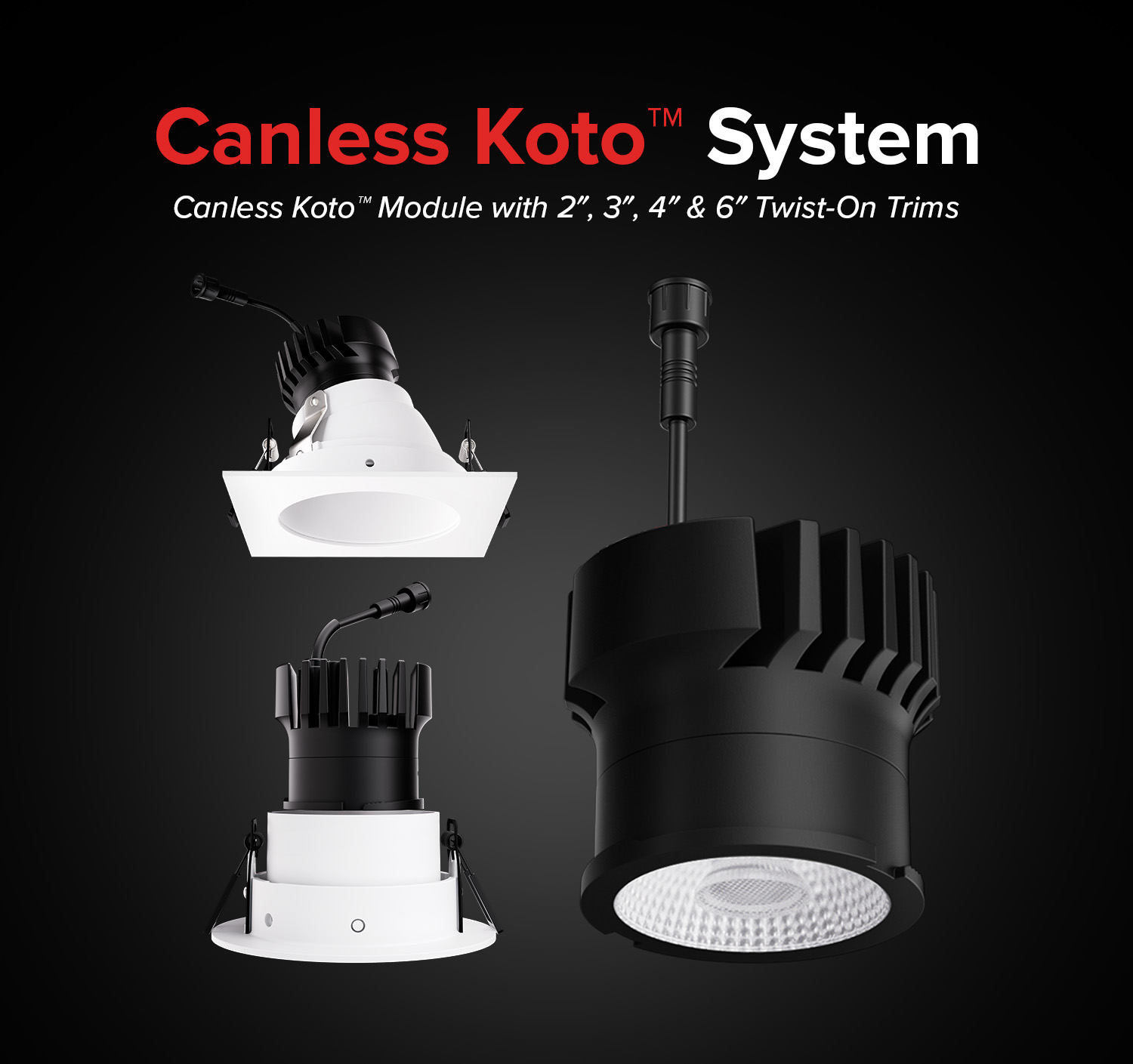
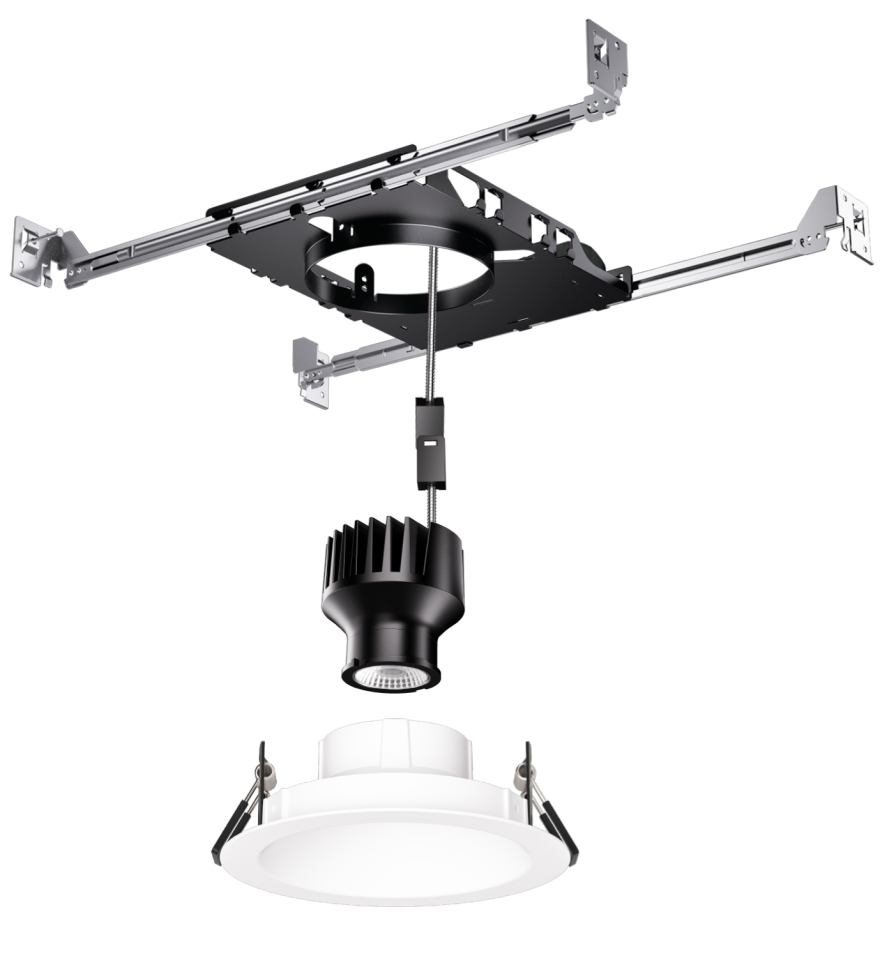
Canless Koto downlights are designed for installations that don’t use a traditional recessed housing. The module pairs with a compatible new construction frame or a remodel power pack, then finishes with a Koto twist on trim.
The Canless Koto module is IC rated and works with compatible 2″, 3″, 4″ and 6″ Koto trims. ELCO lists the 4″ Canless Koto at up to 950 lumens on 10.5W, with 120V or 120/277V configurations and Triac/ELV or 0-10V/Triac/ELV dimming depending on the driver.
That makes Canless Koto the practical choice for remodel work, shallow plenums, and any project where cutting in a conventional recessed can isn’t realistic.
Architectural Koto
Architectural Koto raises the available output and, importantly, moves the driver to the housing. That’s not just a packaging detail. Because the driver lives in the housing, the housing sets the fixture’s final lumen output, and it opens up dimming and emergency options the module can’t provide on its own.
ELCO’s architectural housings are IC rated and airtight, with a driver that pulls out easily and up to 35° of adjustability. They’re available in 120V (Triac/ELV) or 120/277V (0-10V/Triac/ELV), with optional emergency battery backup rated for 90 minutes and an optional Lutron Athena wireless node for networked control. Retail listings put the 2″ architectural module at over 1,950 lumens, but the housing you pair it with is what sets the actual number.
Two light engines serve this family. The standard architectural engine uses the same interchangeable lens system as the rest of Koto. Koto Focus works differently. It adjusts from 18° to 50° with a twist of the lens, so an installer can tune the beam on site without swapping optics at all. That helps on jobs where the furniture and artwork placement still isn’t settled when the housings go in.
All that output and control flexibility makes Architectural Koto the right call for upscale residential, hospitality, retail and light commercial work where lighting performance gets specified rather than estimated.
Koto MAX
For applications that need substantially more output from a small aperture, there is ELCO Koto MAX.
Koto MAX reaches up to 3,500 lumens at 32W, running on 120-277V with 0-10V/Triac/ELV dimming down to 1%. Beam angle options include 18°, 25°, 38°, 60° and 90°.
One thing to understand about Koto MAX is that it’s built like a canless system rather than a housing system. The module works with Koto MAX frames and remodel or retrofit power packs, and it uses Koto canless twist on trims in 2″, 3″, 4″ and 6″. ELCO engineered it to sit as shallow as possible, which is exactly why it suits commercial buildings with tight plenum space between floors.
ELCO positions Koto MAX for offices, conference rooms, lobbies, retail, medical and hospitality spaces. Anywhere the ceiling is high enough that a residential downlight won’t get light down to the floor.
Tunable White Koto
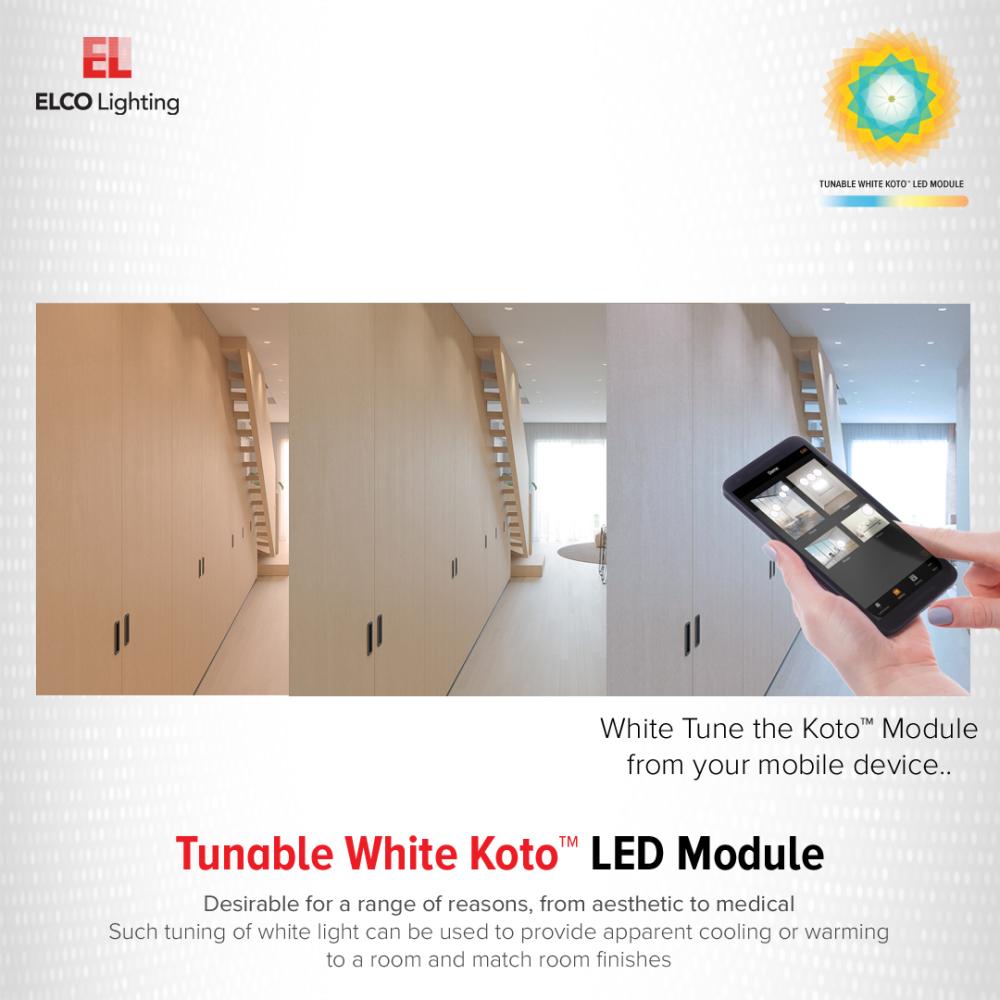
Color temperature doesn’t have to be fixed. Tunable White Koto provides adjustable white light output for projects where the lighting needs to change through the day or serve different uses of the same room.
Tunable White Koto systems are offered in multiple aperture sizes with several control options depending on the configuration.
ELCO also offers selected Sunset, or dim to warm, Koto products, which shift toward a warmer appearance as the fixture dims. The Sunset module travels from 3000K down to 1800K. That behavior mirrors incandescent dimming and works well in living spaces, restaurants and hospitality environments where one room has to handle both task and evening scenes.
Koto Mini
Koto Mini is the 1″ modular downlight in the family, delivering up to 1,000 lumens on 120V with Triac/ELV dimming to 1%. It’s offered in 2700K, 3000K and Sunset, with 25°, 38° and 60° beam angles.
At a 1″ aperture the fixture nearly disappears into the ceiling, which is why Koto Mini tends to show up in minimalist interiors, cove and perimeter detailing, and accent applications where even a 2″ downlight would still read as a light fixture.
Sloped Ceiling Koto
Vaulted and cathedral ceilings need a housing that aims the light straight down instead of angling it out into the room. Sloped ceiling Koto options handle that geometry while keeping the same module and trim ecosystem as the rest of the family.
If any part of the project has a pitched ceiling, sort this out at the housing stage. A trim selection can’t correct it later.
Koto Multiples
Koto configurations with multiple heads put two or more heads in a single housing, which gives you several independently aimed beams from one ceiling penetration.
These are useful for accent lighting along a wall, art and millwork lighting, and any situation where a row of individual downlights would clutter the ceiling.
What Are ELCO Koto Pex Trims?
If you’ve started looking through ELCO products, you’ll see the name Pex repeatedly.
Pex isn’t a separate LED light engine. It’s one of the major trim families used with compatible Koto systems, and it’s where most of the visible design decisions get made.
The Pex trim assortment includes round and square profiles, deep reflectors, pinholes, baffles, wall wash and adjustable designs across multiple finishes. PROLIGHTING’s ELCO assortment is particularly deep here, including square deep reflector, adjustable pinhole, adjustable wall wash and adjustable reflector configurations.
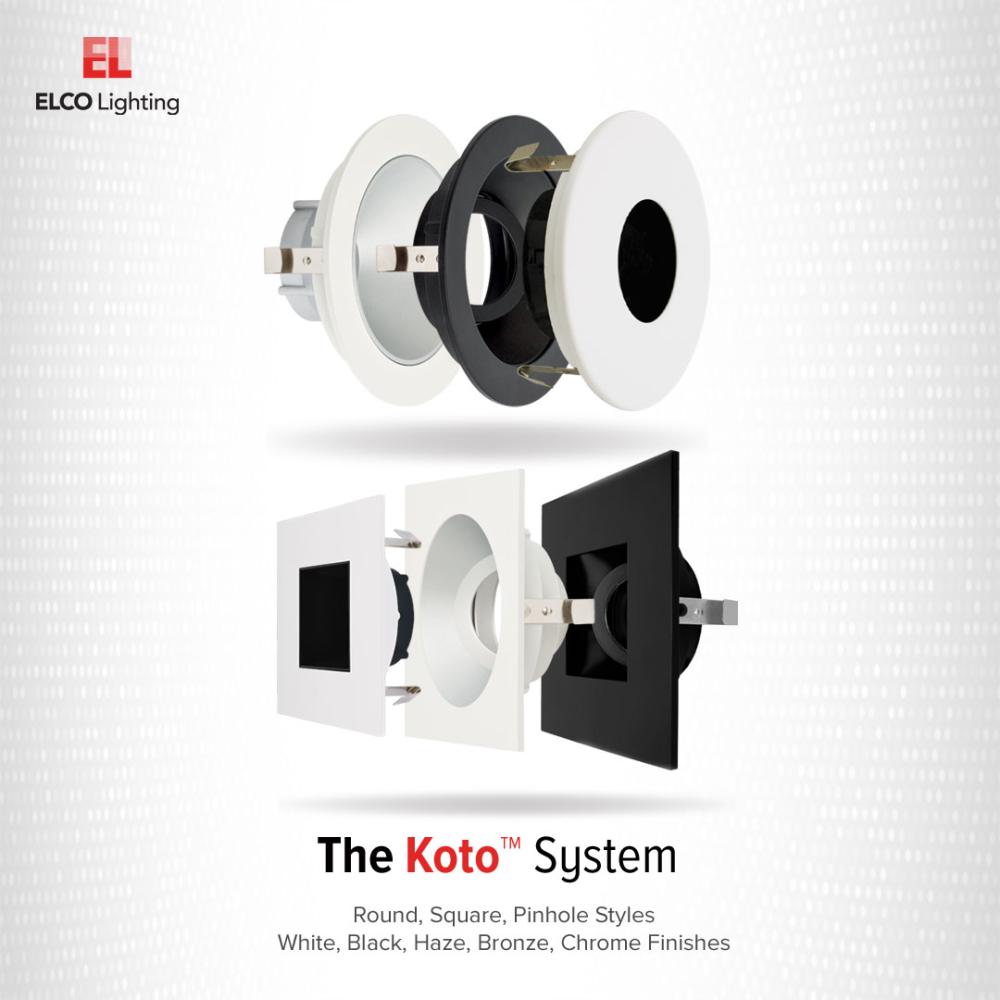
The module handles the light. The trim determines what the customer actually sees in the ceiling and how that light gets delivered into the room.
For minimalist interiors, trimless versions let the downlight blend into the ceiling plane. Adjustable and pinhole trims work when the lighting needs to be directional or tightly controlled. Traditional reflector and baffle styles remain the right answer for general recessed lighting, and baffles in particular help with glare in lower ceilings.
Light Quality, Efficiency and Code Compliance
Lumen output is the spec everyone checks first, but on a specification grade project it’s rarely the one that decides the order.
Color rendering. Koto modules across the family carry 95+ CRI. That’s meaningfully above the 80 to 90 CRI typical of budget canless downlights, and it’s the difference between paint, wood, stone and skin tones reading correctly or reading flat.
Code compliance. Koto modules are ENERGY STAR Certified and Title 24 JA8 compliant, though the JA8 vintage varies by product. Standard Koto modules are listed as JA8-2019 compliant and Koto MAX as JA8-2022-E compliant. If you’re specifying into California, confirm the vintage for the exact catalog number.
Lifespan and warranty. ELCO rates Koto modules at 50,000 hours L70 and backs them with a five year limited warranty.
Location ratings. Koto modules are UL listed for damp locations, and UL listed for wet locations when paired with wet rated trims. That trim dependency matters. A damp rated module in a shower or soffit needs the right trim to carry the wet listing.
How to Choose the Right ELCO Koto Downlight
Because Koto is modular, working through the decisions in the correct order makes the process much easier.
1. Start With the Installation
First determine whether the project is new construction, remodel or canless. Confirm whether the ceiling is flat or sloped, and whether the fixture needs an IC, airtight, damp location or wet location rating. Also check your ceiling thickness. ELCO’s architectural housings accommodate 5/8″ to 1 1/2″, while Koto MAX frames work with ceilings up to 1.25″.
If you’re still deciding on the overall fixture type, our complete recessed lighting selection is a good place to compare different recessed approaches.
2. Choose the Aperture and Light Output
A smaller aperture gives a more discreet architectural appearance, while larger apertures produce a more traditional recessed look.
Don’t choose on diameter alone. The Koto family spans from the 1″ Koto Mini at up to 1,000 lumens to Koto MAX at up to 3,500 lumens, and a 2″ aperture can be specified across most of that range. Work out the lumens the space actually needs, then pick the smallest aperture that delivers them.
3. Choose the Color Temperature and CRI
Warm temperatures such as 2700K suit relaxed residential spaces, while 3000K reads slightly cleaner. Higher color temperatures generally fit task oriented and commercial environments.
Check CRI alongside CCT. Koto modules deliver 95+ CRI across the family, which is worth specifying deliberately in kitchens, retail, galleries, medical spaces and anywhere finishes and materials need to look accurate.
For spaces that need flexibility, look at dim to warm or Tunable White Koto rather than locking the project into a single fixed CCT.
4. Choose the Trim and Optics
Once the functional requirements are set, choose the visible portion of the fixture: round or square, fixed or adjustable, reflector or baffle, standard or trimless, and then the finish.
Beam angle matters as much as trim style. A narrower beam emphasizes an object or architectural feature, while wider distributions suit general illumination. Remember that the standard Koto module includes 25°, 38° and 60° lenses in the box, so you have some room to adjust after installation without reordering.
5. Verify Compatibility Before Ordering
This is the step that causes returns.
Check the module, housing or frame, trim, voltage and dimming configuration together as a set. Here’s a concrete example of what that means. ELCO’s 4″ Koto Architectural Maximum Adjustability High Lumen housing must be paired with Koto Architectural LED light engines from the ELK21 or ELK24 series specifically. The 4″ Architectural Shallow housing accepts ELK19, ELK21 or ELK24. Same aperture, same product family, different compatible engines.
Don’t assume components from a different Koto series will work just because the nominal aperture matches, and definitely don’t assume it about another manufacturer’s parts.
ELCO provides system documentation for its Koto recessed lighting family, and PROLIGHTING can verify the components required for a complete system before you order.
Is ELCO Koto Better Than a Standard Canless Wafer Light?
They serve different needs.
A basic wafer light is the right answer when the priority is thin, simple and inexpensive general illumination. Someone replacing a few basement lights doesn’t need a modular platform.
Koto’s advantages show up on projects where lighting is being designed rather than just installed: modularity, 95+ CRI, interchangeable optics, deep trim selection, output up to 3,500 lumens, and specialized configurations for sloped ceilings, multiple head applications and tunable white. A typical wafer light gives you one aperture, one fixed trim, one beam angle and 80 to 90 CRI.
The maintenance story differs too. When a wafer light fails, the fixture gets replaced. Because Koto puts the driver on the module and makes the architectural housing driver easy to pull, components can be serviced or upgraded without taking the housing out of the ceiling. On a commercial job with a hundred fixtures, that adds up.
Calling Koto another wafer downlight undersells what it is. Think of it as a configurable platform you build the fixture from.
ELCO Koto Recessed Lighting FAQs
What is an ELCO Koto LED module?
The Koto LED module is the light engine at the center of a compatible ELCO Koto system. Depending on the series, it combines with a recessed housing, a canless frame or a power pack, plus a compatible twist on trim.
Are all ELCO Koto trims interchangeable?
No. Compatibility varies by Koto series, aperture, housing type, driver, voltage and other specifications. Some architectural housings accept only specific light engine series. Always verify the complete combination before ordering.
What is the difference between Standard Koto and Canless Koto?
Standard Koto uses compatible recessed housings. Canless Koto operates without a traditional recessed can, working instead with compatible new construction frames or remodel power packs.
What CRI are ELCO Koto downlights?
Koto modules carry 95+ CRI across the family, which is higher than the 80 to 90 CRI typical of standard canless downlights.
Are ELCO Koto downlights Title 24 compliant?
Yes. Koto modules are ENERGY STAR Certified and Title 24 JA8 compliant, though the JA8 vintage varies by product. Standard Koto modules are listed as JA8-2019 compliant and Koto MAX as JA8-2022-E compliant. Confirm the vintage for your specific catalog number when specifying into California.
Does ELCO Koto offer dim to warm lighting?
Yes. Selected Koto products use ELCO’s Sunset dim to warm technology, which shifts from 3000K down to 1800K as the fixture is dimmed. ELCO also offers a Human Centric module that runs from 4000K down to 2200K. Fixed CCT and Tunable White options are available depending on the series.
What sizes are ELCO Koto downlights available in?
The broader Koto family includes the 1″ Koto Mini along with 2″, 3″, 4″, 5″ and 6″ system options. Availability varies by series and configuration.
What warranty comes with ELCO Koto?
ELCO backs Koto products with a five year limited warranty, and rates the modules at 50,000 hours L70.
Where can I buy ELCO Lighting?
You can shop ELCO Lighting at PROLIGHTING, including Koto LED modules, housings, frames, trims and accessories. If you’re unsure which components you need, our lighting specialists can verify compatibility before you order.
Explore ELCO Koto at PROLIGHTING
The real advantage of ELCO Koto recessed lighting is that you configure the downlight around the project instead of the other way around. From straightforward residential installations to canless remodels, commercial applications that need real output, trimless designs and tunable white, the Koto platform covers a wide range within one product family and one set of compatible parts.
Explore our complete ELCO Koto LED Downlights collection or browse all ELCO Lighting products at PROLIGHTING. If you need help matching a module, housing and trim, contact our lighting specialists and we’ll put together the correct system.



Comments are closed.