

The Benefits of Dimming
Controlling light is one of the easiest ways you can enhance a room. With just a touch, you’re able to transform the ambiance in a family room, kitchen, bathroom or nursery, and create just the right light for any activity in essentially any area in your home. Installing dimmers is also one of the simplest eco-friendly home improvements you can make. Utilizing dimmers saves money on your energy bill and can help to extend the life of your bulbs and fixtures.
While lighting is a critical aspect of good interior design, many people overlook the lighting quality in their home and miss out on a key opportunity to save energy. Lighting accounts for almost 20% of an average home’s monthly electric bill. The average homeowner has light controls that consist of a simple on/off switch, rather than a dimmer. This means that no matter what time of day, fixtures are putting out the exact same amount of light. Through dimming, you can control the quantity of light your fixtures provide to fit specific tasks, moods, or situations. This not only improves the atmosphere of your surroundings, but also saves wasted energy in the process.

While lighting technologies have advanced and dimmers have changed to adapt, the process of selecting one doesn’t have to be intimidating. To ensure successful dimming, you’ll need to consider two factors: your light source, and the dimming mechanism to be used. With the correct pairing, you’ll be managing light in no time. If all else fails, always refer back to the manufacturer requirements and recommendations or contact our team of lighting specialists with questions.
Basic Dimmer Types
 Our Lutron dimmers come in a variety of styles and colors. Whether you want a subtle neutral or bold color, we have a dimmer for you. With Lutron dimmers, you can enjoy beautiful dimming with any bulb type, including LEDs.
It’s important to understand that not all dimmers share the same functionality. Each type of lighting source (load type) has individual characteristics, which require special types of dimmers. It is critical to use a dimmer that is designed, tested, and UL listed for your specific lighting source/load type.
- Standard/Rotery: This is original dimmer, invented by Joel Spira – pioneer of Lutron. Designed with incandescents in mind, standard dimmers work like a water spigot; turning raises or lowers the amount of light reaching the lamp and therefor the amount of light generated.
- CL: This is a specific type of dimmer designed for smoother usage of CFL and and LED bulbs.
- Magnetic Low-voltage (MLV): These dimmers are designed to be used with a magnetic driver. This feeds the power out in a way that the driver can read and respond to without damaging the driver hardware.
- Electronic Low-voltage (ELV): Like the MLV dimmer we just mentioned, the ELV dimmer is designed for use with an electronic driver. This is also the same driver required for most dimmable LED fixtures.
- 0-10V: This is a specific dimmer most commonly used in commercial lighting applications. This system requires extra wiring, and is best for projects that are being newly wired or can be easily rewired. For more information on 0-10v dimming for commercial fixtures, refer to our blog post.
- Integrated Dimmers: Some fixtures offer more complex light controls and are built with their own dimming systems. These fixtures will usually offer their own proprietary controls, often remote based.

At PROLIGHTING, our Lutron standalone dimmers come in two distinct styles: slider and digital. Simple slide dimmers use a slider to adjust the light level. Lutron slide dimmer families include Diva, Skylark, Ariadni, and Nova. Digital dimmers use a tapswitch to customize the light level. Maestro is the Lutron digital dimmer family. The newest Lutron dimmer, Sunnata, features a light bar that adjusts lights with a touch or swipe.
All of Lutron’s dimmer families include LED+ options. LED+ dimmers were designed specifically for controlling dimmable LEDs (they also work with incandescents and halogens). Currently, Lutron LED+ dimmers work with over 1,000 LEDs and have been tested for compatibility.
Effectively dimming LED bulbs can be challenging because performance varies between models. Like CFLs, LED bulbs can generally dim using a CL dimmer, but always make sure to check manufacturer requirements. With Lutron’s LED Compatibility Tool, you can easily find the best bulb/dimmer combination. Simply answer a few basic questions and the tool will generate a short list of compatible bulbs or CL dimmers. 
Lighting Sources
 Incandescent/Halogen: Forward phase-control. Line voltage, tungsten filament lamps, including line voltage (120V) halogen lamps. Incandescents are your classic screw-in bulb. While this is the most basic of light sources, it’s also among the least efficient. To help combat this, newer versions use halogen or xenon to improve the lifespan and boost efficiency. Standard rotary or basic slider dimmers do best for basic bulbs. Special requirements: Not for use on magnetic low-voltage (MLV) or electronic low-voltage (ELV).
 Magnetic Low Voltage (MLV): Symmetric forward phase-control. Magnetic (core and coil, toroidal) transformer-supplied low voltage lighting (6, 12 or 24V). MLV dimming uses an MLV dimmer to decrease voltage to the power supply. Improper pairing of dimmers, MLV transformers, drivers, and LED loads can lead to problems. Lutron has a helpful article for best practices here. Special requirements: Symmetric cycles, smooth turn off (positive and negative periods are equal for safe MLV transformer operation). Include transformer losses when calculating the load.
 Electronic Low Voltage (ELV): Reverse phase-control. Electronic (solid-state) transformer-supplied low-voltage lighting. Most ELV dimmers require a neutral wire for proper operation which helps the dimmer switch on and off properly, regardless of code characteristics. Improper pairing of dimmers, ELV transformers, drivers, and LED loads can lead to problems. Lutron has a helpful article for best practices here. Special requirements: Very smooth turn on. Neutral wire connection.
 Fluorescent: Electronic Fluorescent Dimming Ballast. Most often used in commercial and industrial spaces, using a 0-10V dimming system. These systems are touchier than others; they require a ballast that meters out the power to the lamp to ensure there is no buzzing or flickering. Special dimmers are designed and UL listed to send power and control signals to each type of electronic fluorescent dimming ballast.
 Light Emitting Diode (LED): Electronic LED Driver. Dimming LEDs depends on the module used. Like fluorescent, this process requires a metered and even power source – that’s why almost all LEDs have a driver on them. Special dimmers are designed to send power and control signals to each type of electronic LED driver. Be aware of manufacturer requirements and that some LEDs that can dim will cut out at the final 10% of output. While most integrated LEDs require an ELV driver, some do use the 0-10V system. Special requirements: LED light source must be properly matched to LED driver, and LED driver must meet control specifications for control type (i.e. IEC for 0-10V).
Heat Dissipation
During normal operation, dimmers get warm to the touch. Wallbox dimmer efficiency is typically  around 99%. The other 1% is dissipated in the dimmer as heat. So, a 600W dimmer would produce around 6W of heat (equivalent to the heat from a small night light). When properly installed per all national and local electrical codes, and when operating on its rated load in a 77° F ambient, Lutron dimmer accessible surfaces will stay below the UL limits of 140° F.
Ganging and Derating
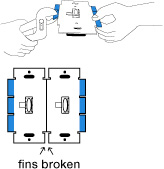 To help the dimmer dissipate the internal heat normal to operation, a typical dimmer is wider than a switch. Dimmers can be ganged together such that the space is the same as switches. A portion of the fins (heat sink) must be removed. The fins are grooved to make removal easy using a pair of pliers. Fin removal reduces the wattage capacity (load) the dimmer can control.
Magnetic Low Voltage Dimmer Ratings
The stated VA (voltage-ampere) rating is the capacity of the dimmer that includes the magnetic transformer heat losses and the lamp load. A Lutron MLV dimmer UL listed for 1,000 VA can be loaded with a full 1,000 VA lamp load. A transformer dissipates up to 20% of the connected load as heat. Better transformers dissipate less than 10% as heat. Added together, the lamp load and the transformer loss determine the dimmer capacity required.
Electronic Low Voltage Dimmer Ratings
Electronic low voltage transformers also dissipate some heat. These inefficiencies are small enough to be accounted for in the dimmer rating. A Lutron ELV dimmer UL listed for 600W can be loaded with a full 600W lamp load. If ganged with other dimmers, standard derating rules apply.
Total Light Control
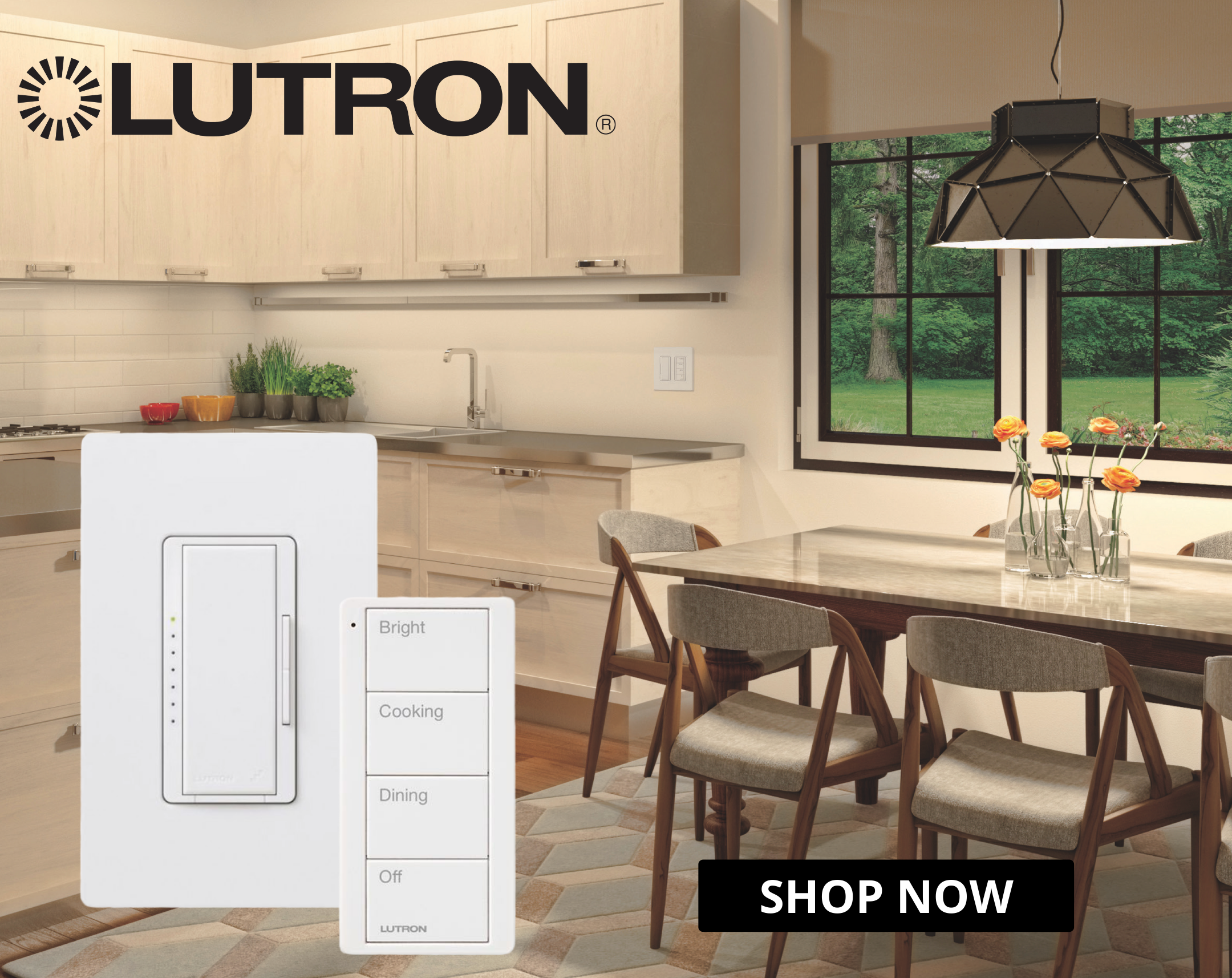
True light control reaches further than dimmers. Lutron light management systems and equipment can make lighting a vibrant and vital part of any space. Daylight sensors, for example, can automatically adjust overhead lights to maintain the perfect look throughout the day, while occupancy sensors can ensure that lights are never left on when a room is not in use.

More sophisticated systems like the RA2 Select and RadioRA 2 can store personalized settings for multiple lights, allowing you to completely tailor the lighting scheme in any room. Selecting a scene is as simple as pressing a single button. The system can also be programmed to transition between scenes at different times of the day.
Preset lighting can have other benefits aside from ambiance and energy savings. Lighting can be set to increase your space’s security and safety. More advanced systems like HomeWorks can work in conjunction with a security system to switch on all lights if an intruder enters a home, simultaneously warning the trespasser and ensuring that law enforcement will know exactly where they are needed.
Lutron solutions provide the right quantity and quality of light in your environment. With such precise and powerful control, you can completely craft the look and feel of any space, as well as its functionality and efficiency.

The Lutron Caseta system brings wireless control to any dimmer switch in your home through a central hub and smartphone app. Control lights from anywhere, set schedules, and integrate with voice assistants like Alexa, Google Home, and Apple HomeKit, all without special wiring. Start with one or two dimmer switches in main living areas and expand whenever you want. The system allows you to create lighting scenes for different activities like movie time or entertaining. You can add Pico remote controls for convenient physical access without requiring any additional wiring at the switch location.
Installation
Replacing a standard light switch with a single dimmer is a relatively easy DIY project. All you need is a screwdriver, and in about 15 minutes you’ll have the ability to customize the light in a room for any activity – and you’ll save energy and extend the life of your bulbs and fixtures.
Lutron’s Wiring Wizard tool can help you install a single pole, 3-way, or multi-location dimmer, switch or sensor. Just answer a few questions, and you’ll be provided with an installation video, wiring diagram, and step-by-step instructions tailored to the type of dimmer, switch or sensor you’re installing. You can get started here.
For larger projects, PROLIGHTING’s certified lighting specialists are also here to help you get started and answer any questions you may have. Our PROs can work with you on a layout or quote for you application, and recommend dimmers unique to your needs. You can email, give us a call, or use the live chat feature on our website during regular business hours (M-F, 8AM-5PM ET) for even faster support.


Comments are closed.