

The right illumination is one of the critical components of a room with a pleasant ambiance. LED flat panels are a strong addition to many spaces in a home or business, turning a basement, workstation or office into a quiet, comfortable place to be. If your indoor space feels flat or uninviting, a flat panel is often the fix.
The savings are substantial too. LED flat panels are far more efficient and last far longer than the incandescent fixtures they replace, which might give you a thousand hours of use. Our panels average 50,000 hours, so you’d be changing a conventional bulb 50 times over the same span.
They also use much less power for the same amount of light. A 40W LED panel produces roughly what a 200W incandescent does. Running 12 hours a day at average commercial electricity rates, that’s around $23 a year for the LED against roughly $114 for the incandescent. Multiply that across a ceiling grid full of fixtures and the payback arrives quickly.
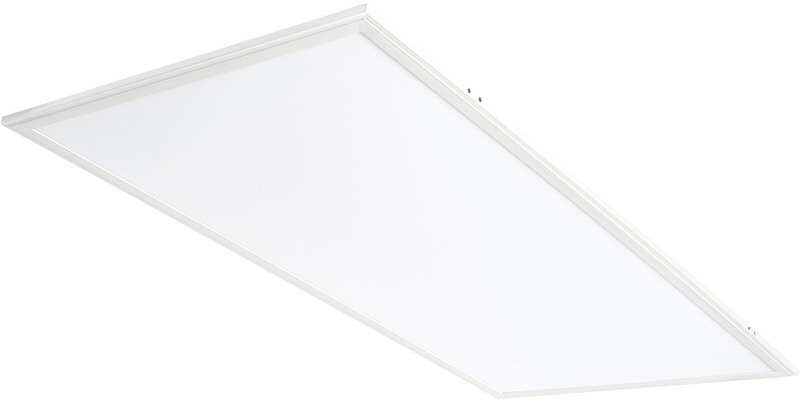
Edge-Lit vs Back-Lit LED Flat Panels
This is the first decision to make, and it’s the one most buying guides skip entirely.
Edge-lit panels place the LEDs around the perimeter of the frame and use a light guide plate to spread that light across the face. The result is an extremely thin fixture, often under half an inch, which is why edge-lit became the standard when panels first replaced fluorescent troffers.
Back-lit panels put the LEDs across the back of the panel, facing forward through a diffuser. The fixture is slightly thicker, but the light path is shorter and more direct, which generally means better efficacy, higher lumen output for the same wattage, and more even brightness across the face with fewer hot spots near the edges.
Back-lit has become the default on most commercial jobs for exactly those reasons, and it’s what we ship the most of. RAB‘s T34 back-lit panels and Keystone‘s back-lit line are both strong sellers in 2×2 and 2×4.
Edge-lit still wins where depth is genuinely tight, or where you want the thinnest possible profile in a surface mount application. Our EZPAN LED panels from RAB remain a solid edge-lit choice.
LED vs Fluorescent
Modern flat panels are a smarter and safer choice than fluorescent lighting.
Fluorescents contain mercury vapor, a hazardous material that poses a risk if a tube breaks, and it’s illegal for businesses to discard those bulbs in the trash when they expire. That’s a disposal cost and a liability most facilities would rather not carry.
Studies have also shown that more than 10% of Americans are sensitive to fluorescent light, which can flicker and cause eye strain and migraines. You won’t run into that with a quality LED panel.
Flat panels also install almost anywhere. They come in 2×2, 2×4 and 1×4 sizes that drop straight into a standard ceiling grid. Because they’re thin and light, they fit where there isn’t much room to maneuver above the T-bar, which makes them a much better proposition than a bulky fluorescent troffer. The back of the panel carries a compact electrical box housing the driver, so integration into new and existing installations is straightforward.
Selectable Wattage and Color Temperature
The biggest change in flat panels since this article was first written is that you no longer pick a wattage and a color temperature at the point of order.
Most panels we sell now ship with both selectable in the field. A single 2×4 might cover 30W, 40W and 50W, and 3500K, 4000K and 5000K, all set with a switch on the fixture during installation.
For a contractor, that’s fewer part numbers on the van and no reorder when a customer decides the light reads too cool. For a facility manager, it’s one replacement SKU covering several rooms instead of a shelf full of variants.
Warm white around 3000K suits residential spaces and anywhere you want a cozy feel. Neutral white at 3500K to 4000K is the workhorse for offices and commercial interiors. Cooler temperatures above 4000K suit work areas where people need to see fine detail. If you want to go deeper on this, read Choosing the Right Color Temperature.
How to Mount a Flat Panel
There are three ways to install a flat panel, and they get confused often.
Lay-in (grid) mounting is the most common. The panel drops directly into a standard 15/16″ or 9/16″ T-bar ceiling grid and rests on the rails. No hardware, no cutting, and it’s the reason 2×2 and 2×4 are the volume sizes.
Surface mounting is for hard ceilings such as drywall or concrete, where there’s no grid to drop into. It uses a separate frame kit that mounts to the ceiling with the panel fixed into it.
Pendant mounting hangs the panel below the ceiling on cable or stem, which suits high ceilings and spaces where you want the light closer to the work surface.

Surface and pendant mounting both need a kit, sold separately from the panel. Order it at the same time. It’s the single most common thing people forget and it holds up an install.
How Many Panels Do You Need?
A rough starting point by panel size:
- 2×2: typically 3,000 to 5,000 lumens
- 2×4: typically 4,000 to 6,500 lumens
- 1×4: typically 2,500 to 4,000 lumens
For a general office, aim for 30 to 50 foot candles. Multiply your square footage by that target to get total lumens needed, then divide by the output of the panel you’re considering.
A 500 square foot office at 40 foot candles needs roughly 20,000 lumens, which works out to four or five 2×4 panels depending on the lumen package. In a grid ceiling the layout usually sorts itself, since the grid spacing already distributes them evenly.
Two Things Worth Specifying
Dimming. Most quality panels include 0-10V dimming as standard. It costs nothing extra on the fixture and it’s what lets you add daylight harvesting or occupancy based dimming later without replacing anything.
DLC listing. If a utility rebate is part of the project, confirm the exact catalog number appears on the DesignLights Consortium list. Listings are assigned per SKU rather than per product family, and most programs want pre approval before the work starts.
Ask the PROs
We hope that sheds some light on why LED flat panels are such a strong choice for the spaces you live and work in. Alongside RAB we carry panels from Sylvania and Keystone across a range of sizes and output levels.
Not sure which size or lumen package fits your space? Reach out to our team and we’ll work through the layout with you before you order.
Updated September 2026


Comments are closed.