

LED lights are everywhere in today’s homes thanks to their efficiency, versatility, safety and low maintenance. The one complaint that comes up more than any other is LED flickering. Bulbs can flicker for a lot of reasons, and with LEDs the cause is harder to pin down than it was with incandescents. The number one culprit is a dimmer that isn’t compatible, but it’s not the only one.
Below is how to narrow it down, starting with the checks that take thirty seconds and working toward the ones that need a meter.
Start Here: Narrowing Down LED Flickering
Before you buy a new dimmer, run through this. It sorts most cases in a few minutes.
- Is it one fixture or several? One fixture points to that fixture, its lamp, or its socket. Several fixtures on the same switch points to the dimmer or the driver. Fixtures across different circuits point to something upstream, like a loose neutral or incoming voltage.
- Does it flicker with the dimmer at full brightness? If it’s smooth at 100% and flickers as you dim, the dimmer or the driver is mismatched. If it flickers at full output, look at wiring and connections first.
- Does it happen when an appliance kicks on? An air conditioner, well pump or dryer starting up pulls a big inrush current and briefly sags voltage across the panel. A quick dip when the compressor starts is normal. Constant flicker is not.
- Tighten the obvious things. Snug the lamp in the socket, and with the breaker off, check the wire connections at the fixture and the switch. A loose connection is the single most common cause that has nothing to do with dimming.
- Bypass the dimmer. Swap in a plain switch temporarily. If the flicker stops, you’ve found it.
120V Line Voltage Systems
Incompatible or low quality dimmer. Line voltage LED lighting usually shows little perceived flicker, and when it does, the dimmer is the first suspect. Line voltage runs on alternating current, and an incompatible dimmer won’t pass enough power at low output levels. That produces a rapid start and stop in the LED that reads as flicker.
The fix is pairing quality LED lamps with an approved dimmer, such as the tested LED+ dimmers from Lutron (formerly branded C·L dimmers). These give finer control across the dimming range and work with LED, incandescent or CFL. The Diva LED+ carries one of the broadest compatibility lists in the category.
Minimum load not met. This one catches people after an LED retrofit. A dimmer rated for 150W or 250W often has a minimum load in the 15W to 40W range. Replace five 60W incandescents with five 9W LEDs and you’ve dropped from 300W to 45W. Get down to one or two fixtures on that dimmer and you may fall below the minimum entirely, which causes flicker or a refusal to turn on at low levels. Check the dimmer’s minimum load against your actual connected wattage, not the old wattage.
Mixing load types. LED and incandescent on the same dimmer rarely behave well. The dimmer can only be tuned for one, so put them on separate controls.
Smart bulbs on a dimmer switch. Very common and easy to fix. A smart bulb has its own driver and expects full voltage. Put it on a dimmer and the two fight each other. Use a smart bulb on a standard switch, or a standard dimmable bulb on a smart dimmer. Never both.
*Rapid flickering (shimmer) may be noticeable up to around 80 Hz, the critical flicker fusion threshold. Above that most people can’t see it directly, though it can still cause headaches and eyestrain over prolonged periods, and stroboscopic effects remain perceptible at much higher frequencies.

12V Low Voltage Systems
Low voltage adds a second variable, because now there’s a transformer between the dimmer and the light.
Incompatible dimmers. A standard 120V incandescent or halogen dimmer will not work with low voltage lighting. Compatible types:
- Magnetic low voltage dimmers (MLV), which dim inductively
- Electronic low voltage dimmers (ELV), which dim capacitively
Match the dimmer to the transformer technology. An MLV dimmer belongs with a magnetic transformer, and an ELV dimmer belongs with an electronic transformer. Crossing them is a reliable way to produce flicker.
Incompatible transformers. Transformers built for low voltage incandescent systems often aren’t suited to LED loads, and the reason is minimum load. An incandescent era transformer may need up to 50% of its rated load before it passes power cleanly. Below that you’re in an unstable zone where flicker and inconsistent output are expected behavior, not a defect.
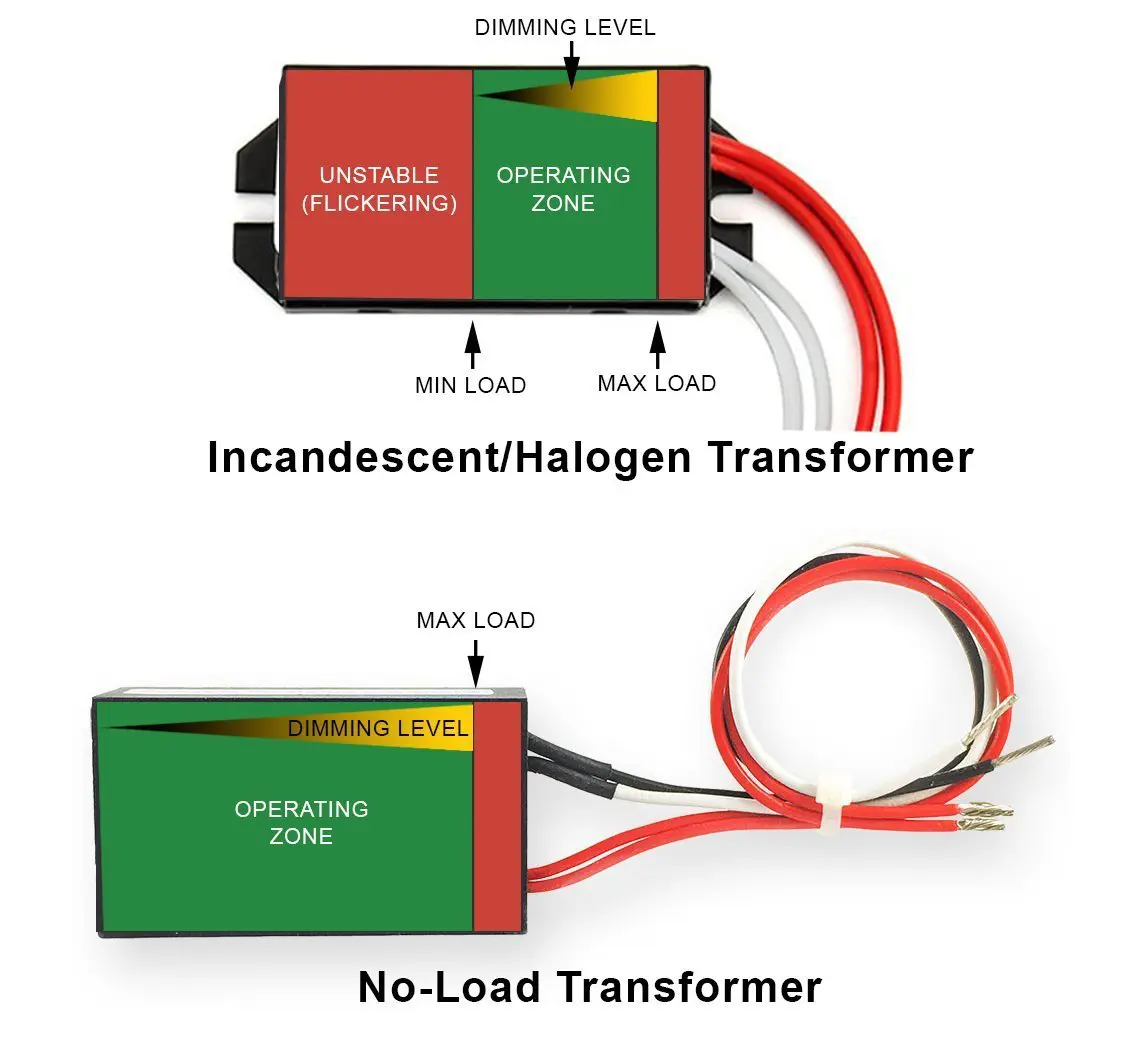
What that looks like in practice:
- Turning on: 20% to 30% output from the dimmer may be needed before the transformer loads enough to pass power to the light source.
- Turning off: the light may cut out abruptly with 20% to 30% of the dimmer’s range still remaining, because the transformer is no longer adequately loaded.
*These percentages are an example. Results vary by product.
The fix: a no load transformer. A proper no load or zero load transformer gives you a smooth dimming gradient with no unstable band. It will pass power with a minimum load under 0.5W, which means a single small LED fixture works fine on it.
The spec to look for isn’t the technology, it’s the minimum load rating. Both magnetic and electronic transformers are made in LED rated, low minimum load versions. What matters is that the transformer is rated for LED loads, that its minimum load sits below your actual connected wattage, and that your dimmer type matches the transformer type.
If you’re troubleshooting low voltage landscape lighting, add one more suspect: voltage drop. A long run can leave the last fixtures below their operating range, which looks like flicker but is a wiring problem.
Other Causes Worth Checking
- Loose or worn socket contacts. Lamps cycled thousands of times wear the contacts. Intermittent flicker in one fixture that a new lamp doesn’t fix usually means the socket.
- A failing driver. Integrated LED fixtures have a driver inside. When it degrades, flicker is often the first symptom, and the fixture or module needs replacing rather than the lamp.
- Loose or shared neutral. If lights flicker on multiple circuits at once, especially when a large load switches, get an electrician to check the neutral connections at the panel. This one is worth taking seriously rather than troubleshooting bulbs.
- Overloaded circuit. Too much on one branch circuit produces sag under load.
How Much LED Flickering Is Acceptable?
There’s a measurable answer, which is useful when you’re specifying rather than troubleshooting.
Flicker is described with a few metrics. Percent flicker measures the depth of modulation, flicker index accounts for waveform shape, and frequency determines whether it’s visible at all. IEEE 1789-2015 gives recommended practices rather than hard requirements, with limits that scale by frequency. At 100 Hz it suggests keeping percent flicker under about 8%; at 40 Hz, under about 1%.
California puts a floor under it. Title 24 requires low flicker operation, defined as less than 30% flicker at frequencies below 200 Hz, with JA10 as the measurement method and JA8 setting the limits. If you’re specifying into California, the JA8 listing already covers this.
For most residential work the practical version is simpler. Quality drivers run their PWM well above the visible range, often between 2 kHz and 20 kHz. Cheap drivers modulate near line frequency, which is where visible flicker and eyestrain live.
LED Flickering FAQs
Why do my LED lights flicker when dimmed but not at full brightness?
Almost always a mismatch between the dimmer and the driver, or a connected load below the dimmer’s minimum. Confirm the fixture appears on the dimmer’s compatibility list, then check your total connected wattage against the dimmer’s minimum load.
Can a dimmer switch cause LED flickering?
Yes, and it’s the most common cause. Standard incandescent dimmers cut the waveform in a way LED drivers don’t tolerate. An LED rated dimmer solves most cases.
Why do my LED lights flicker when the air conditioner turns on?
A large motor draws high inrush current at startup and briefly sags voltage. A momentary dip is normal. Persistent flicker afterward, or flicker across several circuits, points to a loose neutral or an undersized service and warrants an electrician.
Do I need a special transformer for 12V LED lights?
You need one rated for LED loads with a minimum load below your connected wattage. A no load transformer passes power with less than 0.5W connected, which is why it dims smoothly with just one or two small fixtures.
Is LED flickering harmful?
Visible flicker can cause headaches, eyestrain and fatigue with prolonged exposure. Flicker above the visible threshold can still produce stroboscopic effects and discomfort in some people, which is why IEEE 1789 and Title 24 set frequency dependent limits.
Can smart bulbs cause flickering?
Yes, if they’re on a dimmer switch. A smart bulb needs constant full voltage. Use it with a standard switch, or use a standard dimmable bulb with a smart dimmer.
For the best results with a low voltage LED system, pair a no load or LED rated transformer with the matching ELV or MLV dimmer. On line voltage, an LED rated dimmer from a published compatibility list solves most problems on the first try.
Still chasing it? PROLIGHTING‘s NAILD certified lighting specialists can help with troubleshooting, dimmer compatibility and product selection. Contact us today.
Updated September 2026




Comments are closed.