
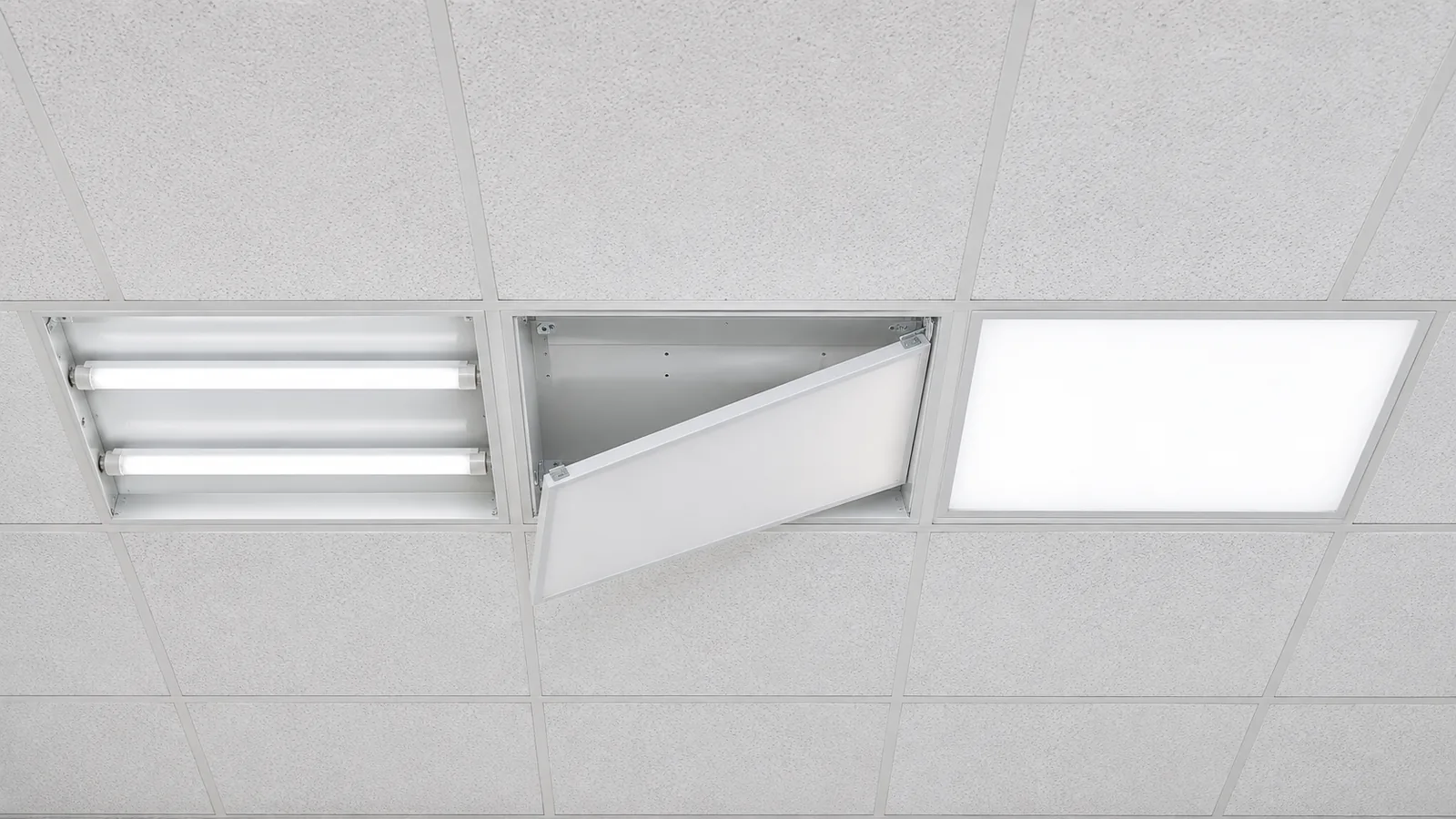
Fluorescent lighting rarely fails all at once. A ballast starts buzzing, a few tubes go dark, and before long someone is up a ladder every week. At that point the question isn’t whether to switch to LED. It’s which LED fluorescent replacement makes sense for the fixtures you already have.
There are three ways to go. You can swap the fluorescent lamps for LED tubes, keep the fixture housing and install an LED retrofit kit, or take the old fixture down and put up a new LED fixture. All three cut energy use and maintenance compared with running fluorescent. The real differences are how much of the old system you keep, how much labor the install takes, and how easy the lights will be to service a few years from now.
This guide walks through each option, untangles the Type A, Type B and Type C labels that trip up most buyers, and covers what to check before you order.
Why Fluorescent to LED Conversion Can’t Wait Much Longer
Fluorescent tubes are getting harder to buy. California, Colorado, Oregon, Rhode Island and Vermont have already ended the sale of most linear fluorescent tubes, and Hawaii, Maine and Minnesota joined them on January 1, 2026. Illinois follows on January 1, 2027, and Washington in 2029.
Even outside those states, fewer companies make fluorescent lamps and ballasts every year, so the parts that keep old fixtures running cost more and take longer to find. If your building still runs on fluorescent, every failed ballast is a good moment to plan the switch instead of buying another ballast.
Fluorescent vs LED Tubes: What Changes When You Switch
| Fluorescent tubes | LED tubes | |
|---|---|---|
| Power | 32 watts per 4 foot F32T8 lamp, plus what the ballast uses | About 10 to 18 watts per 4 foot tube |
| Rated life | Typically about 24,000 to 36,000 hours | Commonly 50,000 hours |
| Cold spaces | Slow to start and dimmer in the cold | Full brightness right away |
| Light direction | Shines in every direction, so some light is lost inside the fixture | Aims the light down where you need it |
| Mercury | Contains mercury and should be recycled | None |
| End of life | Flickers, buzzes and darkens at the ends | Light output depreciates over time; drivers or electronics can also fail |
RAB rates its ballast bypass T8 tubes at about 40 percent more efficient than standard fluorescent T8 lamps, and Keystone rates its DirectDrive tubes at up to 50 percent savings compared with an F32T8. Add fewer trips up the ladder and no more ballast replacements, and most LED fluorescent replacement projects pay for themselves long before the tubes wear out.
LED Fluorescent Replacement Options at a Glance
| Option | Best for | Upfront cost | Install work | Keeps the old fixture? |
|---|---|---|---|---|
| LED tubes | Fixtures in good shape that mainly need new lamps | $ | Easy (Type A) to moderate (Type B) | Yes |
| LED retrofit kit | Good housings with tired lenses, optics or ballasts | $$ | Moderate | The housing only |
| New LED fixture | Damaged fixtures, remodels and jobs that need new controls | $$$ | Moderate to extensive | No |
Tubes are by far the most popular way our customers convert fluorescent fixtures, but they aren’t always the best value once labor and future maintenance are counted. Here’s how each option works.
Option 1: Replace Fluorescent Tubes With LED Tubes
For most buildings, LED tubes are the fastest and least expensive LED fluorescent replacement. You keep the fixture, the lens and the reflector, and change the lamps (and sometimes the wiring). T8 LED tubes, most often the 4 foot size, are the biggest part of this category, and they replace most T8 and many T12 lamps. T5 and T5HO versions cover the slimmer lamps used in high bays and some office fixtures, and U shaped T8 tubes fit the 2×2 troffers that used bent lamps.
Tubes make the most sense when:
- The housing, sockets and wiring are in good condition.
- The existing light distribution works for the space.
- You want the lowest product cost.
- The building has a large number of identical fixtures.
- You’d rather swap a tube than a driver when something fails later.
Before you choose a tube, though, you need to know how it gets power. That’s exactly what the Type A, Type B and Type C labels describe.
Shop T8 LED Tubes or browse Keystone T5 LED tubes.
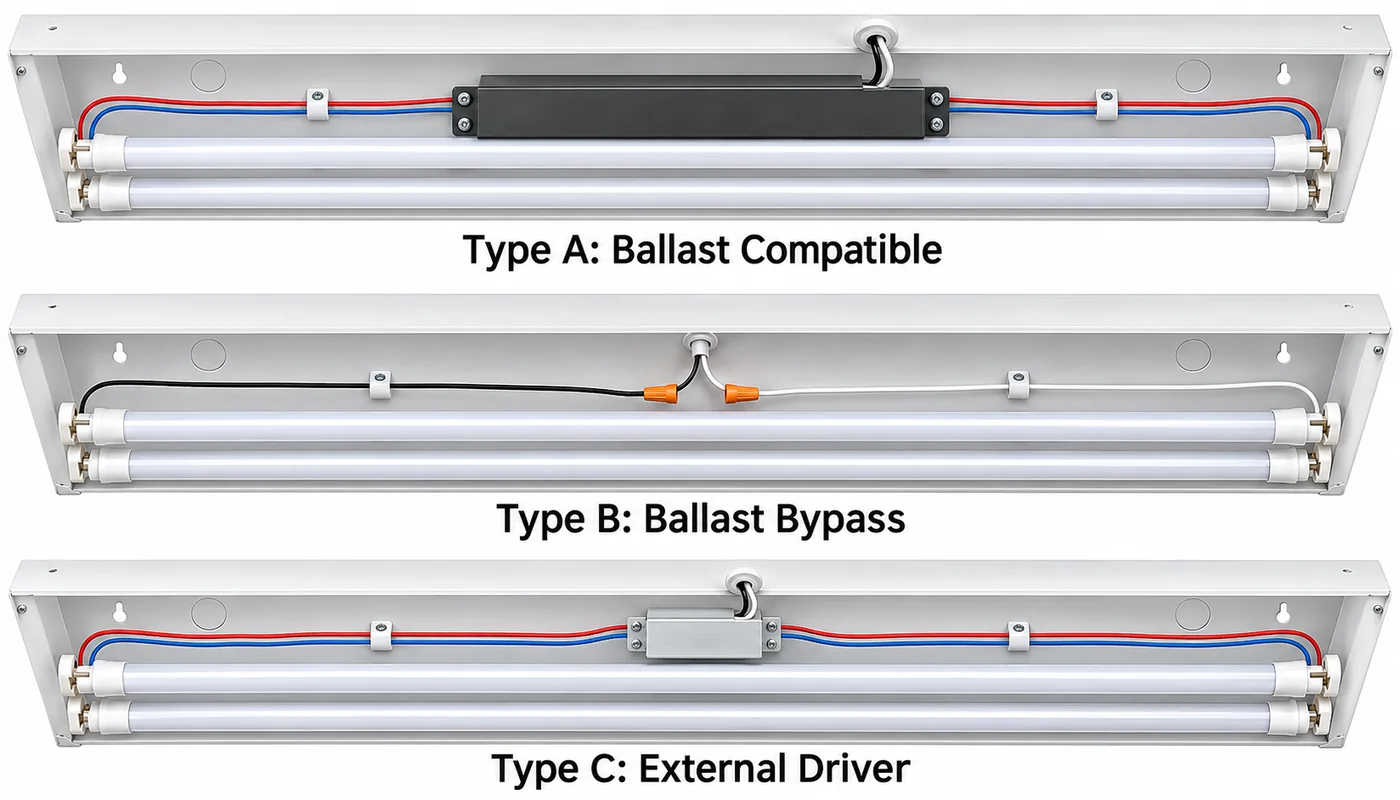
Type A vs Type B vs Type C LED Tubes
| Type | How it gets power | Ballast | Install | Watch out for |
|---|---|---|---|---|
| Type A (ballast compatible) | The existing fluorescent ballast | Stays | Swap the lamp | Ballast compatibility, and the tube goes dark when the ballast fails |
| Type B (ballast bypass) | Line voltage wired straight to the sockets | Removed | Rewire the fixture | Single or double ended wiring and socket type |
| Type A+B (hybrid) | Either one | Stays now, removed later | Swap now, rewire later | Which ballasts it supports |
| Type C (external driver) | A separate LED driver in the fixture | Replaced by a driver | Install the driver and tubes | Tubes and driver have to be a matched set |
Type A: Ballast Compatible LED Tubes
A Type A tube, often called plug and play, runs on the fluorescent ballast already in the fixture. On a compatible fixture you pull the old lamp and put in the new one. There’s no rewiring, which is why Type A is popular in big buildings with hundreds of fixtures.
The catch is the ballast. A Type A tube only works with the ballasts its manufacturer has tested, so check the tube’s ballast compatibility list against the label on the ballast before you buy. Most work best with electronic instant start ballasts, and older magnetic ballasts, common in T12 fixtures, generally won’t work at all. The ballast also keeps using some power, and when it eventually fails, the LED tube goes dark with it.
Choose Type A when: the ballasts are fairly new, confirmed compatible, and you want the fastest swap possible.
Shop Ballast Compatible (Type A) T8 Tubes
Type B: Ballast Bypass LED Tubes
A Type B tube, also called a ballast bypass or direct wire tube, runs directly on line voltage. The ballast is removed or bypassed, and the sockets are wired straight to power. With no ballast left in the fixture, there’s one less part to fail, no compatibility list to check and no ballast losses on the electric bill.
The tradeoff is labor. Every fixture has to be opened and rewired following the tube manufacturer’s instructions, and in a commercial building that’s a job for a qualified electrician. Type B tubes usually come with a label for the fixture showing it has been converted, so nobody puts a fluorescent lamp back in later.
Ballast bypass tubes are the most popular T8 tubes we ship, led by Keystone’s DirectDrive DX2 line, which can be wired single or double ended.
Choose Type B when: the ballasts are old or failing, an electrician is already on the job, or long term maintenance matters more than install speed.
Shop single end wired or opposing end wired ballast bypass T8 tubes.
Type A+B: Hybrid LED Tubes
Hybrid tubes work both ways. Install them on a compatible ballast today, and when that ballast eventually fails, rewire the fixture for line voltage and keep the same tube. That’s handy in buildings where you can’t check every ballast before you order. Keystone ComboDrive, RAB’s HYB tubes and the Type A+B tubes from Westgate and Light Efficient Design all work this way.
Type C: LED Tubes With an External Driver
Type C tubes run on a separate LED driver that’s mounted in the fixture in place of the ballast. It’s the most involved tube option and you’ll see it far less often, but a matched tube and driver set can be very efficient and is the tube option most likely to dim. Most Type A and Type B tubes aren’t dimmable, so if the project needs 0-10V dimming, look at Type C, a retrofit kit or a new fixture.
Keystone uses its own names for these types: SmartDrive is Type A, DirectDrive is Type B and ComboDrive is Type A+B. Our Keystone LED lighting guide decodes the part numbers, and you can shop the full lineup of Keystone T8 LED lamps.
Single Ended vs Double Ended Wiring (and Why the Sockets Matter)
If you go with a ballast bypass tube, its wiring diagram will say single ended, double ended or both.
- Single ended: Line and neutral both connect to the pins at one end of the tube. The other end just holds the tube in place.
- Double ended (also called opposing end): Line goes to one end of the tube and neutral goes to the other.
This matters because of the sockets, often called tombstones. Many fluorescent fixtures with instant start ballasts use shunted sockets, which connect the two contacts inside the socket. A single ended tube needs non shunted sockets at its powered end, because a shunted socket ties line and neutral together and causes a short.
Some tubes take that worry off the table. Keystone’s DX2 tubes, for example, work with both shunted and non shunted sockets. Otherwise, check what’s in the fixture and swap in replacement T8 and T12 sockets where the instructions call for them.
Don’t assume a tube and a fixture are a match just because the tube fits. Match the exact part number to the wiring diagram on its spec sheet, and stick with one wiring method across the building so the next person who services it isn’t surprised.
How to Convert a Fluorescent Light to LED
The steps for an LED fluorescent replacement depend on which tube you choose. Either way, read the instructions that come with the tube first, because they include the wiring diagram for that exact part number.
Converting to Type A Tubes (No Rewiring)
- Turn the light off and give the old lamps a minute to cool.
- Check the ballast label and confirm the ballast is on the tube’s compatibility list.
- Remove the lens or cover. Rotate each fluorescent tube a quarter turn and lower it out of the sockets.
- Install the LED tubes the same way, replace the cover and turn the power back on.
If a new tube flickers or won’t light, the ballast is probably failing or not compatible. That’s usually the point where a ballast bypass conversion makes more sense.
Converting to Type B Tubes (Ballast Bypass)
A ballast bypass conversion means working with line voltage, so in a commercial building it’s a job for a qualified electrician. Here’s what it involves:
- Turn off the circuit breaker, then confirm the fixture is dead with a voltage tester.
- Remove the lens and the fluorescent tubes, then take off the wireway cover to reach the ballast.
- Disconnect the incoming line (usually black) and neutral (usually white) wires from the ballast, cut the ballast wires that run to the sockets, and remove the ballast.
- Check the sockets. A single ended tube needs non shunted sockets at its powered end, so replace any shunted ones there.
- Wire line and neutral to the sockets exactly as the tube’s diagram shows: both at one end for single ended tubes, or one at each end for double ended tubes.
- Put the conversion label from the tube’s box on the fixture, replace the wireway cover, install the tubes and restore power.
The steps are the same for 2 lamp and 4 lamp fixtures. Each tube needs its own line and neutral connection, so the sockets are wired in parallel.
Old fluorescent tubes contain mercury, so recycle them instead of throwing them in the trash. Many states require it.
T12, 8 Foot and Odd Length Fluorescent Replacement
Older buildings still have T12 lamps, and that’s where LED fluorescent replacement gets tricky. Most T12 lamps were phased out by federal efficiency rules more than a decade ago, so these fixtures tend to be old, and many still run magnetic ballasts that Type A tubes can’t use.
Start with the code printed on the old lamp. It tells you most of what you need:
- T8 or T12 is the diameter in eighths of an inch, so a T8 is 1″ across and a T12 is 1 1/2″.
- The number after the F is the wattage on standard lamps (an F32T8 is a 32 watt, 4 foot lamp) but the length in inches on slimline and high output lamps (an F96T12 is 96″ long).
- HO means high output, and letters like CW or D give the color.
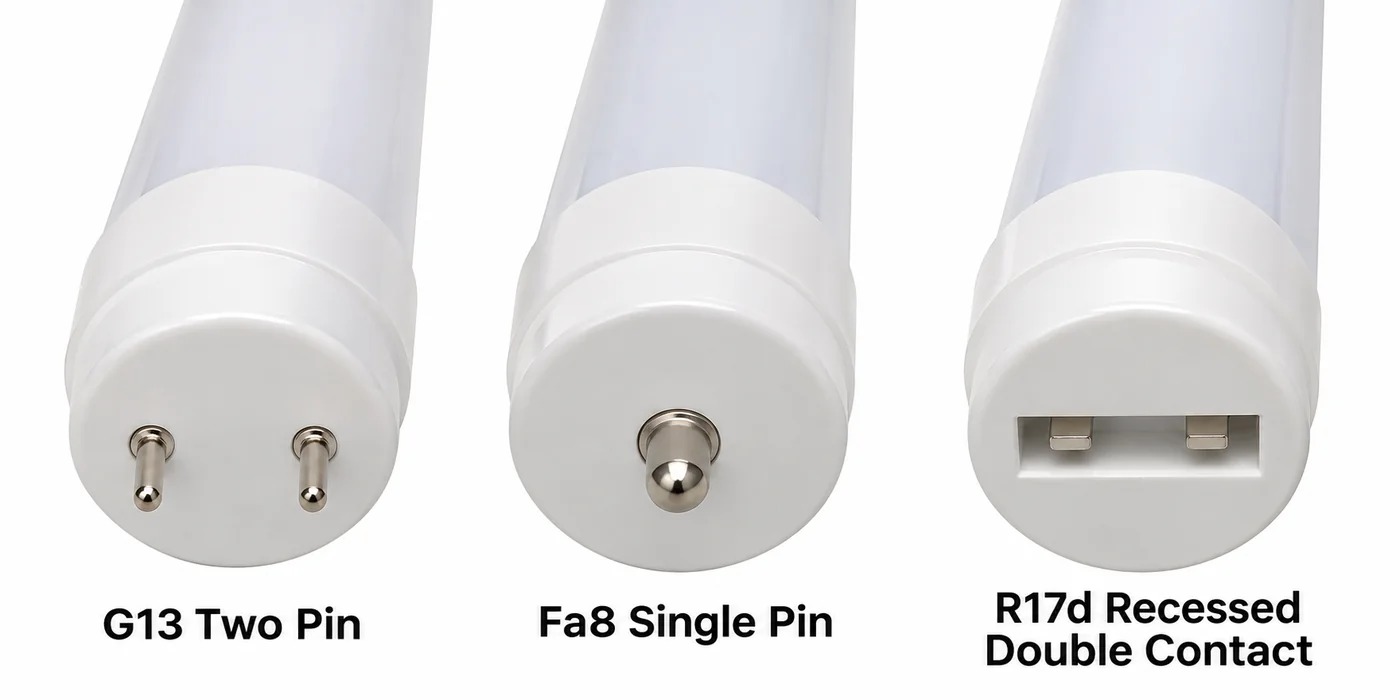
The base matters as much as the length. Standard 4 foot T8 and T12 lamps use a G13 base with two pins on each end. Eight foot slimline lamps like the F96T12 use an Fa8 single pin base, and high output lamps like the F96T12/HO use an R17d recessed double contact base.
There are LED options for all three. Keystone, RAB and Westgate all make 8 foot LED tubes with Fa8 single pin bases, RAB makes R17d versions for HO fixtures, and RAB’s field adjustable 8 foot tube even comes with interchangeable bases. Most 8 foot LED tubes are ballast bypass, so plan on rewiring. If the whole 8 foot strip fixture is worn out, an LED strip retrofit kit or a new 8 foot LED strip is often a better buy than rewiring it for tubes.
Replacing T12 HO Sign Lamps
Searches like “F72T12 CW HO LED replacement” or “F84T12 LED replacement” usually come from someone relamping a lighted sign cabinet. Those odd lengths are classic sign lamps, in high output versions with recessed double contact bases and slimline versions with single pin bases, so check the base before ordering. For signs, skip standard T8 tubes and look at LED sign tubes, which are built to light a sign face evenly in single or double sided versions. Keystone Sign Hero is our most popular line, in lengths like 36″, 48″, 72″ and 84″, and Sylvania makes 360 degree LED sign lamps as well.
Option 2: Retrofit the Existing Fixture With an LED Kit
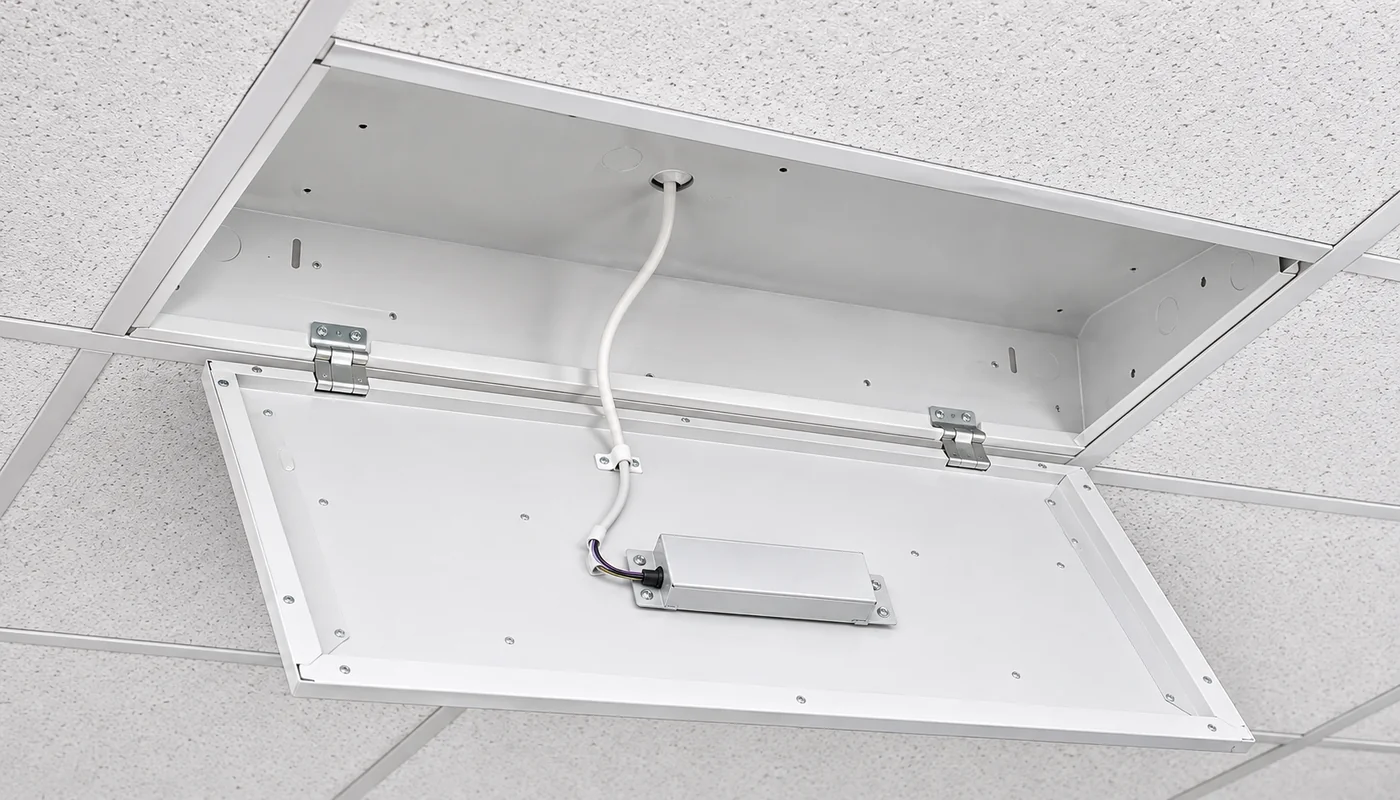
Sometimes new tubes aren’t enough, but tearing out every fixture is more than the job needs. An LED retrofit kit keeps the fixture housing in the ceiling and replaces what’s inside: the lamps, sockets and ballast, and often the lens or door too.
Troffer kits come in two main styles:
- Door style kits replace the old lens and door with a complete LED assembly that mounts into the existing housing. Keystone’s FutureFit doorframe and center basket kits and Sylvania’s troffer retrofit door kits work this way.
- Light bar kits mount LED bars inside the housing and keep the original door and lens. RAB’s field adjustable retrofit light bars are a good example.
We carry troffer kits from Keystone, RAB, Sylvania and Litetronics in 1×4, 2×2 and 2×4 sizes, plus less common 1×2, 1×3 and 2×3 options. Most of them offer selectable wattage and color temperature, and most are 0-10V dimmable.
A kit is worth a look when:
- The recessed housing is structurally sound.
- Pulling the fixture would damage the ceiling or mean working in the plenum.
- You want the lamps and ballasts gone for good.
- The lens or reflector is yellowed or dated.
- You want better light distribution or a cleaner look.
- The upgrade includes dimming or other controls.
One caution: a 2×4 ceiling opening doesn’t guarantee every 2×4 kit fits every 2×4 troffer. Compare the kit’s dimensions with the inside of the existing housing and confirm how it mounts before you order a full job’s worth.
Shop Troffer LED Retrofit Kits or see the Keystone FutureFit kits. Kits for strip fixtures, wraparounds and other linear fixtures are in our LED Retrofit department.
LED Tubes vs Retrofit Kits
If the housing is worth keeping, the decision usually comes down to tubes or a kit.
| Consideration | LED tubes | Retrofit kit |
|---|---|---|
| Product cost | Usually lower | Higher |
| Install speed | Type A is fastest | Moderate |
| Removes the ballast | Type B and Type C only | Yes |
| Updates the look and optics | Very little | Yes |
| Future service | Swap a tube | Replace a driver or LED module |
| 0-10V dimming | Rare (mostly Type C) | Common |
| Selectable wattage and color | Common | Very common |
| Best for yellowed lenses or reflectors | Not ideal | Yes |
If the fixtures are in good shape and you mainly need an affordable lamp change, tubes are hard to beat. If the fixtures look dated, the ballasts are failing or the light needs to be better, a kit gives you a more complete upgrade without pulling the housing.
Option 3: Replace the Fluorescent Fixture With a New LED Fixture
The third option is to take the fluorescent fixture down and install a new LED fixture. In a drop ceiling that usually means an LED flat panel or troffer. In warehouses, garages and back rooms it usually means an LED strip or wraparound.
A new fixture is the better choice when:
- Housings are damaged, rusted or falling apart.
- The sockets or wiring are in poor condition.
- The space is being remodeled anyway.
- You want a different look or better glare control.
- The project needs built in sensors or other controls.
- Rebuilding the old fixtures would cost close to what new ones cost.
Our most popular flat panels include Keystone’s backlit panels, RAB’s T34 backlit panels and EZPAN edge lit panels, and Sylvania LEDVANCE panels, in 1×4, 2×2 and 2×4 sizes. Most let you choose the wattage on site, so one part number can cover several rooms. If you’re new to panels, our introduction to LED flat panels covers the basics.
There’s also a middle ground: LED ready T8 fixtures. These are new strip lights, high bays and vapor tights that come prewired for ballast bypass tubes, with the tubes sold separately. You get a new fixture body and the easy tube service a lot of maintenance teams prefer.
Emergency backup doesn’t always mean a new fixture either. Emergency LED tubes, like the UL 924 listed Keystone DirectDrive emergency tube, have the battery built right into the tube.
Shop LED Flat Panels and Troffers or go straight to RAB EZPAN flat panels and Keystone backlit panels.
Which LED Fluorescent Replacement Is Right for Your Project?
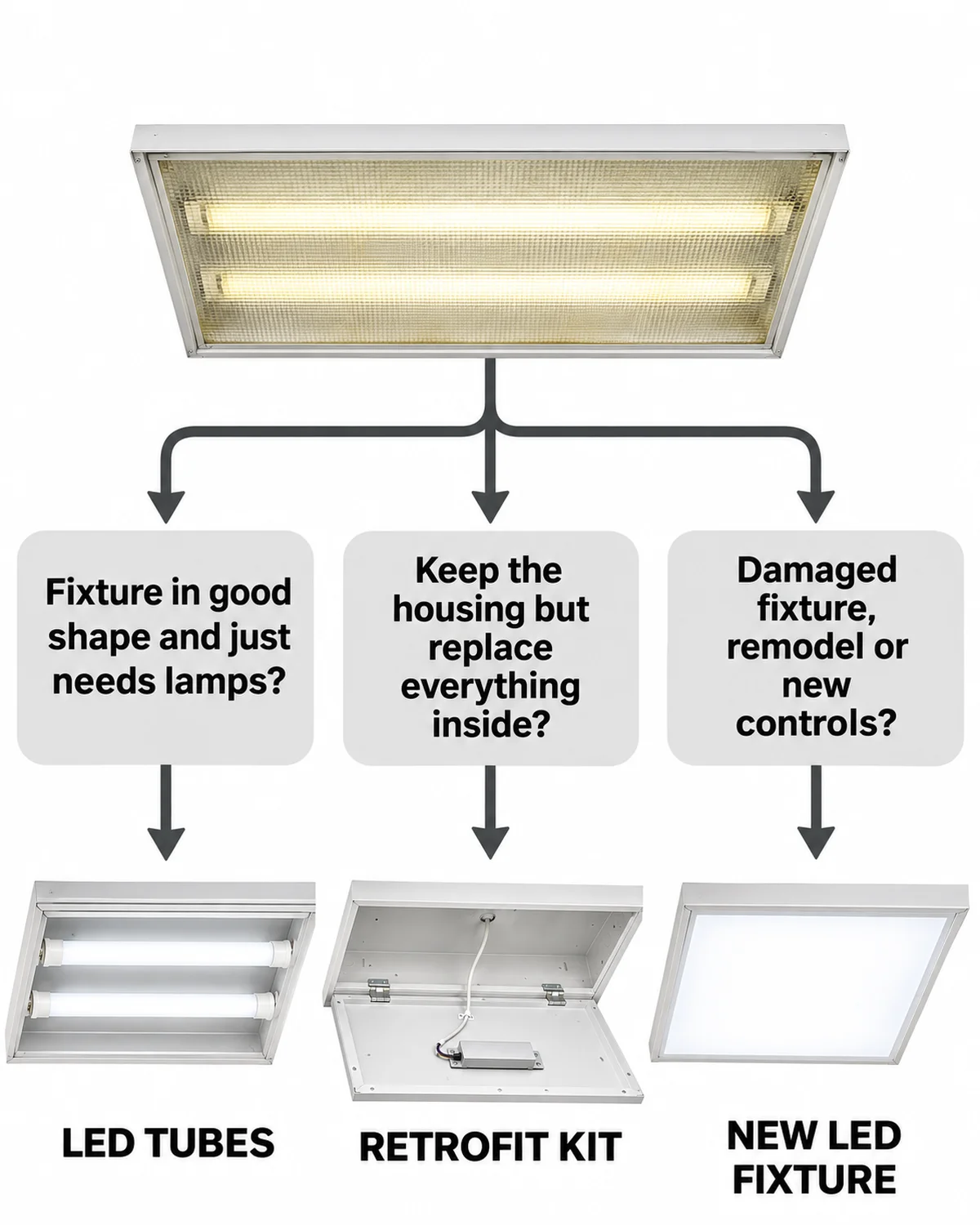
Choose LED Tubes If…
Your fixtures are in good condition and you mainly want an affordable lamp change. Tubes are a great fit for offices, warehouses, utility rooms, retail back rooms and any building with lots of identical fluorescent fixtures.
Choose a Retrofit Kit If…
The housing is worth keeping, but you want to replace more than the lamps. Kits work well in schools, offices and municipal buildings with recessed troffers that are hard to remove or don’t need to come out.
Choose a New LED Fixture If…
The fixture is damaged or outdated, or it can’t deliver the light you need. New fixtures fit remodels, tenant improvements and major upgrades that add controls or sensors.
A Quick Decision Path
- Good fixture, good compatible ballast, lowest install cost: a Type A tube.
- Good fixture, old or failing ballast: a Type B or hybrid tube.
- Good housing, but a yellowed lens or poor light: a troffer retrofit kit.
- Damaged fixture, remodel or new controls: a new panel, troffer or strip.
Compare Installed Cost, Not Just Product Price
The cheapest product isn’t always the cheapest project. To compare options fairly, look at what each one costs to install and to keep running.
Product cost: Tubes cost the least per fixture. Kits cost more because they replace more parts, and new fixtures usually cost the most up front.
Labor: This can change the whole picture. A Type A tube might take a minute per lamp, while a Type B conversion means opening and rewiring every fixture. Kits and new fixtures take more labor still, depending on the ceiling and how easy the fixtures are to reach.
What stays behind: Keeping old parts lowers the upfront cost but can leave future service calls in place. A Type A tube still depends on a fluorescent ballast.
Future maintenance: A tube is simple to replace. A kit or fixture may need a new driver or LED module, depending on how it’s built.
Controls: If you want occupancy sensors, daylight harvesting or 0-10V dimming, compare the complete system instead of assuming the old fixture can support it. Our guide to understanding 0-10V dimming explains the extra control wiring.
Rebates: Many utility rebate programs only pay on products listed by the DesignLights Consortium (DLC). If a rebate is part of the math, confirm the exact part number is listed and that your utility’s current program covers it before you buy.
Lumens, Wattage and Color Temperature
Replacing a 32 watt fluorescent lamp doesn’t mean you need a 32 watt LED tube. Most 4 foot LED tubes that replace an F32T8 draw somewhere between 10 and 18 watts. Instead of matching wattage, compare:
- Delivered lumens and fixture efficiency
- The number of lamps per fixture
- Mounting height and fixture spacing
- Light distribution and the light levels the space needs
LED tubes and panels aim their light down instead of in every direction, so less of it gets lost inside the fixture. A new panel or kit can often light a room just as well with fewer total lumens than the fluorescent lamps it replaces.
For color, matching the existing color temperature is the safest choice when you’re only upgrading part of a building. The common options are:
- 3000K: Warm white.
- 3500K: A neutral warm white used in many commercial spaces.
- 4000K: Neutral white, the most common choice for offices, schools and general commercial spaces.
- 5000K: A cooler daylight look often used in warehouses, garages and task areas.
Many LED tubes, retrofit kits and panels now have selectable color temperature, so you can set it during install. That helps when you aren’t sure what a space needs, or when you want to stock fewer part numbers across a facility.
What to Gather Before You Order
A 4 foot office troffer with a working electronic ballast can need a very different LED fluorescent replacement than an old 8 foot T12 strip in a warehouse. Before you order, collect:
- The full lamp code from the old tube, such as F32T8 or F96T12/HO
- The fixture size and the number of lamps in each fixture
- The ballast brand, model and type (instant start, programmed start or magnetic)
- The input voltage (120V, 277V or 347V)
- The socket type, if you’re considering ballast bypass tubes
- How many fixtures you have
- The color temperature you want
- Any dimming, controls or emergency requirements
- Photos of the fixture, its label and the wiring
Send that list to our lighting specialists and we’ll help you narrow it down to the right tube, kit or fixture.
LED Fluorescent Replacement FAQs
Can I replace fluorescent tubes with LED tubes without changing the fixture?
Usually, yes. A Type A tube runs on a compatible fluorescent ballast with no rewiring. A Type B tube uses the same fixture after it’s rewired to bypass the ballast. Either way, check the requirements for the exact tube and fixture first.
Do I need to remove the ballast when switching to LED tubes?
It depends on the tube. Type A tubes keep the ballast, Type B tubes bypass it, and Type C tubes replace it with an LED driver. Hybrid Type A+B tubes can run either way.
Is it better to bypass the ballast?
For most long term installs, yes. Bypassing removes a part that will eventually fail and stops the ballast from using power. It takes more labor up front, though, so a compatible Type A tube can be cheaper and faster to install when the ballasts are newer.
What’s the difference between single ended and double ended LED tubes?
A single ended tube gets line and neutral at the same end. A double ended tube gets line at one end and neutral at the other. Single ended tubes need non shunted sockets at the powered end, so check the sockets before you rewire, or choose a tube rated for both socket types.
Can LED tubes replace T12 fluorescent lamps?
In many cases, yes, but most T12 fixtures still have magnetic ballasts that Type A tubes can’t use, so plan on a ballast bypass tube. Match the length and base to the old lamp, and use the full lamp code when you search. Odd length HO lamps in sign cabinets are better served by LED sign tubes.
Are fluorescent tubes being banned?
In a growing number of states, yes. California, Colorado, Oregon, Rhode Island, Vermont, Hawaii, Maine and Minnesota have already ended the sale of most linear fluorescent tubes, with Illinois and Washington next. Even where they’re still sold, fluorescent lamps and ballasts keep getting harder to find.
Do LED tubes need a ballast?
It depends on the type. Type A tubes need a compatible fluorescent ballast to run. Type B tubes don’t use a ballast at all, and Type C tubes run on an LED driver instead. LEDs are powered by drivers, so when you see “LED ballast” in a listing, it usually means a driver or a ballast compatible tube.
Are T8 and T12 tubes interchangeable?
Physically, yes. 4 foot T8 and T12 lamps are the same length and use the same G13 base, so a T8 tube fits T12 sockets. Electrically, no. A fluorescent T8 lamp won’t run properly on a T12 ballast, and most Type A LED tubes won’t either. In a T12 fixture, a ballast bypass LED tube is the reliable choice.
What is a troffer?
A troffer is a rectangular light fixture that sits in a drop ceiling grid, usually in 1×4, 2×2 or 2×4 sizes. The name combines “trough” and “coffer.” Most older troffers hold fluorescent tubes behind a lens, which makes them one of the most common fixtures to convert to LED.
Are LED tubes dimmable?
Most Type A and Type B tubes aren’t. A few Type A and hybrid tubes, like Keystone’s ComboDrive X3, will dim when they run on a compatible dimming ballast. For reliable dimming, look at a Type C tube and driver set, a 0-10V retrofit kit or a new dimmable fixture.
Is a retrofit kit better than LED tubes?
Neither one always wins. Tubes are usually the most affordable choice when the fixture is in good shape. Kits make more sense when you want to keep the housing but replace the fluorescent parts, update the look or improve the light.
What size LED flat panel replaces a fluorescent troffer?
Match the panel to the ceiling grid. Common sizes are 1×4, 2×2 and 2×4. Then confirm the mounting method before ordering.
Shop LED Fluorescent Replacement Products at PROLIGHTING
The right LED fluorescent replacement starts with the fixture you already have. Check its condition, the ballast and the wiring, then decide how much of it is worth keeping. That simple order of questions turns a confusing catalog into a short list.
PROLIGHTING carries everything for a fluorescent to LED conversion: T8 LED tubes, T5 LED tubes, troffer retrofit kits, LED flat panels and troffers, LED ready fixtures and the rest of our commercial LED lighting. Shop by brand with Keystone, RAB and Sylvania, or check the full specs on Keystone’s linear LED tube site.
Working on a larger building? Request a quote, ask for a free lighting layout, or join our trade pricing program if you’re a contractor ordering in volume.
Published November 2026

Comments are closed.